June 22, 2025
trees, vegetables, fruit, wildlife, herbaceous, shrubs, seasonal review | permalink
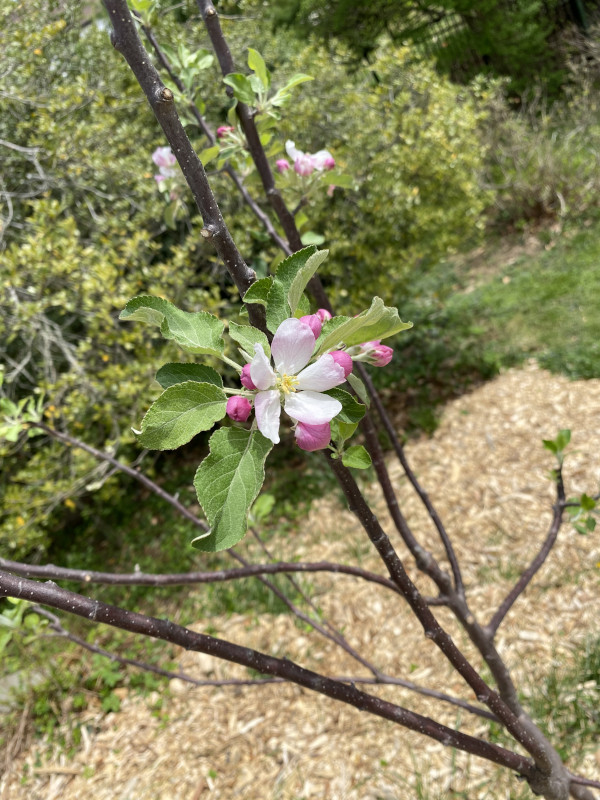
It felt like spring was a lot of effort and not too much to show for it. On the other hand, this work of taking a sterile lawn doused in chemicals to something that actually contributes to and supports the local ecosystem does not happen overnight. I think I need to be more mindful of that, especially at moments of setbacks, of which there were several this season.
I'm going to try something a bit different for this reflection of the past season and go by layer. So let's start from the top: one shade tree went in, a black cherry (prunus serotina). It is at the corner of our property, several feet back from the road. After oaks, it is one of the best trees to plant to support a wide range of wildlife.1
I also planted a few understory trees: an American hophornbeam (ostrya virginiana) and two American hazelnuts (corylus americana).
The black cherry and the hophornbeam came from the township's Shade Commission, while the hazelnuts came from MH.
There was also some work on existing trees: at the end of April, I cut about three feet off the American hornbeam I planted last spring, so now it's about two feet tall. Last year, it dropped nearly all of its leaves during the summer, but then regrew some of them towards fall. I didn't have high hopes that it was going to make it, but then the bottom of it leafed out. Aside from being much shorter, it now looks as healthy as it was when I planted it. I think it probably gets too much sun, so hopefully the black cherry in front of it puts on a few feet in the next couple years to give it a bit of shade. I also extended the fencing on the pear tree and apple tree I put in last season, after removing the top I'd placed on them as a temporary measure. The fencing is now six feet tall rather than four, and so is sufficient for deer protection. I'm not sure how many more trees I'll be putting in, but I'm going to find and use six-foot fencing going forward so I don't have to do that again. Live and learn.
I identified the tree - now about five feet tall - growing in the vegetable garden. It's a northern capalta (catalpa speciosa), which is great luck because I wanted to get one of them. I have not yet decided whether I'm going to do the work to transplant it or just let it go and garden around it. On the one hand, moving it will be a decent amount of work (and it might not survive) and perhaps it could act as a good pole for a pumpkin to climb? On the other, it will probably shade too much of the garden. I'm torn. But I can't be torn for too long, because late fall/early winter will be the best time to move it if I'm going to.
I also have a tentative identification of another tree, which somehow has survived unprotected to about four feet tall in the mulched area in the backyard. It may be an ash - I need to look more closely at it.
So that's the good news on trees. Unfortunately, though, the oak I transplanted last fall did not survive - or at least not as a eight-foot-tall tree. The only sign of life was one shoot coming from its base, which was eaten by some animal within a couple days. I'm reluctant to cut it down, mainly because of how much work it was putting it in but also because I still want to believe it will come back. But I will probably do so between now and next spring. I would like an oak in that spot, so in the meantime I'll probably dig up one of the little saplings I frequently find in the lawn and put it there, under some protection.
The second attempt at a holly hedge failed. I'm going to continue trying, but on a much smaller scale. I'm going to take a cutting or two from one of the existing hollies and see if I can get them to root in water. I think I'm also going to have to protect them from wildlife - while some simply didn't root, others were eaten.
A few shrubs went in: another northern spicebush (lindera benzoin) and two red osier dogwoods (cornus sericea). I put the spicebush between the other two I'd planted in May 2023. I did not cage this one, mainly because it's rather large and probably needed to be pruned after the transplant anyway. I'll watch how much it gets eaten (so far fairly minimal) and then perhaps just cage all three of them together if necessary. I think I need to get one more in that area, opposite the others, to make it too thick for the deer to reach the middle so they'll do better. I did cage the dogwoods. Fucking deer.
I ordered and planted four bearberries (Arctostaphylos uva-ursi), which are doing well. I also tried to propagate several more by root and stem cuttings, but only one may have been successful. It seemed like it was alive the last time I checked.
I spent a lot of time preparing various native seeds for planting outside and then planting either them or the resulting seedlings. None of them developed into full plants, if they grew at all. I knew that would be the case for the milkweeds and blue wild indigo (baptisa australis), but I thought I'd get some decent-looking sundial lupines (lupinus perennis) or literally anything else (black-eyed susans, columbines, purple love grass, little bluestem, buttonbush, blue vervain), but nothing is taller than four inches, except maybe the butterfly milkweeds. I haven't seen a sign of the black-eyed susans, purple love grass (eragrostis spectabilis), little bluestem (schizachyrium scoparium), buttonbush (cephalanthus occidentalis), or blue vervain (verbena hastata). I'm hoping some are just putting down roots and will come up next year. Even if not, I suppose it's ok. I have double that number of species that I'm going to plant in the fall. Seeds are relatively inexpensive (and sometimes free); I'm going to load the ground with them every spring and fall, with the occasional season off to give myself a break.
Removing lawn continued, but at a slower pace than I would have liked. Aside from areas where trees went in, it amounted to maybe 20 square feet.
In the vegetable garden, now nearly double the size it was last year, most things that I planted came up. The things that didn't: about half the corn, most of the Detroit Bull's Blood beets, and none of the handful of cucumbers. Those only accounted for a very small amount of the space, though, and I moved other things that were too thick into their spaces. So everything else came up and grew well, until deer (I assume) got into the raised bed and destroyed the 130 pea plants that were over four feet tall. I was able to save maybe a quart of peas. I'd wanted to keep saving them to replant year after year, but will have to buy some next spring now. Something has also been getting in and eating the green bean leaves. I'm not sure if that's also deer (maybe a rabbit?), but soon I'm going to extend the fencing from four feet to six feet tall. If the green beans are still being eaten, I guess I'll have to put in better protection at the ground level.
I was doing more weeding (mostly grass of one sort or another) than I wanted to, in both the vegetable garden and in the areas where I've removed grass and mulched/planted other things. It's frustrating because one of the reasons I'm trying to remove the lawn is to lower the amount of maintenance needed. And things I've planted are either growing extremely slow or being eaten by deer, allowing room for weeds. It's doubly frustrating because some of it is coming from my compost. I'm hoping that by next year, after another round of native seed planting in the fall, the good things will begin to out-compete the bad things. In the vegetable garden, I think it's now mostly under control from grass clippings I put down, which will have the added benefit of keeping soil more cool and more moist during the hot summer months that are now upon us.
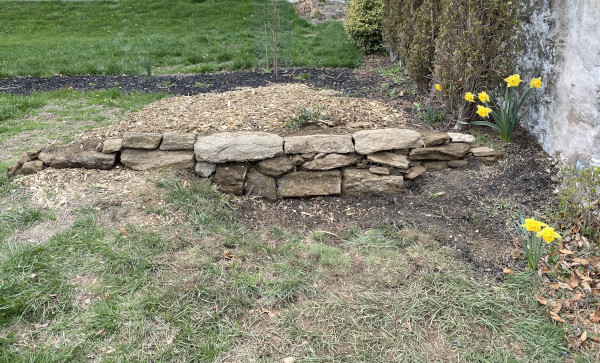
One thing that I did that I had not planned on doing was creating a small rock wall on the western edge of property. I was originally just digging out some rocks so I could plant one of the bearberries, and got carried away, digging up giant rock after giant rock with the help of a neighbor's pry-bar he calls "the persuader". It certainly persuaded the rocks out of the ground much easier than any tool I have. I like how it turned out, and that makes a clear distinction between the grass and the mulched/wildflower area. (Eventually I also intend to start removing the lawn on this side of it, but that's probably at least several years off.)
Other tasks completed:
- fill small sinkhole next to driveway with mulch
- identify groundcover with yellow flowers in space between us and neighbors (lesser celandine)
- empty rotating compost barrel
- transplant blue violets from hillside with grass to new rock wall and hillside with apples
- transplant some of the pussytoes - I don't want to lose them when I eventually get around to removing grass on hillside below flowering dogwood
- plant white hyacinths from MH&DW
- plant sunflowers from MH
- weed and spread woodchips around chestnuts, oak, and maple
- do soil test in vegetable garden
- sharpen mower blades
- Read Chris Baines's How to Make a Wildlife Garden
1. According to Doug Tallamy. I saw this once before but the most recent place was on the May 15, 2021 episode of the Native Plant Podcast.
Previous posts related to this:
- Apr 24, 2025: Oaks
- Oct 19, 2024: Started holly hedge (again)
- Oct 11, 2024: Third oak planted
- May 11, 2024: American hornbeam planted
Follow-up posts: