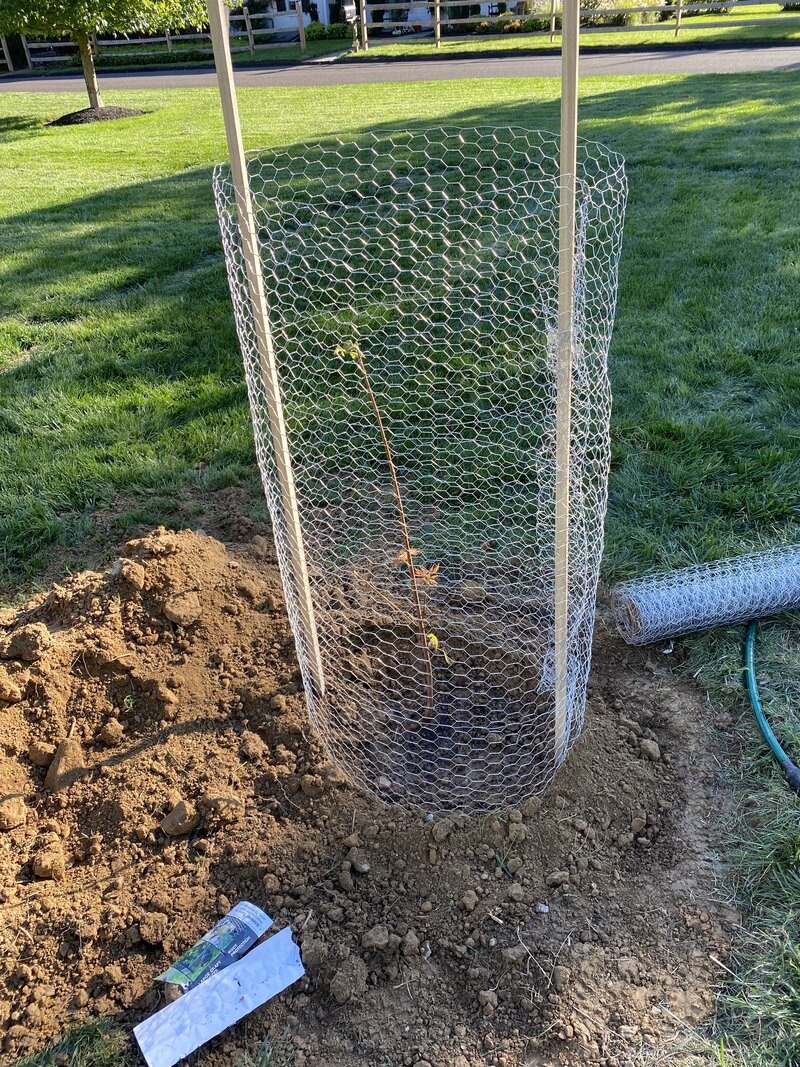
Tree and shrub leaf out and blossoms
April 11, 2026
trees, observations | permalink
April 2
- hop hornbeam
- peaches (blossoms and leaves; only 7 flowers on one in back yard, 30 on newest one on terrace, 100-200 on older peach on terrace)
- lilac and maple in front (and perhaps earlier than this)
April 4
- pagoda dogwood
- red osier (existing, not cuttings)
- American hazelnut (and a fair number of new shoots)
- apples on eastern hillside
- hop hornbeam
April 5
- Flowering dogwood
- black cherry
April 8
- Tulip poplar
- apples on terrace
- some of the red osier cuttings I planted
April 10
- Eastern redbud
- pear
April 12
- apples on eastern hillside beginning to flower; black arkansas a bit ahead of the winecrisp
April 14:
- flowering dogwood is flowering
April 15:
- red or sugar maple
- northern catalpa buds beginning to swell
April 16:
- Ashe's magnolia
- red or black oak
April 17:
- white fringetree
- white oak buds beginning to swell
- northern catalpa
- milkweeds have come up quickly, about 3 inches tall (I think common, not yet butterfly)
Nothing yet aside from buds: bur oak, black walnuts, bald cypress, chestnuts.
Need to check on the black tupelo.
Winter 2025/6
March 21, 2026
seasonal review, planting log, herbaceous, trees, shrubs, fruit | permalink
This winter was the least busy season I've had gardening since moving into the house, which comes down to two things: 1) it being winter and also a particularly snowy one (though that did mean some shoveling) 2) not trying to start any plants inside (aside from a few for the vegetable garden), unlike last year.
Here's a list of the things I did do:
- spread container of ashes around bur oak
- plant swamp milkweed (asclepias incarnata, aka rose milkweed) seeds in southern-facing hillside (removing some ornamental grass and plant in its place)
- move large rocks to curb, replace the ones around herb garden
- (re)plant hemp dogbane around rocks in front
- buy 50 more feet of 48-foot-tall fencing
- go to talk on backyard habitats by Katie Fisk
- prune the red or black oak with two trunks
- take cuttings from red osier dogwoods, cut up red osier canes MH brought over, and put in water to plant later
- plant some of the red osier cuttings directly
- watch this "masterclass" on composting
- watch Cummins Nursery videos on pruning applies
- read this article on co-existing with deer
- restake fencing around eastern redbud near picnic table
- prune/train apple trees
- buy mycorrhizal fungi (at least 2 lbs) from MycoBloom
- prune/train pear tree
- make cages for elderberries and red osiers
- plant elderberry cuttings
- get another chipdrop
- spread woodchips on western woodland edge (not yet finished)
- extend southern woodland edge to include elderberries
Tulip popular budding
January 29, 2026
observations, trees | permalink
The only one that I know of that I can see from my yard, the one in the neighbor's yard who lives diagonally behind us, is starting to bud out. Seems early to me, but I don't really know.
Fall 2025
January 11, 2026
planting log, trees, herbaceous, seed collection, wildlife, seasonal review | permalink
Fall was busy, but that's starting to be a refrain. Every season is busy. I feel like there is a lot of work to do, and I want to get as much of it done as soon as possible so there's more time for things to grow. To get bigger, to spread, to produce fruit, to begin to crowd out the grass, to block the view of the road and the gigantic increase in traffic due to a stop sign being put at one end of it (seriously, somewhere between 50% and more than 100% increase, the exact number depending on getting some raw data from the township for a recent count they conducted). I wrote very little about my activities, so much to catch up on here. I may later go back and add posts for a few of these things, mainly so I can link back to them from future posts and the rough map I'm making.
The biggest project of the season was cutting down the Japanese Maple in the front and planting two Eastern Redbuds (Cercis canadensis) in its place.
I planted two additional trees, both of which came free of charge from the township's shade commission: a White Oak (Quercus ruba), in the southern woodland edge, and a Black Tupelo (Nyssa sylvatica), in the northern woodland edge.
A few existing trees have become tall enough that I'm no longer worried about the deer topping them, and so cages were removed. However, there's still the risk of rubbing. So I did some research on a way to protect the trunks with natural materials (rather than, say, plastic guards), and found the suggestion of burlap. I bought a 35-foot roll of 3-foot-wide burlap from a local hardware store, then cut sections of about 3 or 4 feet long. I then placed these around the trunks, pushing open small holes between the threads to put limbs through where I could, and tied the ends together with some twine. It seems to have been a successful - only one showed a little rubbing, but no further after an adjustment. On the other hand, the serviceberry near the road that I planted either the first fall or spring after moving in needed more protection. Deer have been keeping it trimmed, so I finally put a taller cage around it.
Transplanted somewhere around 50 to 75 common blue violets from my vegetable garden, most to front meadow along road but also a few between the tulip tree sapling and elderberry in western woodland edge. I also collected a fair number of their seed pods and spread the seeds in the same area. American plantains and yellow wood sorrel were also moved from the vegetable garden to the same places, though not nearly as many.
Another big project (maybe 15 hours over a few weeks) was planting literally thousands of native seeds, mostly herbaceous but also some shrubs/small trees. I have no idea the exact number, but somewhere between three and five thousand. The vast majority were tiny tiny seeds that you just strew on the open surface (and hope for the best), but many others were ones that I planted into the soil (and hoped for the best). My plan is to do this every fall, for at least the next few years. Most of them I bought, but some I had collected from existing plants in my garden. Here are the species, with the collected ones indicated with an asterisk, along with location:
- Hickory - at end of driveway, in northern woodland edge; these were given to me by MH, via a friend of his
- Lupinus perennis subsp perennis (Sundial Lupines) - front meadow along road
- Antennaria plantaginifolia (Pussytoes) - western woodland edge, in wood chips between rock wall I built and bald cypress; on eastern hillside
- Rhus aromatica (Fragrant Sumac), which first needed to be hot-water stratified and soaked - western woodland edge mostly, but also some by new white oak in southern woodland edge and some by new brushpile on terrace
- Conoclinium coelestinum (Mistflower) - front meadow, in mulched area in front of butterfly milkweeds
- Penstemon hirsutus (Hairy Beardtongue) - southern woodland edge
- *Apocynum cannabinum (Hemp Dogbane) - front meadow, right at edge of road; in front of blueberries on terrace; in front of blackberries and raspberries on terrace
- *Lepidium virginicum (Virginia pepperweed) - front meadow, along road
- *Plantago rugelii (American plaintain) - front meadow, along road
- Geranium maculatum (Wild Geranium) - front meadow, along road
- Iris versicolor (Northern Blue Flag) - front meadow, along road
- Amsonia tabernaemontana (Eastern Bluestar) - front meadow, along road
- Tradescantia ohiensis (Ohio Spiderwort) - front meadow, along road
- Solidago odora (Sweet Goldenrod) - front meadow, along road
- Cornus amomum subsp. obliqua (Silky Dogwood) - southern hillside
- Packera aurea (Golden Ragwort) - at corner of front of house
- Hibiscus moscheutos (Swamp Rose Mallow) - southern hillside, around existing red osier (that's a wet area and both like wet feet)
- Amorpha fruticosa (False Indigo) - I mistakenly bought a ton of these seeds so they went just about everyone in heavy doses: northern woodland edge, along border of brushpile on terrace, along the log border in middle of terrace, front meadow in grass next to roadside mulched area, at end of driveway, probably other places
- Viola pedata (Bird's Foot Violet) - around new white oak in southern woodland edge
- Clematis occidentalis var. occidentalis (Purple Clematis) - beneath red or black oak in western woodland edge
- Clematis Virginia (Virgin's Bower) - around lamppost in front meadow and pole on front porch
- *a tall goldenrod, either Solidago altissima or Solidago canadensis
- *asters - on terrace
- Carex eburnea (Ivory Sedge) - in backyard, beneath playset after desodding it
- Asclepias incarnata (Swamp or Rose Milkweed) - southern hillside, terrace
I also planted a few things in pots and put them in my fenced-in vegetable garden for some protection from being dug up, like the eastern redbuds I mentioned above:
- Hickories - ones from friend of MH and also ones given to me by a contractor that did work on our house
- Symphyotrichum novae-angliae (New England Aster)
- Physocarpus opulifolius (Prairie Ninebark)
- Staphylea trifolia (Bladdernut)
- Swamp Milkweed
- Sundial Lupines
- Silky Dogwood
- Cornus Florida (Flowering Dogwood)
Stored some seeds I collected paper packets:
- Asters
- Goldenrod
- Eastern Redbud
- American Plantain
- Hemp Dogbane
I finished making the birdbath stump that I'd started in summer, or at least enough for now. Two-thirds of the top is chiseled out. Maybe I'll do the other third sometime. At first I thought it wasn't working, because the first time I filled it, it was empty about 30 minutes later. But it just needs to get water-logged and then it will hold water for a while - possibly a couple days (which is great, because I don't want stagnant water to be around for mosquitoes to lay eggs in, and perhaps it drying out is a good trap for them). Idea came from National Wildlife Federation, David Mizejewski, Attracting Birds, Butterflies, and Other Backyard Wildlife, 2nd edition, 2019 (p. 73).
Other things:
- planted mountain laurel
- bought more elderberry cuttings that will be arriving later this month or early next. Of the dozen I'd planted last year, three or four did not survive.
- bought and put out a "leave the leaves" sign.
- split firewood
- harvested first apples - from the black arkansas tree - with my daughter.
- planted garlic
- put vegetable garden beds to bed
- read A New Garden Ethic: Cultivating Defiant Compassion for an Uncertain Future by Benjamin Vogt
Two American Sweetgums
November 8, 2025
trees, observations | permalink
Last week, I was talking to neighbors JM & CM as they were doing some yard work, and JM pointed out an American sweetgum (Liquidambar styraciflua) on my property as we were talking about the various trees around. I hadn't noticed it before amongst all the thistle, but it was about five feet tall. It's between the two hickories I planted last August that did not survive. It must have grown a lot in the past year, because I didn't register it when putting in the hickories. Then yesterday, I found another, about the same height, on the southern-facing hillside, just behind a boxwood.
We're near the northern edge of its native region. Nice to find another native, particularly without having to do the work to put it in myself. However, in the three sources I read about it from (Wikipedia, USDA Plants Database, and the Arbor Day Foundation), there was no mention of it being a host plant to lepidoptera species, which is somewhat unusual. The Arbor Day Foundation page had the most information on its benefits to wildlife, stating "American sweetgum seeds are eaten by eastern goldfinches, purple finches, sparrows, mourning doves, northern bobwhites and wild turkeys. Small mammals such as chipmunks, red squirrels and gray squirrels also enjoy the fruits and seeds."
Japanese maple felled
October 16, 2025
This is one of the bigger changes I've made to the yard. I began planning a few weeks in advance - scheduling it, watching instructional videos, gathering some gear, etc. About a week before the chosen date, I started to look carefully at the tree for about ten minutes at a time, figuring out which way it was likely to go and what might need to be done to help it along that way. Two days before, my neighbor, who used to be a tree surgeon, saw me doing this and came over to see what was up. After we talked about it a bit, he lent me some of his old gear and I cut off several limbs on one side with a long pole saw to help put the weight in the direction it seemed most likely to go (which, thankfully, was into the open front yard).
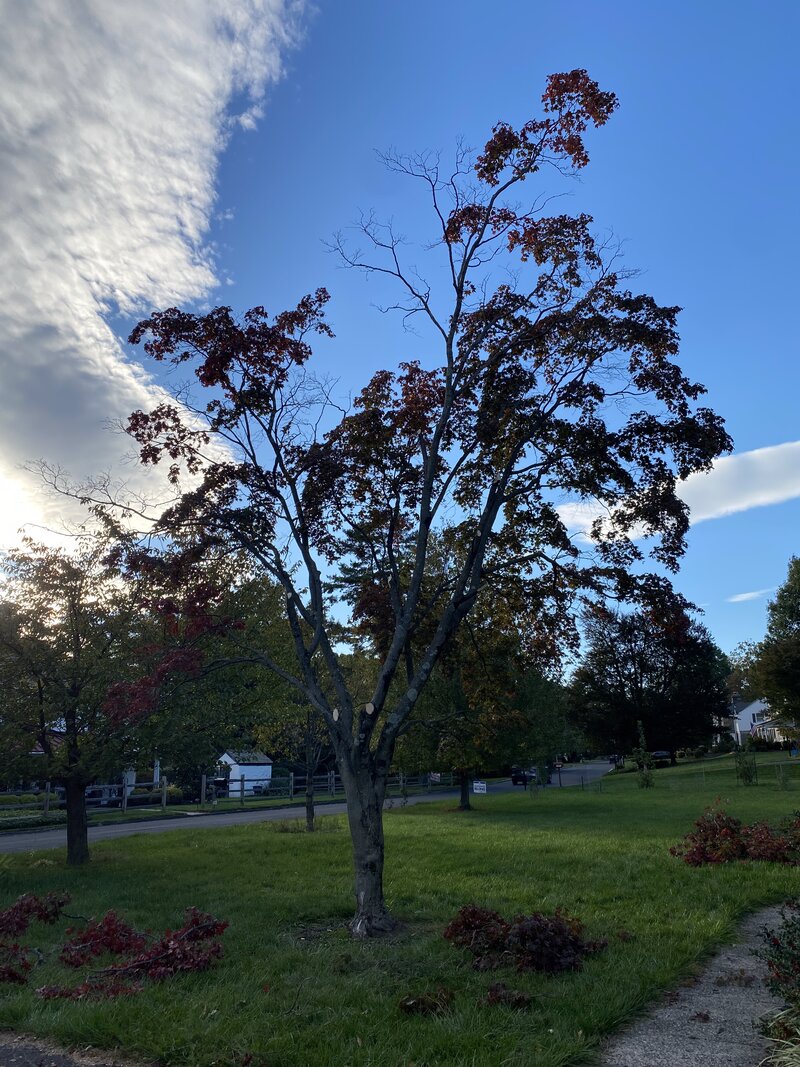
Then the day came and my father-in-law arrived at around 10 in the morning with his gear. I climbed up and tied the neighbor's heavy rope about halfway up and then FIL walked the other end into the yard and got into a tug-of-war stance. I pulled on the helmet he lent me and got to work. It's been literal decades since I cut down a tree, and it was as much fun, or perhaps more, than when I was running around the woods behind my house in my early teens chopping down dead trees with a hatchet to build forts. This time it was with a chainsaw. I had some trepidation when it wasn't beginning to fall when I thought it should, but another inch or so and it went exactly where I wanted it to. It was a great feeling of accomplishment.
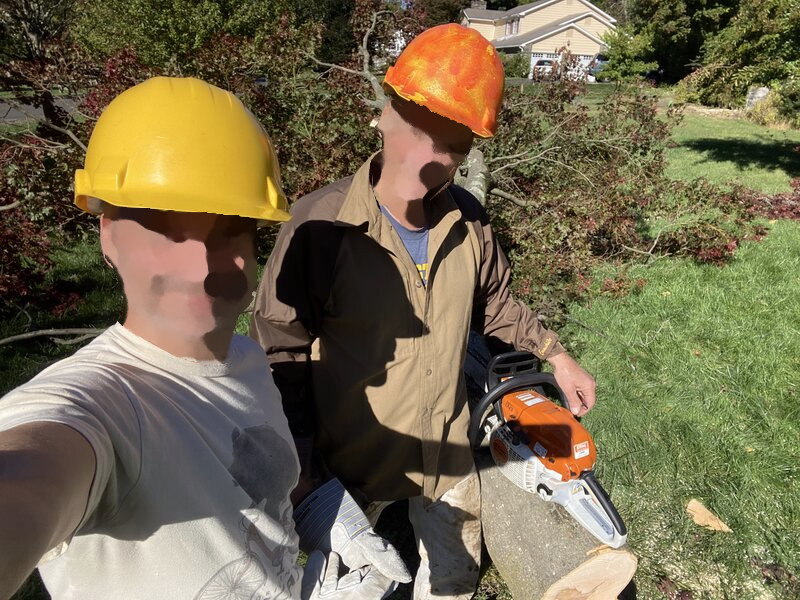
Once it was down, I found less rot in the wood around the base than I'd expected, but it was only going to get worse (result of landscapers volcano mulching it in the past) and plus it was a non-native that threw out tons of seedlings everywhere. Some of its wood went to the firewood pile and will be burned for probably the next two winters after this one. The rest went to turning a small brush pile I'd started into a large one. Oh, and a couple small limbs were cut into "walking sticks" for my daughter.
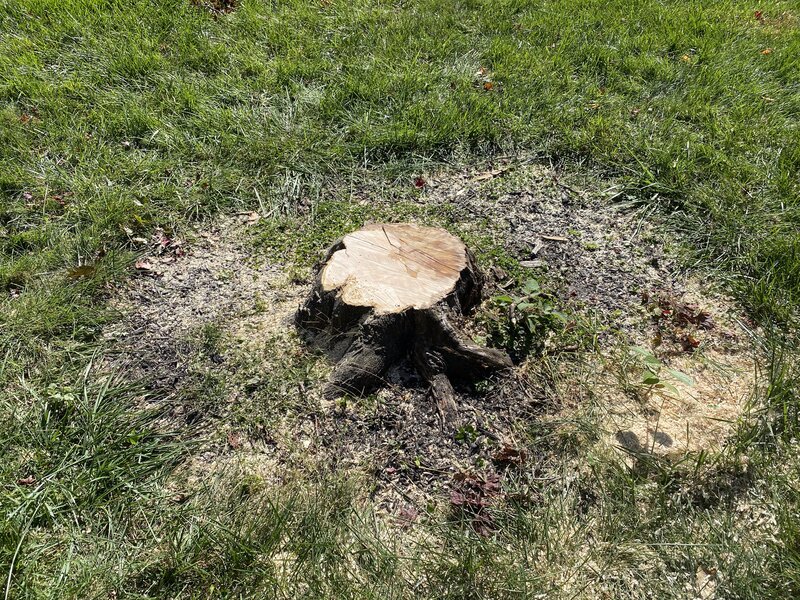
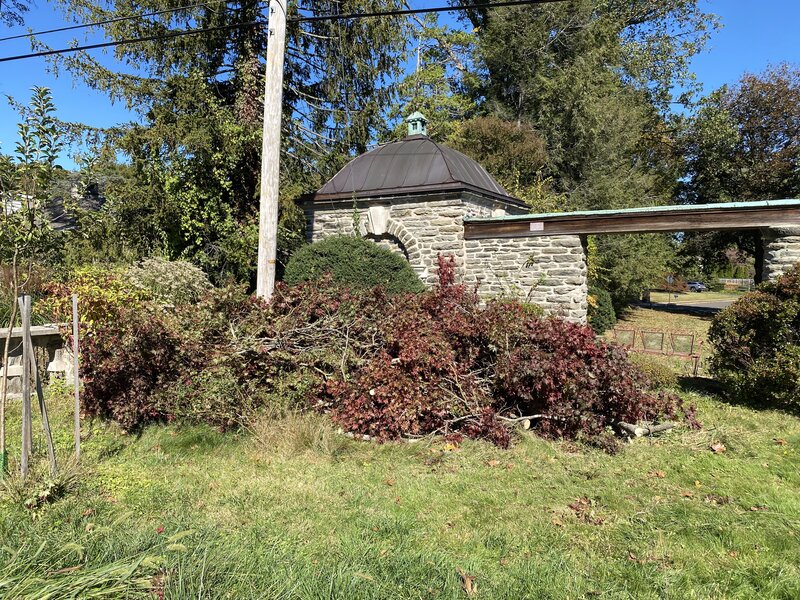
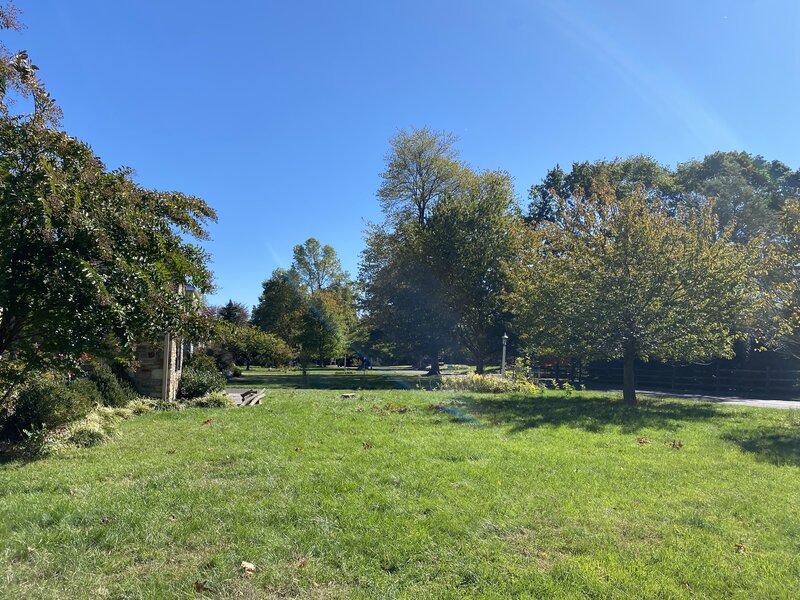
I transplanted two eastern redbuds that were growing in my vegetable garden to either side of its stump. I'm not sure the larger one (about 4 1/2 feet tall) will survive; it was much harder to get the roots out than I expected and I ended up cutting more off than I would have liked. I think the smaller one will do fine, as I was able to scoop out pretty much the entirety of its roots. I planted a bunch of redbud seeds I scavenged from various places, now sitting in pots in the vegetable garden, so if the larger one doesn't make it, hopefully I'll have another to take its place, and some more on top of that to plant elsewhere.
Summer 2025
September 29, 2025
trees, shrubs, herbaceous, vegetables, fruit, lepidoptera, seasonal review, planting log | permalink
On the tree front, I transplanted a few small saplings (4 or 5 inches tall at a maximum) from one place to another: I found a small eastern redbud (cercis canadensis) growing between two of my blueberry bushes, and moved it near the picnic table on the terrace, for eventual shade. I attempted to move a black walnut out of the yard and to the western treeline, but it did not survive. Similar thing with an oak, but on the other side of the driveway. But then I was successful, after being more careful with the roots and more frequent watering, with moving two other oaks out of the yard to the same place. I attempted to graft a few cuttings from the apple tree at my mom's house, whose apples I learned to juggle with. Neither survived. Did not help that it was not the correct season for it. I will try again either late this fall or early next spring. I identified, with the help of MH, three black walnuts. (I was worried they were the non-native alanthus altissima, "tree of heaven".) Two are good where they are, but the third is in the herb garden and so that will have to be moved once we get closer to winter. Removed the fencing on a couple, but then protected with burlap in mid September to protect from deer rubbing.
In shrubs, I found a great laurel (Rhododendron maximum) naturally root layering while visiting my mom, and I think it has successfully taken to my place on the western edge, although growth is slow. Of the 12 elderberries I planted in February, the range of success is pretty wide: of the nine that survived, one is about 4 feet tall (with a new shoot from the ground the same height), another is nearly 3', a couple are close to 2', and the rest are between 1 and 2'. The ones doing the best I had to put bigger cages around, twice. I'm starting to have fencing on hand when I need it, which is convenient and no further expense.
Perhaps the biggest effort of the season was at the herbaceous layer, namely removing the crabgrass that had taken over the four-foot-wide strip of mulch next to the road that I put in last year. That little patch - what I'm trying to make into a "roadside meadow" - has been a bit of a pain in the ass. First I heavily mulched it to kill the grass. A fair amount of weeding grass that survived was done a number of times. Twice I tried to start a holly hedge, and both times it failed. I spent a lot of time planting lupine and blue vervain seeds in it this spring, and mostly they were eaten by the deer. And then the fucking crabgrass. It took a good five or six hours worth of work to remove it all, and then an hour getting and spreading mulch, and then the occasional 15 minutes of weeding here and there to get what survived. After that, beginning in late August, I spent several mornings every week digging up and transplanting blue violets, and the occasional spotted spurge, from my vegetable garden. In all, it ended up being about 40 or 45 of them. I planted them right at the edge of the grass, every six inches or so, hoping they will help to keep it out. The spurge went further in, toward the road. I really like those two plants together. At times I found seed pods from the blue violets and tucked them into the mulch beyond the spurge. I also started a little patch of yellow wood sorrel on the other end, also dug up from my vegetable garden. A couple American plantains got transplanted on that side as well, and some of their seeds spread. Little bluestem seeds sown at the corner with the driveway, but no germination and probably wrong time of year (going to try again in spring).
In other places, non-native thistle was removed, native pokeweed was frustratingly removed by the spouse, grapevines removed from azaleas (I'm actually not sure of nativity of either of those, come to think of it, nor if the vines are really grapevines). Various things trimmed around the AC units. Bricks and rocks moved from one place to another. Got (self-)certified with National Wildlife Foundation, and put up a sign.
The herb and vegetable gardens were good, in addition to being a source of blue violets and yellow wood sorrel. Tons of tomatoes. Cherokee corn, but I need to learn how to harvest/cook it properly if I try it again. Damn groundhog ate the green beans a number of times, resulting in not many harvested. Peas got thrashed by deer, I think, just as they were beginning to first ripen (they ate the tops of the plants, not the pods, damaging the whole plant anyway). I gave up after the second time it happened and the plants didn't seem like they would recover. That was also a disheartening moment. Decent garlic harvest.
The backyard orchard: peaches grew, but I either waited too long to harvest or the trees are just too young (or some other reason that caused them to be dried up and molding when I checked on them in July). Of the seven apples on the apple trees I counted in May, there are three still left on the Arkansas black. Not sure what happened with the two other trees, but the one missing from the black is from me trying it way too early. Have since read up and discovered that it won't ripen until probably November and with perhaps three months of storage after that.
In addition to the black walnut (and redbud), I also identified:
- bittersweet/climbing nightshade (solanum ulcamara, not native)
- various asters (native)
- common dewberry (Rubus flagellaris), common copperleaf (Acalypha rhomboidea), and white vervain (Verbena urticifolia) (native)
- Virginia Pepperweed (lepidium virginicum, native), whose seeds I collected, spread, and stored (it's plain but still pretty, seems like a few more would be good)
- white clover throughout grass (trifolium repens, not native)
- monarchs, monarchs, monarchs
- definitely much more that maybe I'll add later
Finally, I read Attracting Birds, Butterflies, and Other Backyard Wildlife by David Mizejewski/The National Wildlife Federation (2nd ed., 2019).
Peaches dried up or moldy
July 26, 2025
trees, fruit, observations | permalink
All of the peaches left (about 10 on the tree planted in 2024 on the terrace) were dried up/moldy. I'd been waiting to see if they'd get any bigger - they were only about an inch and a half in diameter. They were supposed to ripen in mid August, but that's based on Ithaca, NY and so maybe it's mid July here. It could just also be the fact that it's only a two-year-old tree. I wasn't even expecting to get any peaches this year. Though I'm still disappointed I missed the chance to try one.
Spring 2025
June 22, 2025
trees, vegetables, fruit, wildlife, herbaceous, shrubs, seasonal review | permalink
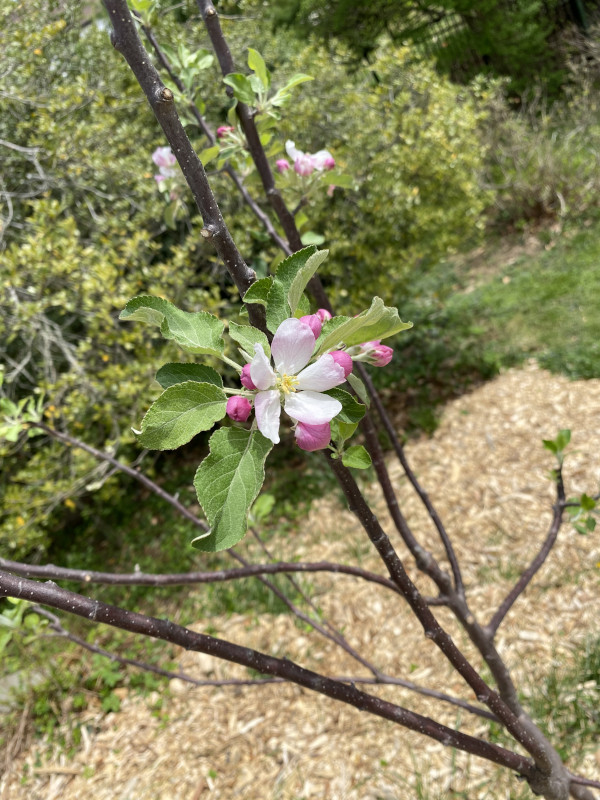
It felt like spring was a lot of effort and not too much to show for it. On the other hand, this work of taking a sterile lawn doused in chemicals to something that actually contributes to and supports the local ecosystem does not happen overnight. I think I need to be more mindful of that, especially at moments of setbacks, of which there were several this season.
I'm going to try something a bit different for this reflection of the past season and go by layer. So let's start from the top: one shade tree went in, a black cherry (prunus serotina). It is at the corner of our property, several feet back from the road. After oaks, it is one of the best trees to plant to support a wide range of wildlife.1
I also planted a few understory trees: an American hophornbeam (ostrya virginiana) and two American hazelnuts (corylus americana).
The black cherry and the hophornbeam came from the township's Shade Commission, while the hazelnuts came from MH.
There was also some work on existing trees: at the end of April, I cut about three feet off the American hornbeam I planted last spring, so now it's about two feet tall. Last year, it dropped nearly all of its leaves during the summer, but then regrew some of them towards fall. I didn't have high hopes that it was going to make it, but then the bottom of it leafed out. Aside from being much shorter, it now looks as healthy as it was when I planted it. I think it probably gets too much sun, so hopefully the black cherry in front of it puts on a few feet in the next couple years to give it a bit of shade. I also extended the fencing on the pear tree and apple tree I put in last season, after removing the top I'd placed on them as a temporary measure. The fencing is now six feet tall rather than four, and so is sufficient for deer protection. I'm not sure how many more trees I'll be putting in, but I'm going to find and use six-foot fencing going forward so I don't have to do that again. Live and learn.
I identified the tree - now about five feet tall - growing in the vegetable garden. It's a northern capalta (catalpa speciosa), which is great luck because I wanted to get one of them. I have not yet decided whether I'm going to do the work to transplant it or just let it go and garden around it. On the one hand, moving it will be a decent amount of work (and it might not survive) and perhaps it could act as a good pole for a pumpkin to climb? On the other, it will probably shade too much of the garden. I'm torn. But I can't be torn for too long, because late fall/early winter will be the best time to move it if I'm going to.
I also have a tentative identification of another tree, which somehow has survived unprotected to about four feet tall in the mulched area in the backyard. It may be an ash - I need to look more closely at it.
So that's the good news on trees. Unfortunately, though, the oak I transplanted last fall did not survive - or at least not as a eight-foot-tall tree. The only sign of life was one shoot coming from its base, which was eaten by some animal within a couple days. I'm reluctant to cut it down, mainly because of how much work it was putting it in but also because I still want to believe it will come back. But I will probably do so between now and next spring. I would like an oak in that spot, so in the meantime I'll probably dig up one of the little saplings I frequently find in the lawn and put it there, under some protection.
The second attempt at a holly hedge failed. I'm going to continue trying, but on a much smaller scale. I'm going to take a cutting or two from one of the existing hollies and see if I can get them to root in water. I think I'm also going to have to protect them from wildlife - while some simply didn't root, others were eaten.
A few shrubs went in: another northern spicebush (lindera benzoin) and two red osier dogwoods (cornus sericea). I put the spicebush between the other two I'd planted in May 2023. I did not cage this one, mainly because it's rather large and probably needed to be pruned after the transplant anyway. I'll watch how much it gets eaten (so far fairly minimal) and then perhaps just cage all three of them together if necessary. I think I need to get one more in that area, opposite the others, to make it too thick for the deer to reach the middle so they'll do better. I did cage the dogwoods. Fucking deer.
I ordered and planted four bearberries (Arctostaphylos uva-ursi), which are doing well. I also tried to propagate several more by root and stem cuttings, but only one may have been successful. It seemed like it was alive the last time I checked.
I spent a lot of time preparing various native seeds for planting outside and then planting either them or the resulting seedlings. None of them developed into full plants, if they grew at all. I knew that would be the case for the milkweeds and blue wild indigo (baptisa australis), but I thought I'd get some decent-looking sundial lupines (lupinus perennis) or literally anything else (black-eyed susans, columbines, purple love grass, little bluestem, buttonbush, blue vervain), but nothing is taller than four inches, except maybe the butterfly milkweeds. I haven't seen a sign of the black-eyed susans, purple love grass (eragrostis spectabilis), little bluestem (schizachyrium scoparium), buttonbush (cephalanthus occidentalis), or blue vervain (verbena hastata). I'm hoping some are just putting down roots and will come up next year. Even if not, I suppose it's ok. I have double that number of species that I'm going to plant in the fall. Seeds are relatively inexpensive (and sometimes free); I'm going to load the ground with them every spring and fall, with the occasional season off to give myself a break.
Removing lawn continued, but at a slower pace than I would have liked. Aside from areas where trees went in, it amounted to maybe 20 square feet.
In the vegetable garden, now nearly double the size it was last year, most things that I planted came up. The things that didn't: about half the corn, most of the Detroit Bull's Blood beets, and none of the handful of cucumbers. Those only accounted for a very small amount of the space, though, and I moved other things that were too thick into their spaces. So everything else came up and grew well, until deer (I assume) got into the raised bed and destroyed the 130 pea plants that were over four feet tall. I was able to save maybe a quart of peas. I'd wanted to keep saving them to replant year after year, but will have to buy some next spring now. Something has also been getting in and eating the green bean leaves. I'm not sure if that's also deer (maybe a rabbit?), but soon I'm going to extend the fencing from four feet to six feet tall. If the green beans are still being eaten, I guess I'll have to put in better protection at the ground level.
I was doing more weeding (mostly grass of one sort or another) than I wanted to, in both the vegetable garden and in the areas where I've removed grass and mulched/planted other things. It's frustrating because one of the reasons I'm trying to remove the lawn is to lower the amount of maintenance needed. And things I've planted are either growing extremely slow or being eaten by deer, allowing room for weeds. It's doubly frustrating because some of it is coming from my compost. I'm hoping that by next year, after another round of native seed planting in the fall, the good things will begin to out-compete the bad things. In the vegetable garden, I think it's now mostly under control from grass clippings I put down, which will have the added benefit of keeping soil more cool and more moist during the hot summer months that are now upon us.
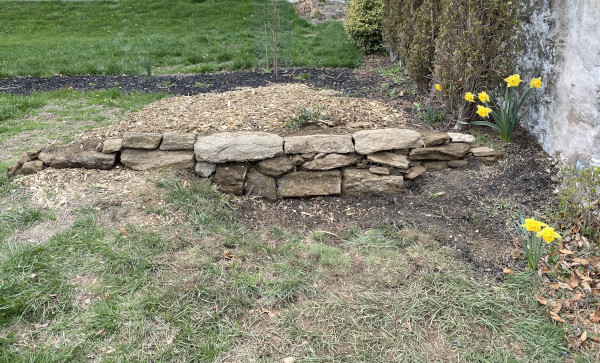
One thing that I did that I had not planned on doing was creating a small rock wall on the western edge of property. I was originally just digging out some rocks so I could plant one of the bearberries, and got carried away, digging up giant rock after giant rock with the help of a neighbor's pry-bar he calls "the persuader". It certainly persuaded the rocks out of the ground much easier than any tool I have. I like how it turned out, and that makes a clear distinction between the grass and the mulched/wildflower area. (Eventually I also intend to start removing the lawn on this side of it, but that's probably at least several years off.)
Other tasks completed:
- fill small sinkhole next to driveway with mulch
- identify groundcover with yellow flowers in space between us and neighbors (lesser celandine)
- empty rotating compost barrel
- transplant blue violets from hillside with grass to new rock wall and hillside with apples
- transplant some of the pussytoes - I don't want to lose them when I eventually get around to removing grass on hillside below flowering dogwood
- plant white hyacinths from MH&DW
- plant sunflowers from MH
- weed and spread woodchips around chestnuts, oak, and maple
- do soil test in vegetable garden
- sharpen mower blades
- Read Chris Baines's How to Make a Wildlife Garden
1. According to Doug Tallamy. I saw this once before but the most recent place was on the May 15, 2021 episode of the Native Plant Podcast.
Lilac tree blooming
June 1, 2025
trees, observations | permalink
The lilac tree out front is in full bloom; hadn't noticed it until now.
Peach count
May 31, 2025
fruit, trees, observations | permalink
Counted the peaches on the peach trees: 30 on the one on the terrace, 13 on the one in the backyard (and none on the newest, naturally).
Apple count
May 23, 2025
fruit, trees, observations | permalink
I went around and counted how many apples have started: 1 on the Crimson Crisp, none on the Honeycrisp, 2 on the Winecrisp, and 4 on the Black Arkansas. (And obviously none on the Sundance, just planted a couple months ago.)
Oaks
April 24, 2025
trees, observations | permalink
The red (or black) oak in front of the gazebo, that MH and I transplanted on March 12, 2023, and is now about 8 or 9 feet tall, began to leaf out. Makes me slightly worried for the third one that I planted, in October of last year, since it's not showing any sign of life yet. But this first one also took a little while to come to life that first year after being moved, so we'll see.
Dogwood
April 6, 2025
trees, observations | permalink
Dogwood is starting to break bud.
Tree-planting advice
January 28, 2025
I think I'll add additional tips later, but for now I wanted to note this passage from Doug Tallamy's book Nature's Best Hope: A New Approach to Conservation That Starts in Your Yard (Timber Press, 2020, pp. 195-7):
Life is not risk-free, but treefalls are something we can and should manage. The obvious solution most people offer is to plant all trees with the potential to become large far from the house or driveway. This works if you own lots of land, but it's not an option on small properties. Not planting large trees also deprives your house of the cooling that shade from trees provides in the summer and the windbreak trees provide during winter.
Fortunately, there is another solution to this vexing problem and it comes from the way trees grow in nature. Trees evolved to grow together in a forest. They intertwine their roots, forming a root matrix that is nearly impossible to uproot. Forest trees with interlocked roots may snap off in big winds, but they typically don't uproot. Because aesthetics have trumped function for so long, we have planted large, isolated specimen trees ready to blow over nearly everywhere. If we change our goal from creating majestic specimen trees to picturesque groves of trees, the interlocking effect of root matrices will be strongest. [...] if we planted our trees in groups of three or more on ten-foot centers, the resulting root matrix would keep them locked in place thick and thin. None of the trees would develop into a single majestic specimen tree, but together they would form a single grove of trees that the eye will take in just as if they were one large tree. Planting tree groves will also protect against the domino effect. Every time we take down a tree, we are making the remaining trees more vulnerable to straight-line winds. There is one catch to this approach, however: the trees must be planted young, so their roots can interlock as they grow. Transplanting five-inch caliper trees that are twenty feet tall for instant gratification is a poor way to achieve interlocking roots with any strength.
Second Chestnut Planted
December 10, 2024
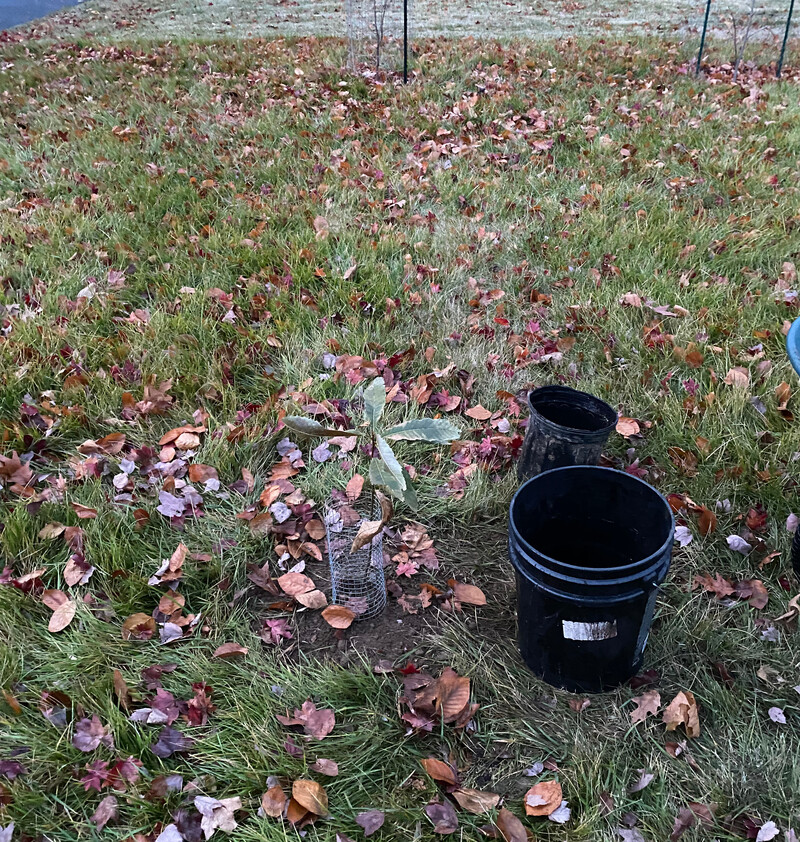
I planted the second chestnut given to me by MH, to go along with the first one planted two years ago, in December 2022. Just as the first one, this one is also from the American Chestnut Foundation - their "Improved American Chestnut Seeds with Intermediate Blight Resistance" stock. These are the only ones they offer east of the Mississippi, due to the chestnut blight. From the ACF's website:
These hybrid seeds have some level of Chinese chestnut ancestry to confer blight resistance. They will tolerate blight infection more effectively than an American chestnut, but not as well as a Chinese chestnut. In general, blight will grow rapidly on an American chestnut, more slowly on these hybrids, and do minimal damage to a Chinese chestnut. At this time there is no 100% blight-resistant American chestnut seed or seedling and there is no guarantee that any seed will grow free from blight. Scientific efforts toward this goal are part of TACF’s mission.
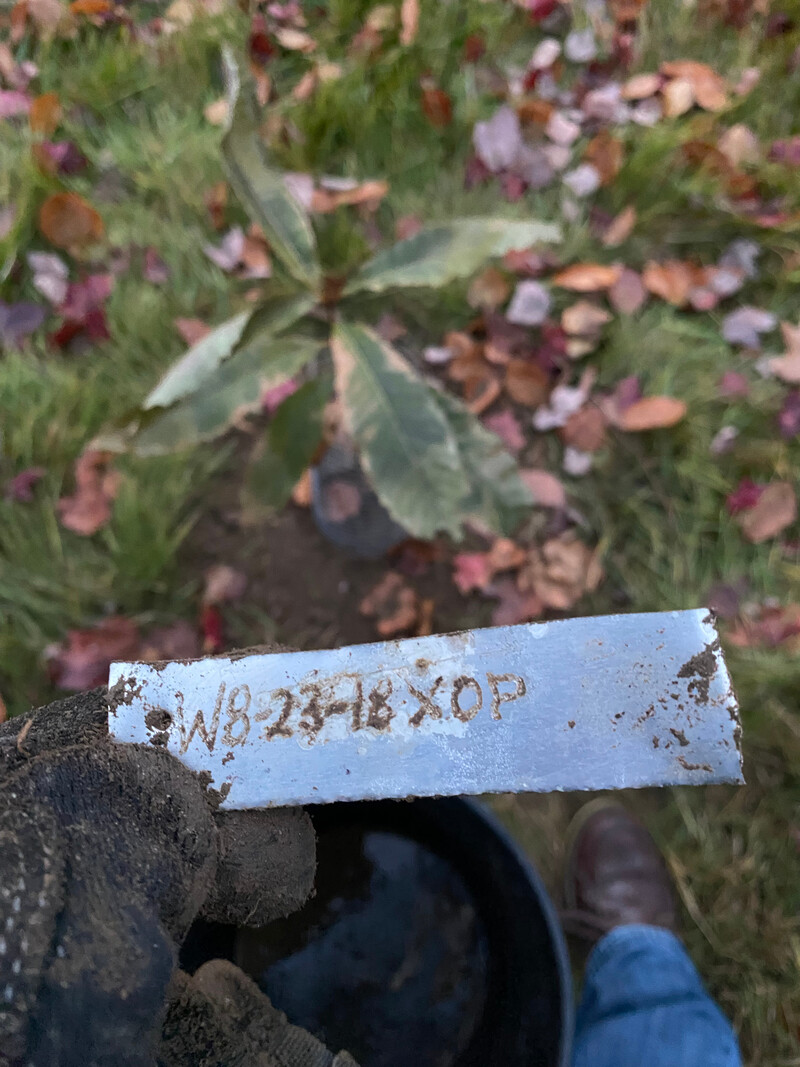
Mine's ID is W8-23-18XOP. I briefly tried to figure out what the numbers mean with no luck, though I assume the "23" is for the year it was started, since the previous one I planted in 2022 had "20" in that position.
It's on the front line between the maple that was already here and the American hornbeam I planted earlier in the year, and diagonal to the first chestnut, maybe 20 feet away.
Pagoda dogwood planted
November 2, 2024
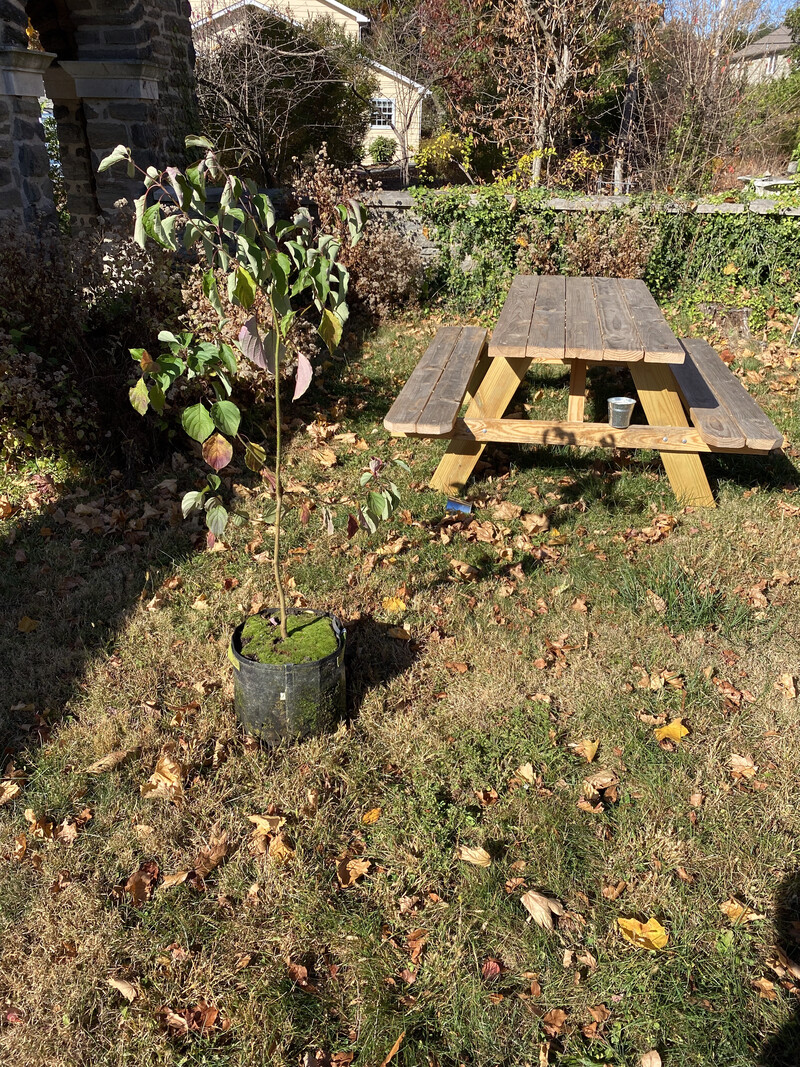
I planted a pagoda dogwood, courtesy of the shade tree commission. It was fairly easy digging compared to others. It went in the ground several feet to the southeast of the picnic table, for future shade.
White fringetree planted
October 27, 2024
I planted a white fringetree, courtesy of the shade tree commission. Top of the steps to the terrace, on the left. Like all of the trees I've planted, I am interested in seeing how it turns out over the years. This one was placed to add a bit of shade to the front of terrace before the vegetable garden. With some shrubs I want to put in front of it, on the hillside next to where the foxgloves were planted, it's the start of a section of taller things that will provide a different habitat along with screening.

Third oak planted
October 11, 2024
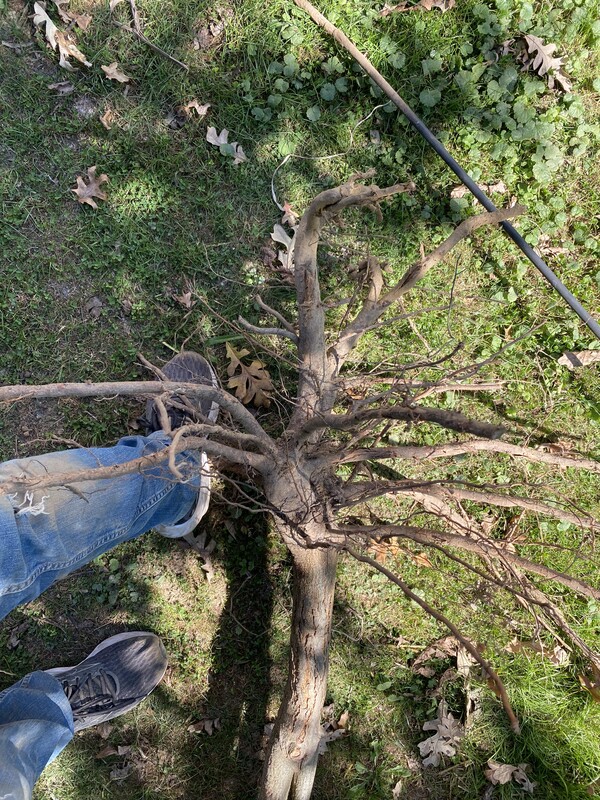
Over the course of five hours, I dug up, drove, and planted a third oak tree, from MH/DW's place. This one was about 8' tall, just a bit taller than than the one MH and I had transplanted from their place in May 2023. I had originally planned on bonsaiing this one (just I had the other), and so about two years ago I topped it at about 12". At that time, it had probably been 4' tall. Grew back with a vengeance. Two-thirds of the five hours was digging it out. It was tiring, dirty work, and I wasn't able to get the tap root out complete. The drive in the little car was thankfully smooth, and so was digging the big hole to put it in. I also found a cool surprise while digging the hole at home: two glass bottles made in my hometown. If my dad were alive, he'd probably be able to tell you what they were and the approximate year they were made.
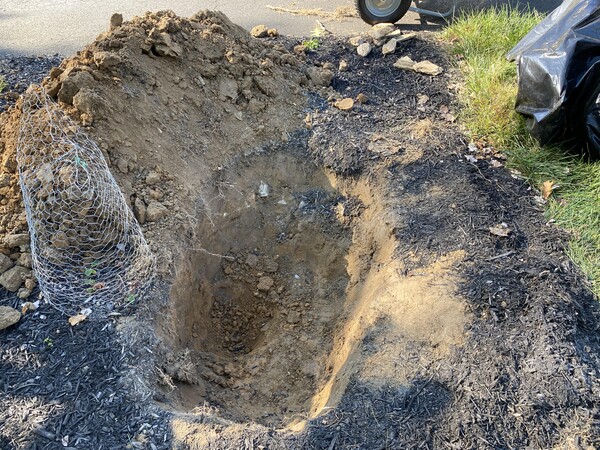
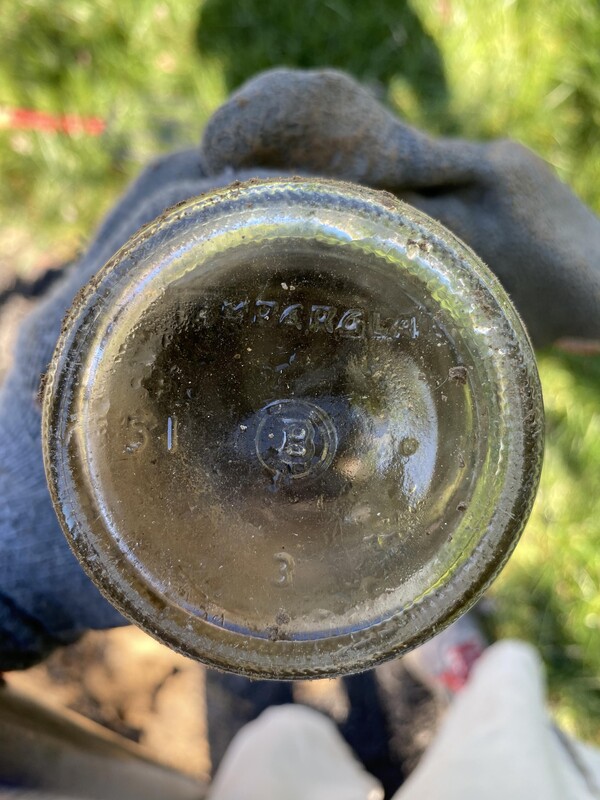

EDIT, 2025-10-07: I originally referred to this as the second oak, but it was indeed the third that I planted.
Pumpkin and the fox
June 7, 2024
wildlife, trees, vegetables | permalink
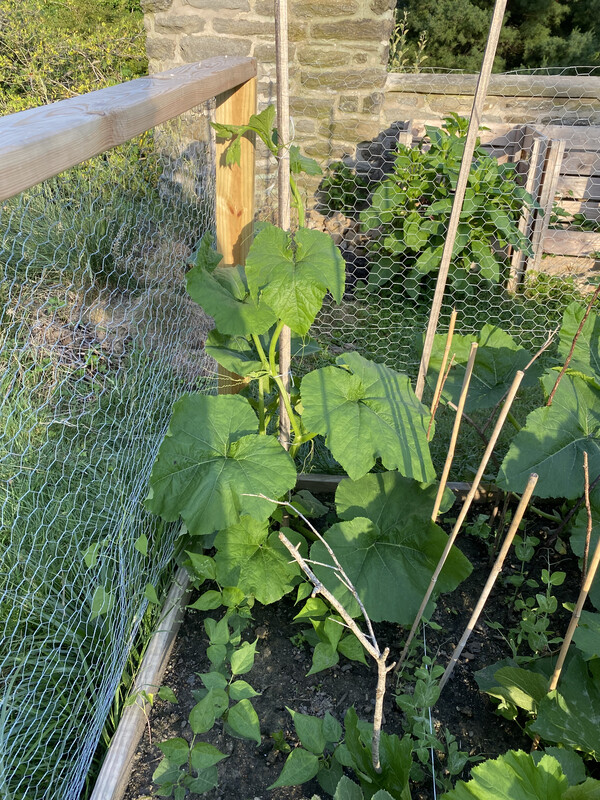
This pumpkin is currently my favorite plant. Look at it! It was about six inches tall two weeks ago. I'm training it up the wooden stake so it will have more room; we'll see how it survives once I get it up over the side. Deer snack? Maybe. Though I have another growing outside the raised bed and it has been untouched so far, knock on wood.
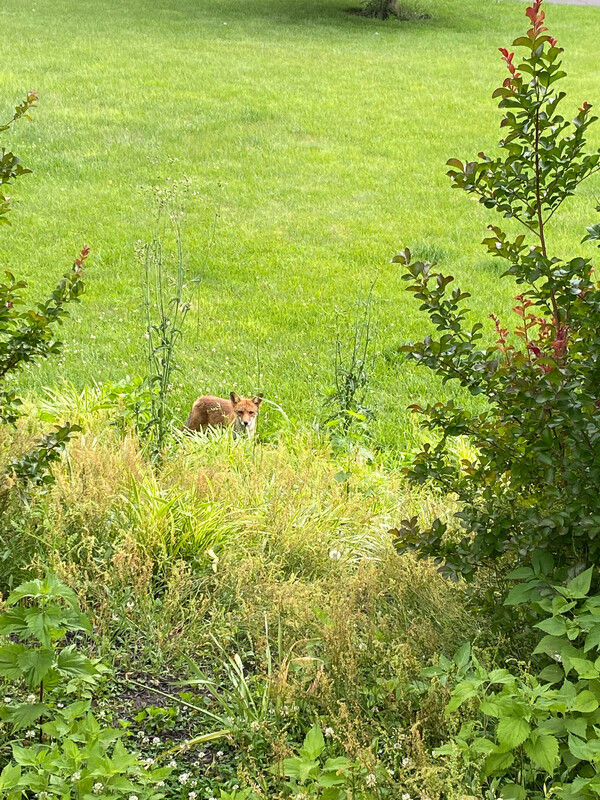
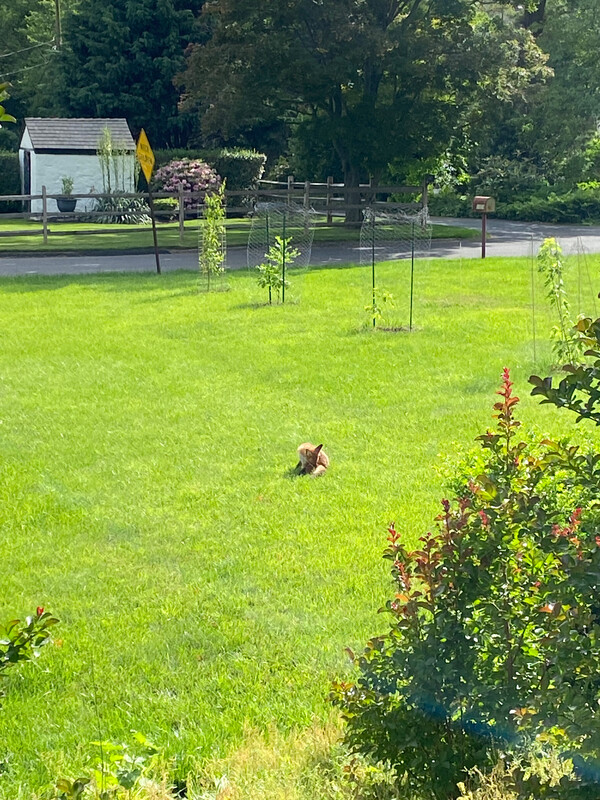
Speaking of wildlife, a bit earlier I had finished putting protection around the two newly planted hickories (because they've already been nibbled by deer), and then ran into the fox. Not sure if it's always the same fox I see, but likely? We had been walking towards each other from two different paths on the terrace. I was unaware of it until I turned onto the path it was on, which was coming from the raised bed and compost area. I'm sure the fox had already noticed me, though I think both of us were surprised. I backed up and it slowly but fairly nonchalantly continued on its way, marked its territory on a juniper I had planted, and then ended up where I took these pics a couple minutes later. First curious, then indifferent.
Black walnut planted
May 18, 2024
No picture yet, but I transplanted the black walnut from MH/DW. Surprisingly easy removal; I think it took all of 5 minutes to get it out. Easy planting too. It's in front of the hickories I planted.
It was much too late in the year for a transplant and it's been struggling since, but I hope that it'll survive.
American hornbeam planted
May 11, 2024
The son of neighbor MM/SM picked this up from the township's Shade Commission giveaway on April 27 since I wasn't able to go, and it sat on the back patio until today. It was bigger than I expected - nearly 7 feet tall. I put it on the southwest edge of the yard, so it's now the first in the line of trees along the western boundary.
Peach trees planted, blueberry and apple blossoms
April 26, 2024
I took the day off work so I could plant two peach trees and do other yard work. The trees had arrived the weekend before - if not before that - from Cummins Nursery, based out of Ithaca, NY, the same nursery where I had got the four apple trees the year before. The peach trees were supposed to both be grade 1, but they had miscounted their inventory, so I had one grade 1 and one grade 4. Both are Challengers, a yellow flesh peach, on BY520.9 root stock. The description from their page for the cultivar:
A very cold-hardy, freestone peach with excellent disease resistance. Also known as NC-C3-68.
Challenger is very cold hardy. Its flowers buds, bloom, and young fruit all demonstrate high tolerance for freezing temperatures. This tree also has excellent resistance to bacterial spot. It is self-fertile and does not need a second variety present as a pollenizer.
Challenger is an improved descendent of Reliance. It has a larger fruit with more attractive coloring, firmer flesh, and improved texture. The peaches are medium sized with a red, low fuzz skin.
Crossed in 1987 and selected in 1990, this cultivar is a cross of Redhaven with a breeding selection derived from Reliance and Biscoe. It was developed by NCSU.
One I put on the terrace, about 15 fifteen in front of the two apple trees up there, and the other in the backyard near the property line with AM. Peach trees are surprisingly small. These are both standard trees, and will grow to 12 to 13 feet tall. I'm not sure if this is true of all peach trees, but these ones are self-fertilizing.
I also noticed that the largest of the four blueberry bushes I planted last spring had a few blossoms on it. And so did two of the four apple trees - the Arkansas Black (below) and also the Winecrisp.

Two hickories planted
April 24, 2024
I haven't taken pictures of these yet, but I planted the two hickories gifted by MH. They are in the shared area beyond the rock wall, bordering JM & CM.
False hollies planted
March 31, 2024
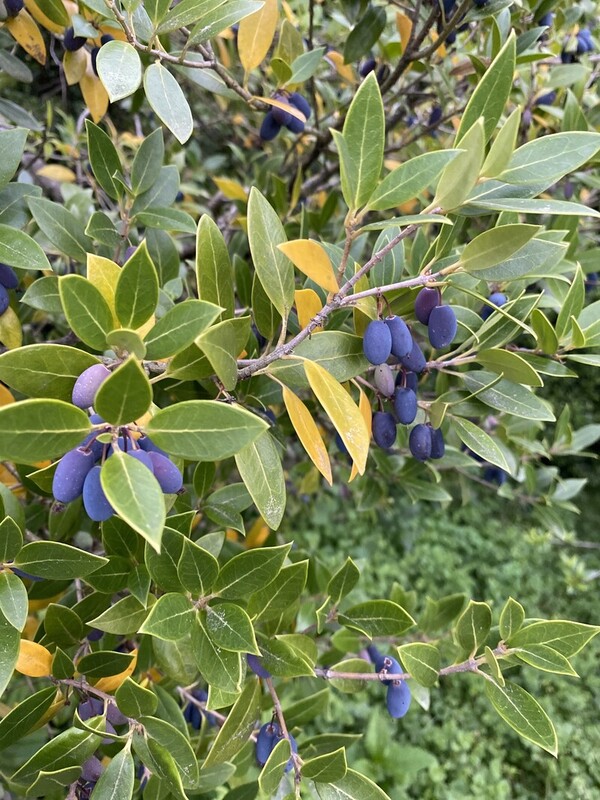
I thought I was planting hollies, but since they were planted, I discovered they actually are not. I took these from the large bush at the back property line of the house, where a branch had dipped down to the ground and layered itself. I was able to pull out three separate trunks from this, between two and three feet tall. Planting was easy, and I thought I was getting a good start to the holly hedge I'm attempting to start along the road.
The reason I thought these were hollies was because the leaves near the bottom of the tree very much looked like holly leaves - dark green, thick, jagged edges. I remember reading some time ago that holly leaves will lose this jaggedness towards the top of the tree, and I assumed that was the reason that most of the leaves of the tree were ovate. However, once the fruit developed on the parent tree, it was obvious it wasn't a holly. Instead of a small red berry, there is a larger dark blue/purple ovoid drupe (which something enjoys eating - been finding the seeds on the playset, on the raised bed frame, and on the top of the compost bin). My first attempt at identifying it came up with Phillyrea latifolia (via the PlantNet app), but now I think it is Osmanthus heterophyllus, aka "false holly" according to Wikipedia. (Another good source on it is from Trees and Shrubs Online, a publication of the International Dendrology Society, which I did not know existed until now.)
Holly planted
March 16, 2024
I've been carting around a small holly in a large container between the moves the last few years, and now it has found its permanent home: on the other side of the gazebo.
Ashe's magnolia and bald cypress planted
October 28, 2023
I got both of the trees from the township's fall giveaway. They came with good fencing too. The magnolia went in easily, less so with the bald cypress because of rocks. In all, about 3 hours work to put them in the ground. Not bad at all for the benefits of trees. Glad to have some less common species, and that they are native.
Second oak planted
March 12, 2023
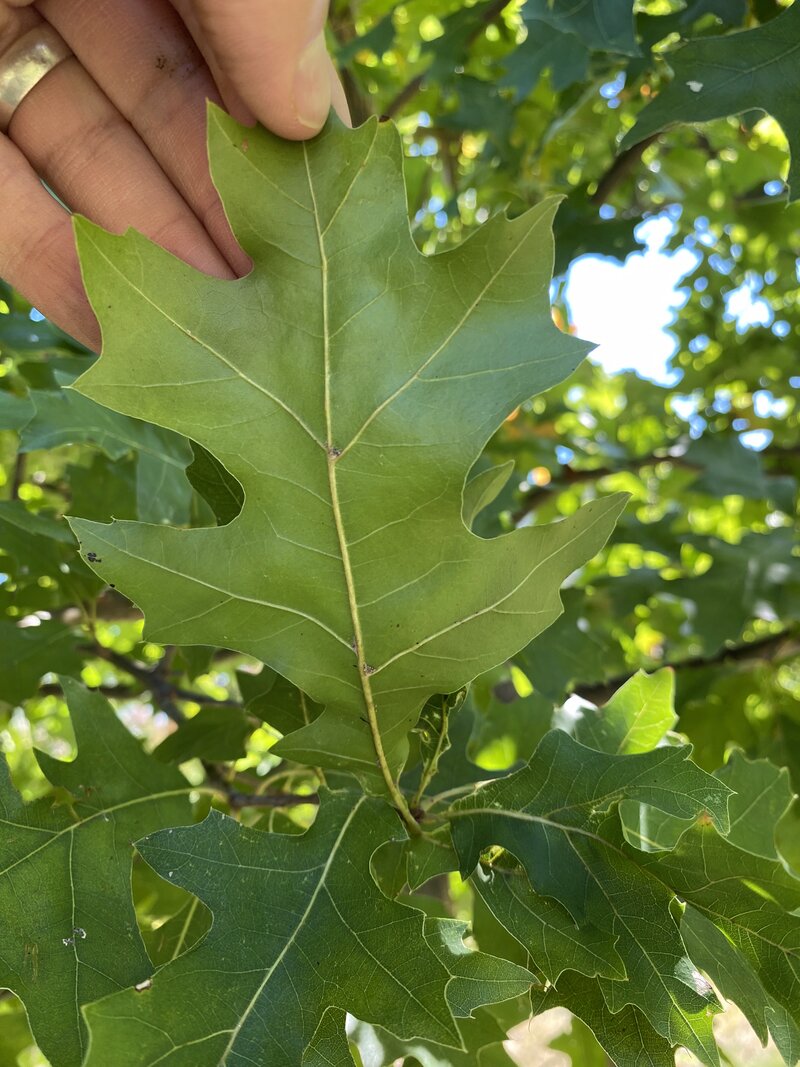
With a fair amount of effort, MH helped me dig up this oak, which he thought was some kind of red oak, from his place and move to ours. I was originally going to bonsai it, and so had cut it at about 12 or 15" tall about two(?) years prior. It grew back amazingly fast to be about 6 or 7 feet tall when we put it in.
In early October 2025, I did some research on what type it may be. Using the book (that MH let me borrow or maybe gave to me - memory is not clear) Trees of the Eastern and Central United States and Canada by William M. Harlow (Dover Publications, 1957), I narrowed it down to one of three trees in the red oak group: black oak (quercus velutina), northern (common) red oak (quercus ruba), or scarlet oak (quercus coccinea). This was based mostly on the leaf, by tracing various characteristics through his numbering system, from 1 to 9 to 11 to 12 to 13 to ... not sure. I think I need to wait for it to get a bit older and use acorns or bark to get to the final identification. Leaf color in fall might help, but I don't think I'll be able to tell myself from that.
The White Oak Initiative (ironically) has some guides for those trees that were useful in at least suggesting I was on the right track. So was "Northern Red Oak vs Black Oak" from bplant.org.

First Chestnut Planted
December 27, 2022
I planted the chestnut given to me by MH, which came from the American Chestnut Foundation, ID W9-20-115. It's about six feet in front of the maple on the western line.
First Oak Planted
December 27, 2022
I planted the oak of unknown species given to me by MH, dug up from his yard. It went in between the chestnut and the road, about six feet from the chestnut. It was maybe 18" tall when planted.
EDIT, 2025-09-13: I'm fairly confident this is a bur oak (Quercus macrocarpa), a type of white oak. The Seek app identified it as either that or swamp white oak, and after reading "Swamp White Oak vs Bur Oak", it looks more like a bur oak, mainly in leaves and bark. Finally, I remembered that MH has an oak that has "cup" somewhere in its name, and in doing some searching found that mossycup oak is another name for bur oak. It is now about 10 feet tall, but it won't produce acorns until at least 35 years old. So, only 32 or so to go. Sorry squirrels. The USDA's Natural Resources Conservation Service has an informative guide about it.
Volunteer maple planted
September 24, 2022
Planted the volunteer maple that came up in a container from a couple of living places ago, with neighbor JM. His pry bar ("the persuader") was crucial. I'm not sure what kind it is - red? sugar?