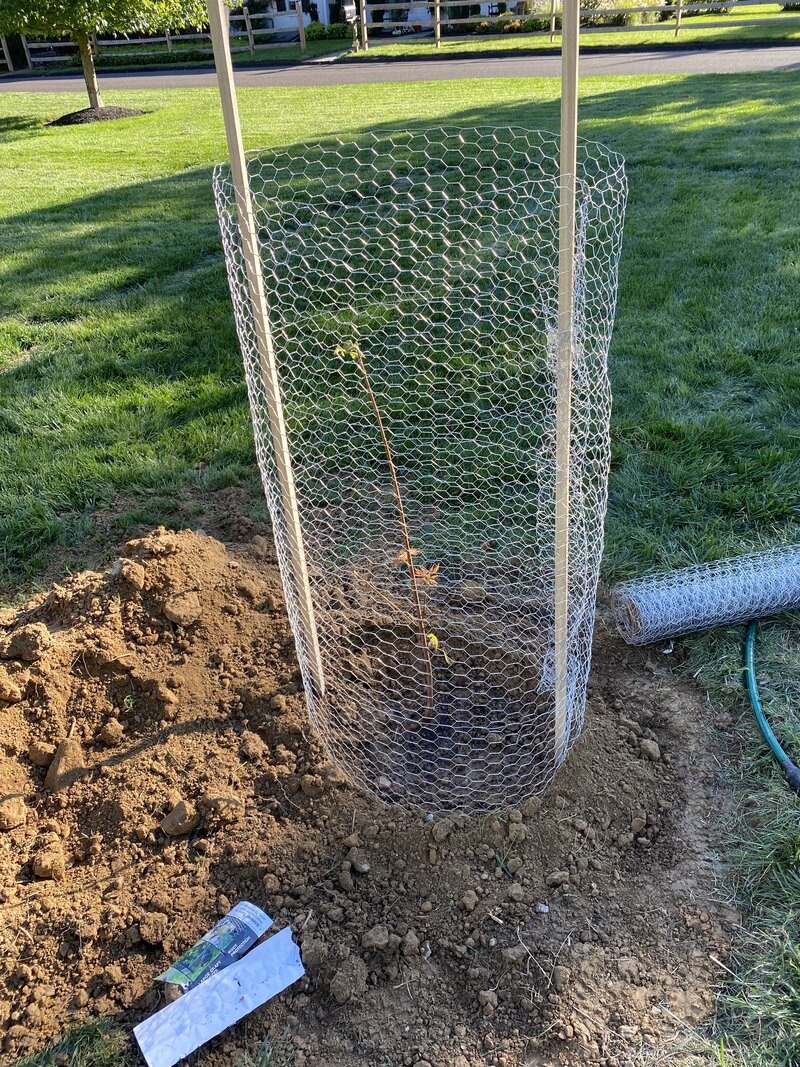
Lupines transplanted
April 17, 2026
planting log, herbaceous | permalink
I transplanted all the lupines that I'd started in pots and put in the vegetable garden during the fall. I planted 60 seeds in 12 pots and about 45 came up, making a 75% germination rate, which is decent, I think. Most went in the mulched area right along the road close to the lawn, but I also put six in on the west side of the large tree stump on the terrace, and another eight within the fenced-in area of the southern woodland edge, near the serviceberry (which has started doing well now that the deer can't get to it). I also noticed while doing this that many that I directly sowed in the front mulched area in the fall have come up and have thus far survived. The tallest are about two inches tall, but most are closer to an inch.
Tree and shrub leaf out and blossoms
April 11, 2026
trees, observations | permalink
April 2
- hop hornbeam
- peaches (blossoms and leaves; only 7 flowers on one in back yard, 30 on newest one on terrace, 100-200 on older peach on terrace)
- lilac and maple in front (and perhaps earlier than this)
April 4
- pagoda dogwood
- red osier (existing, not cuttings)
- American hazelnut (and a fair number of new shoots)
- apples on eastern hillside
- hop hornbeam
April 5
- Flowering dogwood
- black cherry
April 8
- Tulip poplar
- apples on terrace
- some of the red osier cuttings I planted
April 10
- Eastern redbud
- pear
April 12
- apples on eastern hillside beginning to flower; black arkansas a bit ahead of the winecrisp
April 14:
- flowering dogwood is flowering
April 15:
- red or sugar maple
- northern catalpa buds beginning to swell
April 16:
- Ashe's magnolia
- red or black oak
April 17:
- white fringetree
- white oak buds beginning to swell
- northern catalpa
- milkweeds have come up quickly, about 3 inches tall (I think common, not yet butterfly)
Nothing yet aside from buds: bur oak, black walnuts, bald cypress, chestnuts.
Need to check on the black tupelo.
Frost! and wishing for a potato recovery
April 8, 2026
potatoes, vegetables | permalink
Well, I knew it was a risk when I planted the potatoes before our last average frost date (April 9th), but I did it anyway. Last night they suffered for my eagerness. It dipped down to 28 and when I was able to check on them early this afternoon the previous foot-tall, healthy stalks were just laying limp on the ground. They had good root systems when they went in, though, so I'm hoping some new growth emerges.
Edit, Apr 10: The rhubarb also got hit, though to a lesser extent and is already pushing up new leaves. It had just started to flower - wonder if it will try again.
Edit, April 16: One potato has new growth.
Fox
April 5, 2026
wildlife, observations | permalink
About 6:30 this morning I came downstairs, and went to the living room to look out the back windows to see what might be going on. I thought I saw a small movement up by the vegetable garden, so grabbed the binoculars sitting on the shelf and peered out. At first I wasn't sure what I was looking at, if anything, because there wasn't any movement and I was still focusing. Was it just the wood chips around the garlic bed? No, I shouldn't be able to see them from here. Then a head and ear. Dog? Why is the neighbor's dog up there? More focusing and movement and why hello there fox.
This one seemed to be slightly on the younger side - perhaps two or three years old? I'm not an expert on foxes, but it wasn't a kit and didn't appear to be as old as others I've seen. It walked down the path I take to get to the vegetable garden, then hopped up on the big stump, smelled around, looked interested in something in the big hole at the center of it. After a few more sniffs it turned away from it, looking towards the street. It paused for a few moments. I wished I had a good camera so that I could capture it in profile there. I would have had to have been pretty quick, though, because soon it stepped off and went through the grass toward the south hill. It turned in toward the gazebo and walked down along side it and into the front yard. I was somewhat surprised that it chose to walk through the wood chips I'd recently spread there. It stopped again and smelled around, then sauntered across the road, and picked up a little speed as it went through one side of the neighbor's fence and then through another, disappearing from sight.
Parsley, cilantro, and basil sown
April 4, 2026
herbs, parsley, cilantro, basil, planting log | permalink
I put one row of each of these in the front of the left bed, just in front of the two rows of beets I planted last week. First parsley, then cilantro, then basil. These rows were a bit closer than the rest of the bed - maybe 8" apart instead of 10 to 12. The parsley and cilantro were spaced two inches between each seed, while I did the basil every inch. Hopefully the heights work out as planned, with the basil somewhat shading the parsley and cilantro but with neither of those latter two shading the beets. However, thinking of it afterward, I shouldn't have put the basil in there but rather another row of cilantro probably, since the wildlife seem to mostly leave the basil alone aside from the infrequent nibble. (More than nibbling is the reason I'm moving the cilantro and parsley from the unprotected herb garden to the fenced-in vegetable garden this year.) There were only about a dozen basil seeds left in the packet, so I threw them in the garlic bed, along with a few cilantro for the hell of it. The cilantro seeds were those I'd saved from the herb garden in 2024, the basil I'd saved and packaged on Oct 3, 2025, and the parsley from a store-bought package from 2024.
Last potato and two more red osiers planted
April 1, 2026
potatoes, shrubs, planting log, vegetables | permalink
After giving me daughter ample opportunities to plant the second and last of her potatoes that we started inside, I decided it was time to put it in the ground. So now there are four along the back right side of the right raised bed. All are about a foot tall, and have good root systems.
I also pulled out two of the red osier dogwood cuttings that had roots on them from the jars on the windowsill and put them next to the other two I planted the other day at the edge of the mulched area in the front meadow. So far, deer have not touched the other two, though I won't really be surprised if they get around to eating them sometime soon. I just don't feel like putting up the caging.
As usual for this spring, I sprinkled some mycorrhizal fungi into the hole for each of these three plants before I put them in.
Rhubarb and red osier dogwoods planted
March 30, 2026
shrubs, vegetables, planting log, rhubarb | permalink
I picked up two rhubarb crowns from the expensive non-native garden center on my way back from dropping my daughter at pre-k today, and then planted them on the edge of where I'd spread yards of wood chips at the corner of the front meadow and the western woodland edge. Deer should leave them alone - supposedly - and they should spread. I'm hoping for a nice patch in a few years that I can maybe harvest enough to make some strawberry-rhubarb pies.
Just a few feet away from them, at the edge of the front meadow, I put in a couple of red osier dogwood cuttings. One was from MH's property, one from ours, and both had been sitting in water since mid February and developed some small roots.
Both were amended with a little bit of the mycorrhizal fungi I bought earlier this month.
Potatoes planted, blue violets moved
March 29, 2026
planting log, herbaceous, vegetables, potatoes | permalink
Three of the four potatoes my daughter and I started inside are now planted in the back right of the right raised bed. As I was doing that, I also weeded that bed, and moved about 20 blue violets to the front meadow. There, I removed another small piece of sod and put them in its place, then didn't feel like removing any more and so planted the rest on the edge between the grass and mulch. Now about half of that mulched area has a row of blue violets at its border, spaced about two or three inches apart. I hope they fill in well and help to keep back the grass.
Left raised bed mostly planted
March 28, 2026
vegetables, planting log, kale, broccoli, cauliflower, carrots, beets | permalink
In the back of the left bed, I have three rows of spinach, with space beyond them for a row of corn. Now, in front of the spinach, from back to front, I have:
- 1 row of kale
- 1 row of broccoli
- 1 row of cauliflower
- 3 rows of oxheart carrots
- 2 rows of danvers 126 carrots
- 1 row of detroit dark red beets
The rows are about 10 inches apart and the seeds are spaced 2 inches apart. I sprinkled mycorrhizal fungi into the little trenches I made before dropping the seeds in.
More tomatoes started
March 22, 2026
tomatoes, vegetables | permalink
I was talking to neighbor CM yesterday, and she said she was going to try to start a small garden this year. I asked if she wanted tomatoes and what kind, so I started six more seeds of the bush round tomato that I'd saved seeds from on Sept 30 last year. While I was doing that, I also remembered that MH gave me Juliet tomato seeds last spring that I didn't up using (already had plenty started), so I threw six of those into some soil as well for him.
Updates:
- March 30:
- 5 bush tomato seedlings
- 2 Juliet seedlings
- Apr 1:
- 5 bush tomato seedlings
- 4 Juliet seddlings
- Apr 3: planted two Juliet seedlings in the cells where nothing came up
- Apr 13: potted up the Juliets
- Apr 14: potted up the bush tomatoes
Winter 2025/6
March 21, 2026
seasonal review, planting log, herbaceous, trees, shrubs, fruit | permalink
This winter was the least busy season I've had gardening since moving into the house, which comes down to two things: 1) it being winter and also a particularly snowy one (though that did mean some shoveling) 2) not trying to start any plants inside (aside from a few for the vegetable garden), unlike last year.
Here's a list of the things I did do:
- spread container of ashes around bur oak
- plant swamp milkweed (asclepias incarnata, aka rose milkweed) seeds in southern-facing hillside (removing some ornamental grass and plant in its place)
- move large rocks to curb, replace the ones around herb garden
- (re)plant hemp dogbane around rocks in front
- buy 50 more feet of 48-foot-tall fencing
- go to talk on backyard habitats by Katie Fisk
- prune the red or black oak with two trunks
- take cuttings from red osier dogwoods, cut up red osier canes MH brought over, and put in water to plant later
- plant some of the red osier cuttings directly
- watch this "masterclass" on composting
- watch Cummins Nursery videos on pruning applies
- read this article on co-existing with deer
- restake fencing around eastern redbud near picnic table
- prune/train apple trees
- buy mycorrhizal fungi (at least 2 lbs) from MycoBloom
- prune/train pear tree
- make cages for elderberries and red osiers
- plant elderberry cuttings
- get another chipdrop
- spread woodchips on western woodland edge (not yet finished)
- extend southern woodland edge to include elderberries
Peas sown
March 15, 2026
planting log, vegetables, peas | permalink
I sowed Wando peas in the back half of the right bed, with rows 18" apart and 2" between each pea, amounting to about 100 in total. I left space along the right side for a row of potatoes. I still have to put in something for them to climb on. Last year I used twine tied from the furring strips on top and anchored into the soil with short sticks, but whatever animal got in made a giant mess of it so I'm not going to do that this year. I think instead I'm going to use bamboo. So, I guess, need to add that to the list.
Updates:
- March 31: Saw a bunch of seedlings coming up today as I was dumping the compost.
Blue violets and lupines planted
March 10, 2026
gardening, planting log, herbaceous | permalink
While preparing the right raised vegetable bed for planting, I dug up about 10 blue violets. I only noticed them because of the long, dense root system, which I became familiar with last year as I dug them out of the same place when they had lots of leaves. No leaves on them this time of year, just little stubby stems with the very beginning of green shoots. I also noticed that something was starting to emerge from what I'd planted into pots in the fall and placed between the two beds. I picked up one pot and it was labeled as three lupines and, as luck would have it, it had three seedlings coming up. I didn't do a thorough evaluation of how everything was doing, though in some pots there's nothing yet and in others there were more lupines.
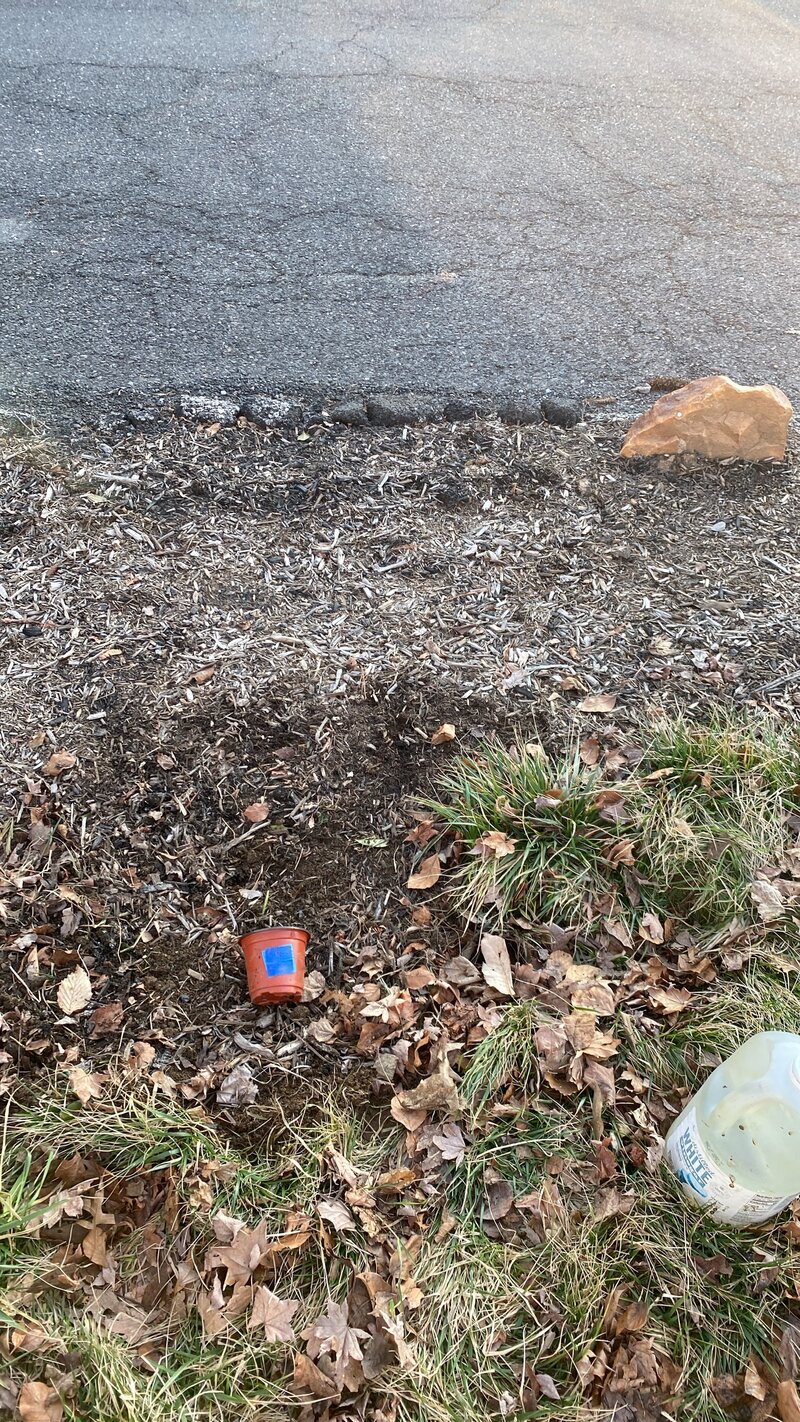
Off both sets of plants went to the roadside meadow. After removing a chunk of grass along the mulched area, I put the blue violets on the border with the (cursed) lawn and the lupines a few inches in. I looked around for any sign of the lupines that I planted there, but didn't see any. That area gets much less sun than where the pots in the vegetable garden are, so hopefully it's just a matter of soil temperature and later germination/growth rather not growing or deer eating them. In any case, I'm going to let the other lupines stay in their pots to get a bit bigger before I move them, in the hope that the deer won't eat them after a certain size.
Tomatoes, basils, and cauliflowers started
March 9, 2026
vegetables, tomatoes, herbs, cauliflower | permalink
In the basement, now under grow lights, I started the following seeds, in order from left to right by six-pack:
- 6 basil, collected from ones I grew last year
- 6 more basil, also from ones I grew
- 6 cherry/grape indeterminate, noted to be from a spouse favorite after a taste test, from a descendant of the original 2024 volunteer and packaged on Sept 8, 2025
- 6 cherry/grape indeterminate tomato seeds from the original 2024 volunteer
- 6 round bush heirlooms from March 31, 2025, from one of the store-bought tomatoes I used last year
- 6 round bush heirlooms from ones I grew, packaged on Sept 30, 2025. On the package I noted "Very good plant, seems to not get too big/little to no blight"
- about 20 cauliflower, bought from store, in a burlap roll, inspired by GrowVeg
Aside from maybe planting more of these if they don't all come up, I don't intend to start anything else inside.
Updates:
- March 14: 5 cauliflower seedlings are already up and about 3/4" tall.
- March 15, 4pm: 9 cauliflower seedlings now up
- March 16, noon:
- 10 cauliflower
- 1 basil
- 1 tomato (indeterminate, from Sept 8 2025)
- 5 tomato (indeterminate, from original 2024 volunteer)
- 3 tomato (bush, from Sept 30 2025)
- March 17, 10pm:
- 10 cauliflower
- 4 basil
- 5 tomato (indeterminate, from Sept 8 2025)
- 6 tomato (indeterminate, from original 2024 volunteer)
- 4 tomato (bush, from March 31 2025)
- 6 tomato (bush, from Sept 30 2025)
- March 18, 9pm:
- 12 cauliflower
- 4 basil
- 6 tomato (indeterminate, from Sept 8 2025)
- 6 tomato (indeterminate, from original 2024 volunteer)
- 4 tomato (bush, from March 31 2025)
- 6 tomato (bush, from Sept 30 2025)
- March 20, 9pm: 1 more basil
- March 23: 1 more basil
- March 25: 1 more basil (now 7)
- March 27:
- potted up all the tomatoes (with an extra from the original volunteer, since I apparently dropped two seeds in one cell)
- a couple of the bush tomatoes are starting to develop true leaves
- one of the cherries/grapes has a set of three initial leaves instead of two - haven't seen that before (in my limited experience). I noticed this a week or so ago but kept forgetting to note it.
- planted five basil seeds in the cells where the first ones didn't come up
- Apr 3: a cauliflower seedling has come up in one of the tomato pots
- Apr 8: I think it's broccoli, not cauliflower that came up in the tomato. Now there are four of them. And another tomato.
- Apr 12: potted up the round bush heirlooms from the Sept 30, 2025 seeds into bigger pots. I topped up the soil on all the other tomatoes.
- Apr 13: potted up the cauliflower. Lost one somewhere along the way so now there's 11.
Spinach seeds sown
March 8, 2026
planting log, vegetables, spinach | permalink
Three rows in the back of the left bed, with space for a row of corn behind them.
A dozen more elderberry cuttings planted
March 7, 2026
fruit, shrubs, planting log | permalink
Last year, I ordered and planted a dozen elderberry cuttings from Rivers Hills Harvest. It was moderately successful - I think seven or eight have survived - and so I decided to do it again. I planted the first one on February 20, but then life - mostly snow - got in the way and I planted six on March 1, four on March 5, and the last one on March 7. About half of them went in between the others on the western woodland edge, one went on the south hill among a bunch of red osier cuttings I planted, and the remaining four went together in a circle (saved a bunch of fencing work) at the southern woodland edge, in front of the white oak. The four at the southern woodland edge and one on the other side got a dose of mycorrhizal fungi. The intention is for those on the woodland edges I'm creating to be part of a hedge, partly for wildlife and partly for blocking the view of the road.
A mycorrhizal spring
March 2, 2026
It's nearly spring, and so it's time to shift away from all the coding I've been doing in my spare time during the winter to focus more on gardening. My daughter found crocus flowers this morning, so it's coming, despite the small amount of snow in the forecast. I am looking forward to it. The other day I was working on organizing all the pictures I took over the last year (a task I've been doing a little bit of every day for the past month or more) and was surprised by how lush and green everything was in one of them. It's easy to forget that in February in the northeastern United States, even though I'm on the south end of that region.
So, it was perfect timing that I was listening to a podcast about mycorrhizal fungi while doing dishes this evening. It wasn't a foreign concept to me prior to this (I think I first heard about it from the Roots and All podcast), but I've not used any (aside from what's already existing in my garden) because I've been skeptical of the products I've found when looking to buy some. (Thankfully so, given the guest's analysis of some products on the market.) But now there's seemingly a good source, produced by a scientist (yes, that same guest): MycoBloom. Two pounds are already bought and should be shipped my way soon. Can't wait to start adding it to my soil.
A new groundhog?
February 21, 2026
I was out pruning one of the apples on the east hill today (more on that another time), and noticed some freshly dug dirt at the entrance to the groundhog burrow. In November, I'd found the remains of a groundhog on the terrace. So I'm curious - was that a different one than the one I'd previously seen in this burrow? Is this a different one taking up residence? When I see it, I doubt I'll be able to tell if it's the same one or a different one. I've previously thought about getting a decent camera for taking better pictures, perhaps if I do I'll be able to see some distinctive markings?
Update, March 23: I saw it this morning after dumping the compost and checking out the fruit trees. I think it had been watching me, because I didn't spot it until I happened to look in its direction and it ran (behind the compost bins, to the burrow). I then saw it sticking its head out of the tunnel on the other side of the hill just like before; no idea if it's a different one.
Red osier cuttings planted
February 19, 2026
shrubs, planting log | permalink
The other day I took some small cuttings off the red osier dogwoods (Cornus sericea) I planted last spring and then I realized that MH had much bigger ones and asked if he could spare a few stems. He brought some over last night and then I cut them into 8 to 10" pieces. Today I put them into the ground, first using a thin rod from something or other to make the hole, then pushed them in up to 6" deep. I put about 6 over by the black cherry, 10 near the existing one on the south hill, and 5 on the other side of the driveway. The latter I put a cage around - I put them close enough to fit in one of the cages meant for tree protection I still have. I think I'm going to leave the ones on the hill unprotected, but soon I'll make a big cage to put around the ones by the black cherry. I still have 20 cuttings sitting in about two inches of water; I want to see if they'll root so I'm going hang on to them for a week or so.
Cold
February 9, 2026
The past two weeks have been the coldest since I've lived in the area, and rivaling the coldest days in northwest Pennsylvania. I think the lowest actual temperate was -2. The other day, the windchill around 4pm was -11. My daughter wanted to go outside and play; 15 minutes was enough for me, though she, being a penguin, wanted to stay out. The pipe from the bathtub froze one night. It's unreachable, so I tried various things (hair dryer on drain, baking soda and vinegar, and finally salt). I think the salt did it, as that was the last thing I tried before going to bed and all the water had drained out by morning. The faucet has since been dripping every day that the low temperature has been below 15 or so, which has been every day except for two or three.
On top of the temperatures, the ground has been covered in a 6- or 8-inch layer of snow topped with a crust of ice. I've been throwing out copious amounts of birdseed. In addition to birds, squirrels and deer have been eating it. The deer have also been eating the cherry laurel around the house, which is the first time I've noticed them doing that. In the years ahead, there should be more evergreens around here for them - I'll be putting in some winterberry hollies next month, will just have to protect them for a few years first.
I'm looking forward to the thaw. It looks like we're out of the single digits now and after tomorrow we'll be out of the teens. Starting on Sunday, the temperature is forecast to be in the low 40s, so it's coming soon.
Differing opinions on crows, I imagine
January 30, 2026
observations, wildlife | permalink
I saw six crows in the back from the bedroom window today. I was watching two eating seeds/cracked corn I'd thrown on top of the snow on the terrace, then one that had been sitting high up in a tree took off. One of the two on the ground then went with it, then another from a tree, then another, and then finally the other one on the ground. I've seen four together before, but not six.
I enjoy seeing them around, but I doubt the hawks do. I remember spotting some crows and a hawk high up in the tulip poplar and the cherry tree not long ago. I grabbed my binoculars to try to get a better look at the hawk. While I watched it, one crow that was sitting on a branch several feet away repeatedly cawed directly at it. The hawk was looking forward the whole time, occasionally preening, and I imagine it was thinking, in hawk language, "such a motherfucker".
Tulip popular budding
January 29, 2026
observations, trees | permalink
The only one that I know of that I can see from my yard, the one in the neighbor's yard who lives diagonally behind us, is starting to bud out. Seems early to me, but I don't really know.
The robins brought their appetites
January 16, 2026
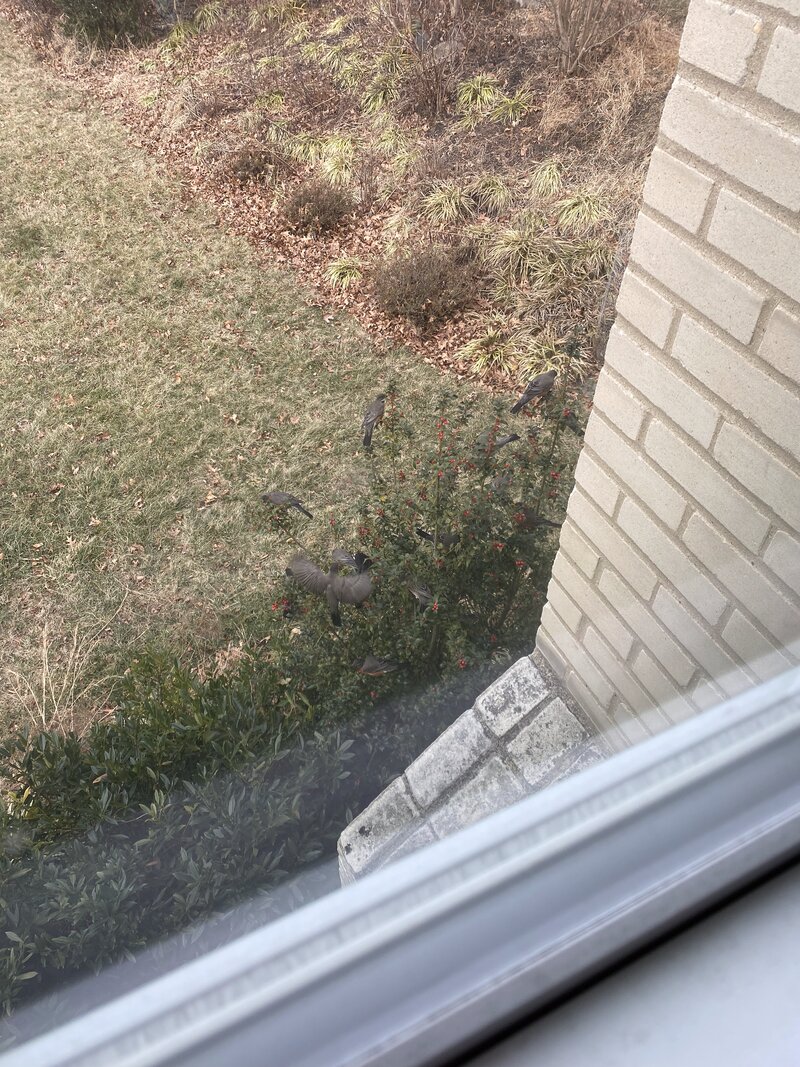
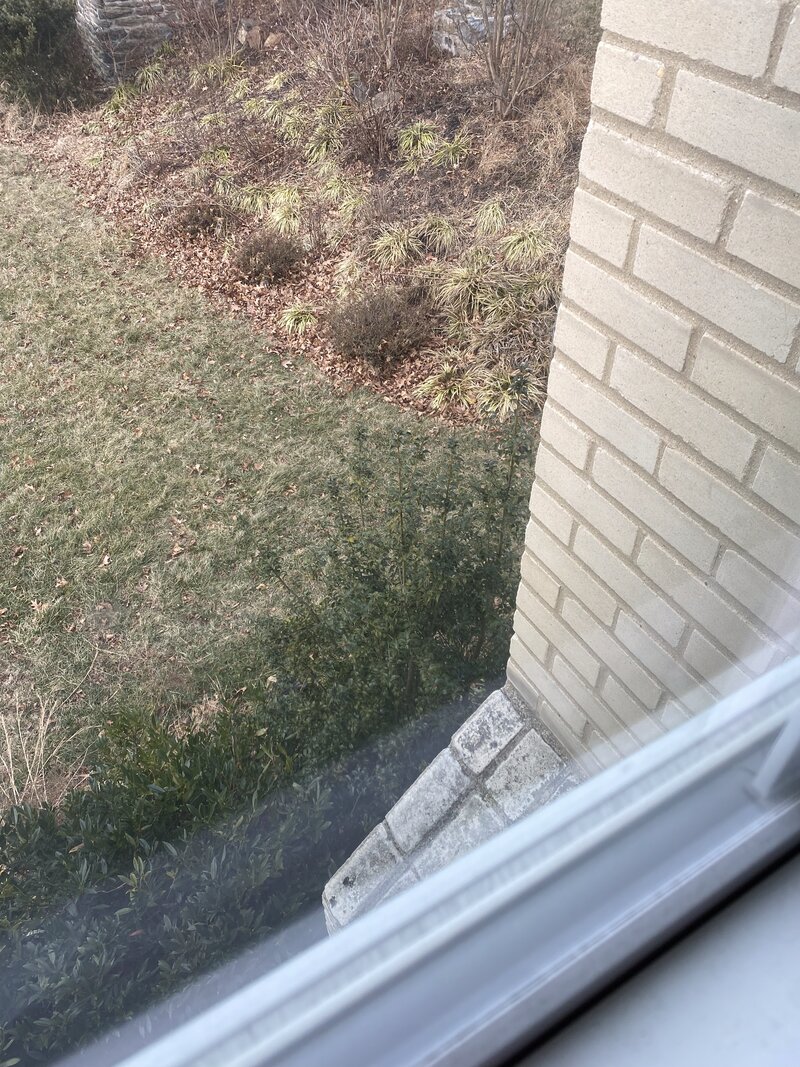
My cat jumped up on a windowsill while I was working and looked very interested in something outside. I came to check it out, and found robins descending on a holly tree (which I'm pretty sure is a non-native variety, from Asia, and so will eventually be replaced with a native one). They brought their appetites for the berries.
Fall 2025
January 11, 2026
planting log, trees, herbaceous, seed collection, wildlife, seasonal review | permalink
Fall was busy, but that's starting to be a refrain. Every season is busy. I feel like there is a lot of work to do, and I want to get as much of it done as soon as possible so there's more time for things to grow. To get bigger, to spread, to produce fruit, to begin to crowd out the grass, to block the view of the road and the gigantic increase in traffic due to a stop sign being put at one end of it (seriously, somewhere between 50% and more than 100% increase, the exact number depending on getting some raw data from the township for a recent count they conducted). I wrote very little about my activities, so much to catch up on here. I may later go back and add posts for a few of these things, mainly so I can link back to them from future posts and the rough map I'm making.
The biggest project of the season was cutting down the Japanese Maple in the front and planting two Eastern Redbuds (Cercis canadensis) in its place.
I planted two additional trees, both of which came free of charge from the township's shade commission: a White Oak (Quercus ruba), in the southern woodland edge, and a Black Tupelo (Nyssa sylvatica), in the northern woodland edge.
A few existing trees have become tall enough that I'm no longer worried about the deer topping them, and so cages were removed. However, there's still the risk of rubbing. So I did some research on a way to protect the trunks with natural materials (rather than, say, plastic guards), and found the suggestion of burlap. I bought a 35-foot roll of 3-foot-wide burlap from a local hardware store, then cut sections of about 3 or 4 feet long. I then placed these around the trunks, pushing open small holes between the threads to put limbs through where I could, and tied the ends together with some twine. It seems to have been a successful - only one showed a little rubbing, but no further after an adjustment. On the other hand, the serviceberry near the road that I planted either the first fall or spring after moving in needed more protection. Deer have been keeping it trimmed, so I finally put a taller cage around it.
Transplanted somewhere around 50 to 75 common blue violets from my vegetable garden, most to front meadow along road but also a few between the tulip tree sapling and elderberry in western woodland edge. I also collected a fair number of their seed pods and spread the seeds in the same area. American plantains and yellow wood sorrel were also moved from the vegetable garden to the same places, though not nearly as many.
Another big project (maybe 15 hours over a few weeks) was planting literally thousands of native seeds, mostly herbaceous but also some shrubs/small trees. I have no idea the exact number, but somewhere between three and five thousand. The vast majority were tiny tiny seeds that you just strew on the open surface (and hope for the best), but many others were ones that I planted into the soil (and hoped for the best). My plan is to do this every fall, for at least the next few years. Most of them I bought, but some I had collected from existing plants in my garden. Here are the species, with the collected ones indicated with an asterisk, along with location:
- Hickory - at end of driveway, in northern woodland edge; these were given to me by MH, via a friend of his
- Lupinus perennis subsp perennis (Sundial Lupines) - front meadow along road
- Antennaria plantaginifolia (Pussytoes) - western woodland edge, in wood chips between rock wall I built and bald cypress; on eastern hillside
- Rhus aromatica (Fragrant Sumac), which first needed to be hot-water stratified and soaked - western woodland edge mostly, but also some by new white oak in southern woodland edge and some by new brushpile on terrace
- Conoclinium coelestinum (Mistflower) - front meadow, in mulched area in front of butterfly milkweeds
- Penstemon hirsutus (Hairy Beardtongue) - southern woodland edge
- *Apocynum cannabinum (Hemp Dogbane) - front meadow, right at edge of road; in front of blueberries on terrace; in front of blackberries and raspberries on terrace
- *Lepidium virginicum (Virginia pepperweed) - front meadow, along road
- *Plantago rugelii (American plaintain) - front meadow, along road
- Geranium maculatum (Wild Geranium) - front meadow, along road
- Iris versicolor (Northern Blue Flag) - front meadow, along road
- Amsonia tabernaemontana (Eastern Bluestar) - front meadow, along road
- Tradescantia ohiensis (Ohio Spiderwort) - front meadow, along road
- Solidago odora (Sweet Goldenrod) - front meadow, along road
- Cornus amomum subsp. obliqua (Silky Dogwood) - southern hillside
- Packera aurea (Golden Ragwort) - at corner of front of house
- Hibiscus moscheutos (Swamp Rose Mallow) - southern hillside, around existing red osier (that's a wet area and both like wet feet)
- Amorpha fruticosa (False Indigo) - I mistakenly bought a ton of these seeds so they went just about everyone in heavy doses: northern woodland edge, along border of brushpile on terrace, along the log border in middle of terrace, front meadow in grass next to roadside mulched area, at end of driveway, probably other places
- Viola pedata (Bird's Foot Violet) - around new white oak in southern woodland edge
- Clematis occidentalis var. occidentalis (Purple Clematis) - beneath red or black oak in western woodland edge
- Clematis Virginia (Virgin's Bower) - around lamppost in front meadow and pole on front porch
- *a tall goldenrod, either Solidago altissima or Solidago canadensis
- *asters - on terrace
- Carex eburnea (Ivory Sedge) - in backyard, beneath playset after desodding it
- Asclepias incarnata (Swamp or Rose Milkweed) - southern hillside, terrace
I also planted a few things in pots and put them in my fenced-in vegetable garden for some protection from being dug up, like the eastern redbuds I mentioned above:
- Hickories - ones from friend of MH and also ones given to me by a contractor that did work on our house
- Symphyotrichum novae-angliae (New England Aster)
- Physocarpus opulifolius (Prairie Ninebark)
- Staphylea trifolia (Bladdernut)
- Swamp Milkweed
- Sundial Lupines
- Silky Dogwood
- Cornus Florida (Flowering Dogwood)
Stored some seeds I collected paper packets:
- Asters
- Goldenrod
- Eastern Redbud
- American Plantain
- Hemp Dogbane
I finished making the birdbath stump that I'd started in summer, or at least enough for now. Two-thirds of the top is chiseled out. Maybe I'll do the other third sometime. At first I thought it wasn't working, because the first time I filled it, it was empty about 30 minutes later. But it just needs to get water-logged and then it will hold water for a while - possibly a couple days (which is great, because I don't want stagnant water to be around for mosquitoes to lay eggs in, and perhaps it drying out is a good trap for them). Idea came from National Wildlife Federation, David Mizejewski, Attracting Birds, Butterflies, and Other Backyard Wildlife, 2nd edition, 2019 (p. 73).
Other things:
- planted mountain laurel
- bought more elderberry cuttings that will be arriving later this month or early next. Of the dozen I'd planted last year, three or four did not survive.
- bought and put out a "leave the leaves" sign.
- split firewood
- harvested first apples - from the black arkansas tree - with my daughter.
- planted garlic
- put vegetable garden beds to bed
- read A New Garden Ethic: Cultivating Defiant Compassion for an Uncertain Future by Benjamin Vogt
Stone border added along road
January 11, 2026
planting log, herbaceous | permalink
Following some advice on the fediverse after voicing frustration about people driving their vehicles through landscaping where I'd recently mulched and planted a bunch of native seeds, I added a border of large stones every six feet or so just inside the curb. The biggest probably weighs 100 lbs or more, but most were like 30 or 40, some less. I scavenged them from elsewhere on the property - some were along the edge of the patio, some I'd used to make a border around the herb garden, two I'd put in front of apple trees I planted on the eastern hillside, and the last was one I'd previously moved from the very back of the yard to the edge between the grass and the various shrubs behind the bird feeder on the terrace. It amounted to 11 of them in all. Around them I planted hemp dogbane (Apocynum cannabinum) seeds, which I'd collected from the back of the terrace in November.
BONAP as Snapshot in Time
January 5, 2026
Here is a small part of an interview with David McKinney, Curator of Collections and Grounds at Iowa Arboretum and Gardens, on the Dec 5, 2025 episode of the Native Plants, Healthy Planet podcast that I thought was worth noting:
Fran Chismar, one of the hosts: "What are your thoughts on BONAP with how accurate it is?"
McKinney: "Yeah. BONAP, like you said, it's a wonderful tool. However, for most counties, it's a survey of the native plants as a snapshot at that point in time. And as we know ecosystems and plants are dynamic and so it doesn't account for the fact that plants move over time and that populations change in response to climactic factors, in response to natural disasters, into deer pressure...All of these factors Bonap does not take into account; it's just a survey. And so if you're using data from the [...] 1870s, like what a lot of Iowa surveys were started with, you're seeing what was native in that county in 1870 and oftentimes they were using common names because they didn't have Latin names for some of these plants they were discovering for the first time and sometimes those things have been speciated out, they've undergone taxonomic changes, and in some cases, after farming, those plants are no longer native to that county because they can't be found anymore. Or in the instance of my Dodecatheon, right, unless they had been surveying in that county after a fresh burn the likelihood of them finding that plant growing in a tall-grass prairie would have been zilch. And so it's a great tool, it's a great snapshot in time, but it's not the definitive decider about whether or not a plant is native to that particular place and time. Particularly if you look at the interruption of colonialism coming to this continent, we don't know where these plants would have traveled to historically after these snapshots in time."
Fox running
January 3, 2026
wildlife, observations | permalink
I happened to be looking out the back windows of the living room and a fox went running by at a decent speed - up the hill, around the dogwood, back towards the compost pile. There's been snow the last several days and there are several sets of tracks along the same path across the patio.
Rest in peace, one of the foxes
December 13, 2025
Today during a playdate for my daughter and a neighbor's daughter, I learned that one of the foxes in the neighborhood met a grim death over the summer. Apparently, the previous owners of their house, which they had just moved in to, had Christmas lights strung up year-round on a tree in their backyard. They came home to see the body of a fox part way up the tree dangling from the wires. She did not go into too many details, but I'm guessing it got the wires caught around its neck and was hung by them. What an awful, absolutely terrible and bullshit way to die. I'm sorry you went like this, fox. I wonder if you were the one that I'd seen so often in our backyard, and that was comfortable with my presence - the one I filmed pulling food out of our compost bin while I sat weeding or doing something in the vegetable garden less than 10 feet away (below). Or the one I saw be skeptical of a minivan. Or the one that was curious about me, which, I think, was the same one that was also curious about my work on the vegetable garden. Even if you weren't one I'd ever seen before, I'm still sad, and wish you hadn't died a needless death.
I've never decorated the outside with lights - mainly because I have no interest in people thinking I'm Christian and I've only lived in my house a few years - and now I have a new reason not to. It also makes me wonder how many animals are killed by this wasteful cultural practice.
Light snow
November 30, 2025
weather, observations | permalink
There was a light snow flurry this morning, around 9am. It didn’t stick, and turned to rain later.
Rest in peace, groundhog
November 12, 2025
I took a short walk around the terrace today to strew some hemp dogbane seeds from their pods, and noticed the remains of an animal in the middle of it. Upon closer inspection, it was a groundhog. I'm not positive, but I think there's only one in the vicinity of our yard this year. So, I assume it was the same groundhog that kept getting into my garden this summer and that had made the tunnel under the rockwall. I have mixed feelings. Mostly, sadness. But on the other hand, it was certainly a fox that did it, and a fox has to eat. I'm also surprised - it had good hiding places, I thought maybe it was too large for a fox to try to hunt, and it was fast. I guess I hope it was a quick death.
First snow
November 11, 2025
observations, weather | permalink
Barely, but there were definitely some tiny snowflakes gently falling from the sky yesterday as I picked up my daughter at 3pm.
Fox
November 9, 2025
wildlife, observations | permalink
Yesterday, I had joined my cat in looking out the window for a few moments. I asked him if there was anything interesting. He didn't answer. I told him it had been a while since I'd seen a fox. Well, while getting a glass of water in the middle of the night (1:45am) today, I looked out another window to see what might be going on outside. I spotted what I initially thought was a small deer in front of neighbor AM's house, but soon realized it was a fox as it trotted in my direction and then took a turn up the driveway into the backyard.
Two American Sweetgums
November 8, 2025
trees, observations | permalink
Last week, I was talking to neighbors JM & CM as they were doing some yard work, and JM pointed out an American sweetgum (Liquidambar styraciflua) on my property as we were talking about the various trees around. I hadn't noticed it before amongst all the thistle, but it was about five feet tall. It's between the two hickories I planted last August that did not survive. It must have grown a lot in the past year, because I didn't register it when putting in the hickories. Then yesterday, I found another, about the same height, on the southern-facing hillside, just behind a boxwood.
We're near the northern edge of its native region. Nice to find another native, particularly without having to do the work to put it in myself. However, in the three sources I read about it from (Wikipedia, USDA Plants Database, and the Arbor Day Foundation), there was no mention of it being a host plant to lepidoptera species, which is somewhat unusual. The Arbor Day Foundation page had the most information on its benefits to wildlife, stating "American sweetgum seeds are eaten by eastern goldfinches, purple finches, sparrows, mourning doves, northern bobwhites and wild turkeys. Small mammals such as chipmunks, red squirrels and gray squirrels also enjoy the fruits and seeds."
Light frost
November 7, 2025
There was a light frost last night. As I was taking the compost bucket up to dump it into the compost bin around 7:45am, the grass had a white/bluish tint to it, although it didn't crunch beneath my feet.
Japanese maple felled
October 16, 2025
This is one of the bigger changes I've made to the yard. I began planning a few weeks in advance - scheduling it, watching instructional videos, gathering some gear, etc. About a week before the chosen date, I started to look carefully at the tree for about ten minutes at a time, figuring out which way it was likely to go and what might need to be done to help it along that way. Two days before, my neighbor, who used to be a tree surgeon, saw me doing this and came over to see what was up. After we talked about it a bit, he lent me some of his old gear and I cut off several limbs on one side with a long pole saw to help put the weight in the direction it seemed most likely to go (which, thankfully, was into the open front yard).
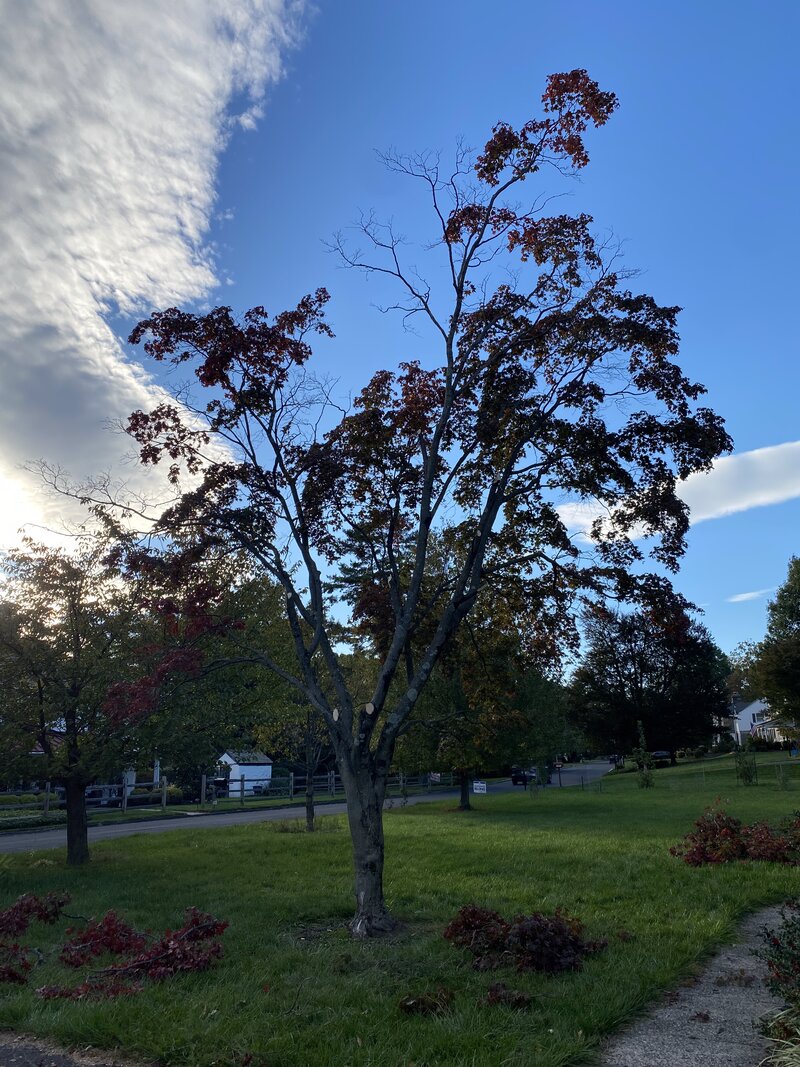
Then the day came and my father-in-law arrived at around 10 in the morning with his gear. I climbed up and tied the neighbor's heavy rope about halfway up and then FIL walked the other end into the yard and got into a tug-of-war stance. I pulled on the helmet he lent me and got to work. It's been literal decades since I cut down a tree, and it was as much fun, or perhaps more, than when I was running around the woods behind my house in my early teens chopping down dead trees with a hatchet to build forts. This time it was with a chainsaw. I had some trepidation when it wasn't beginning to fall when I thought it should, but another inch or so and it went exactly where I wanted it to. It was a great feeling of accomplishment.
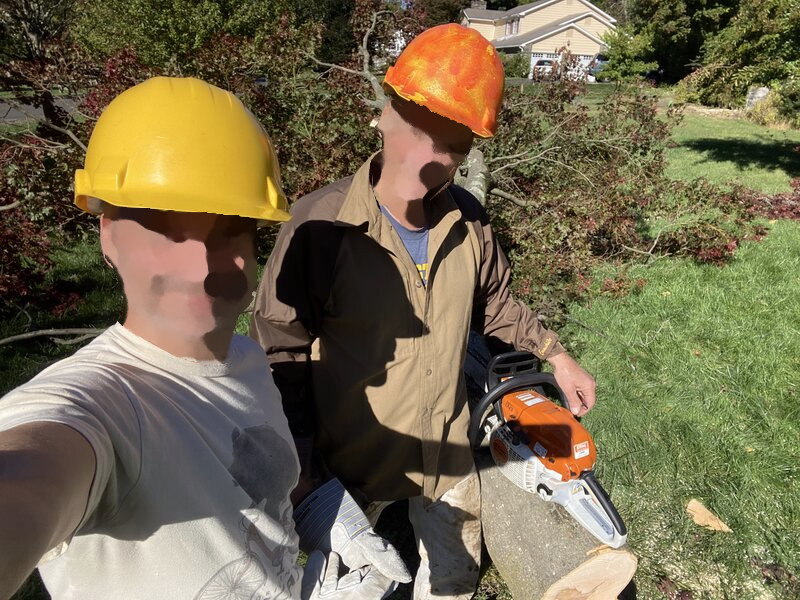
Once it was down, I found less rot in the wood around the base than I'd expected, but it was only going to get worse (result of landscapers volcano mulching it in the past) and plus it was a non-native that threw out tons of seedlings everywhere. Some of its wood went to the firewood pile and will be burned for probably the next two winters after this one. The rest went to turning a small brush pile I'd started into a large one. Oh, and a couple small limbs were cut into "walking sticks" for my daughter.
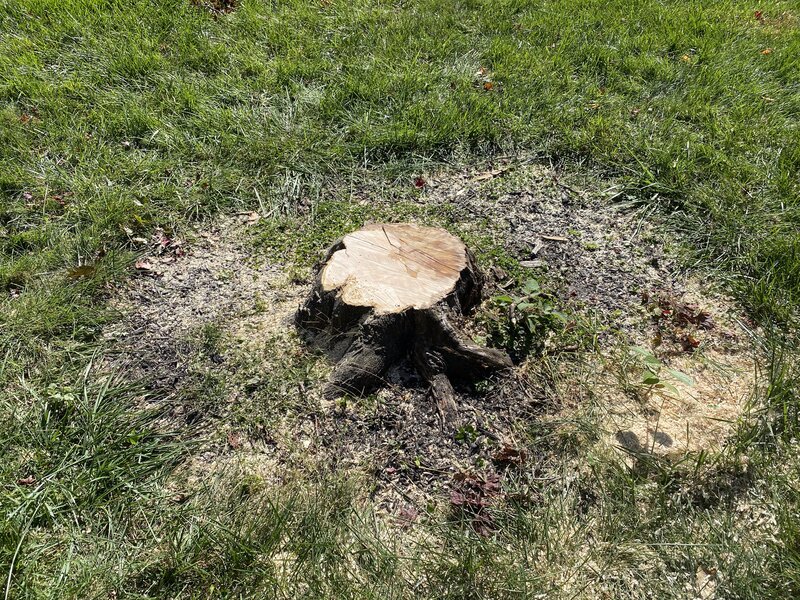
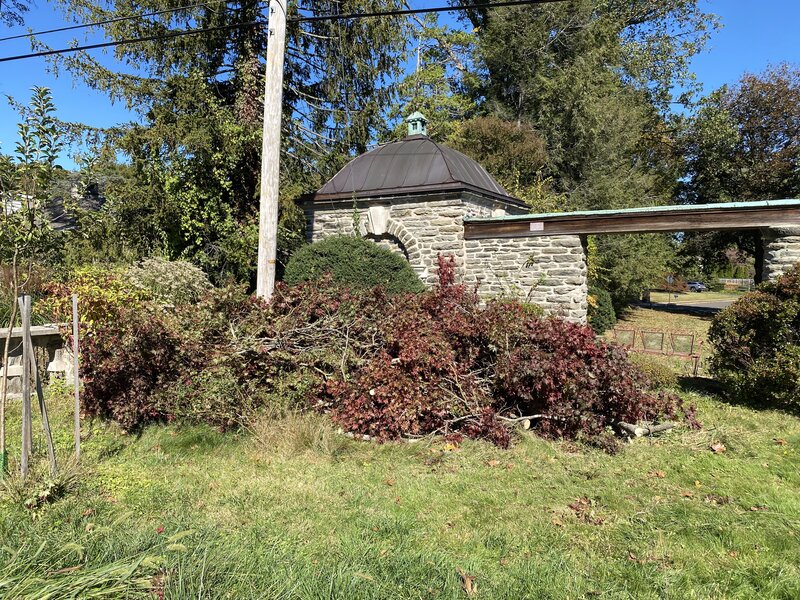
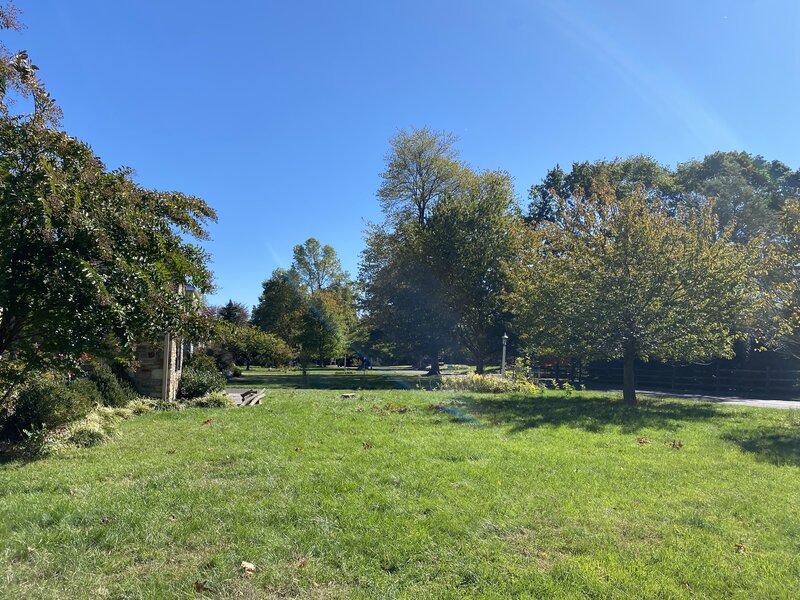
I transplanted two eastern redbuds that were growing in my vegetable garden to either side of its stump. I'm not sure the larger one (about 4 1/2 feet tall) will survive; it was much harder to get the roots out than I expected and I ended up cutting more off than I would have liked. I think the smaller one will do fine, as I was able to scoop out pretty much the entirety of its roots. I planted a bunch of redbud seeds I scavenged from various places, now sitting in pots in the vegetable garden, so if the larger one doesn't make it, hopefully I'll have another to take its place, and some more on top of that to plant elsewhere.
Garlic year three planted
October 10, 2025
garlic, planting log | permalink
This afternoon I planted 64 cloves from the biggest heads harvested mid-summer, timing it to coincide with the advice my mom was handed down to plant during the waning phase of the moon. There are still a few basil plants in the bed that I'm letting go to seed, but thankfully they all happened to not line up with the rows, so I think I got the garlic evenly spaced out. I planted a little shallower than last year, thinking that maybe the failure rate was higher this past year than the year before because I'd planted deeper. We'll see. Once they were in, I covered the bed with a thick layer of dried grass clippings. Weather-wise, it's been cool the last few days - nearly 60 during the day and mid 40s or low 50s at night. Mostly that way for the next week, though will be almost 70 tomorrow. Looks like a good chance of rain for a couple days in the week ahead, so that's good.
Wrens
October 9, 2025
wildlife, observations | permalink
The other day I saw a pair of what I thought were Carolina wrens on the terrace. But looking at the Sibley guide now, I'm leaning more toward house wrens, because of their slenderness and color (grayish/brownish on top and somewhat dull yellow on belly and sides). The Merlin bird app has suggested Carolina wrens a number of times from their calls, and I think I've seen them on the hillside in front of the terrace, but I think these were different. So maybe both are here. Or maybe the other ones I've seen are song sparrows, which are of a similar size and stoutness. I'm not good at identifying birds yet. Anyway, they were around and under the asters in front of the older peach tree. When I came up, they went to the large pokeweed.
Mountain laurel planted
October 3, 2025
shrubs, planting log | permalink
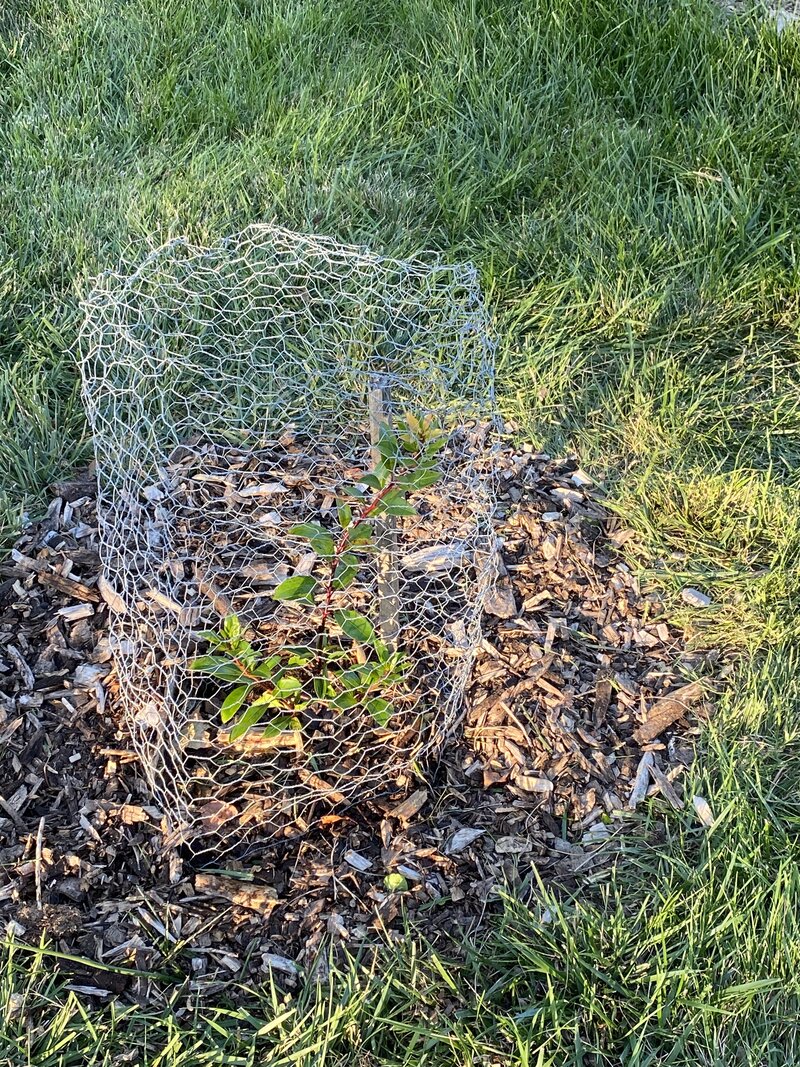
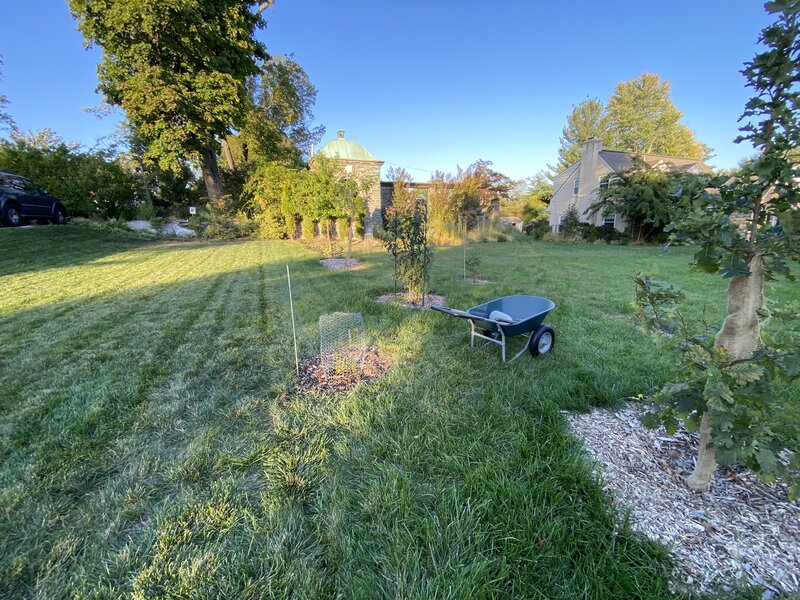
My excellent wife got me a gift card for Direct Native Plants earlier this year and I finally used it to buy a mountain laurel (Kalmia latifolia). The timing of its delivery worked out well: it hadn't been long after I finished preparing the site that it arrived and I put it in the ground. Looking forward to having Pennsylvania's state flower blocking part of the view to the road. Many more things will need to go in to fully block the view, but it's a start.
Groundhog in tunnel
October 3, 2025
wildlife, observations | permalink
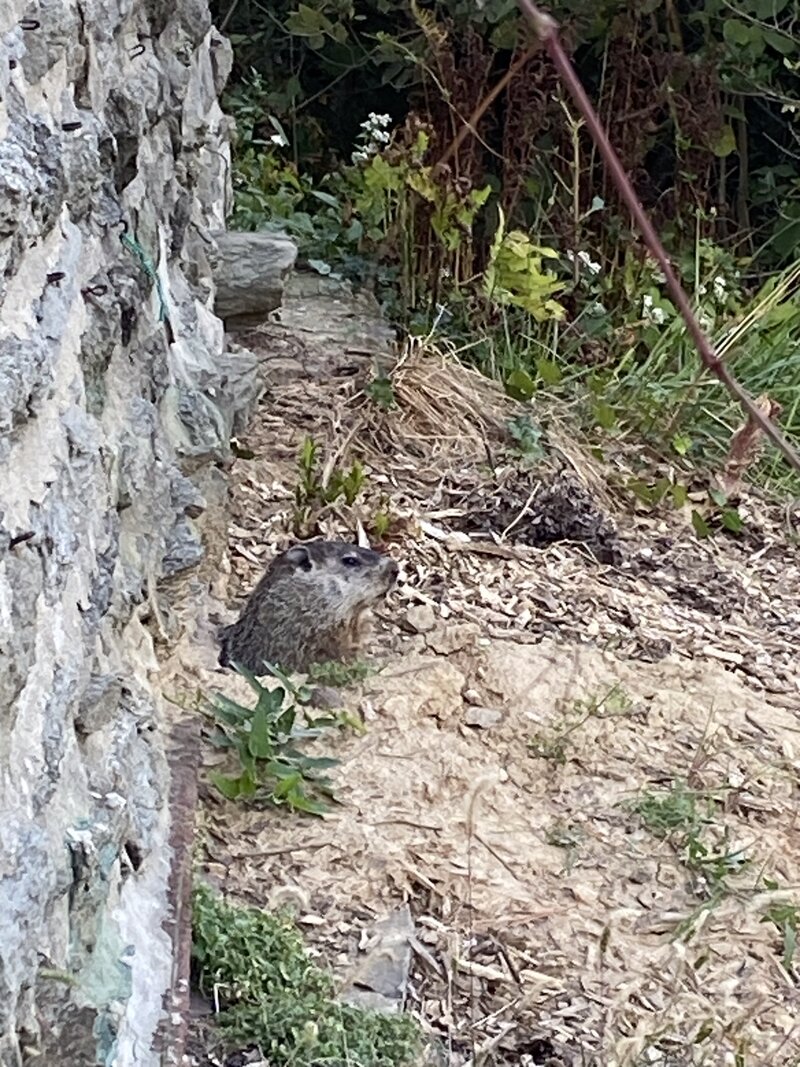
I was able to get close enough to take a decent picture of the groundhog. It had been on the other side of the wall, but when I started walking that way it went into the tunnel. I quietly stepped around the other side and got a few pics. As I was taking a video after this picture, I made a too-fast movement and it ducked back the other way. It's really an excellent placement for a little tunnel.
Summer 2025
September 29, 2025
trees, shrubs, herbaceous, vegetables, fruit, lepidoptera, seasonal review, planting log | permalink
On the tree front, I transplanted a few small saplings (4 or 5 inches tall at a maximum) from one place to another: I found a small eastern redbud (cercis canadensis) growing between two of my blueberry bushes, and moved it near the picnic table on the terrace, for eventual shade. I attempted to move a black walnut out of the yard and to the western treeline, but it did not survive. Similar thing with an oak, but on the other side of the driveway. But then I was successful, after being more careful with the roots and more frequent watering, with moving two other oaks out of the yard to the same place. I attempted to graft a few cuttings from the apple tree at my mom's house, whose apples I learned to juggle with. Neither survived. Did not help that it was not the correct season for it. I will try again either late this fall or early next spring. I identified, with the help of MH, three black walnuts. (I was worried they were the non-native alanthus altissima, "tree of heaven".) Two are good where they are, but the third is in the herb garden and so that will have to be moved once we get closer to winter. Removed the fencing on a couple, but then protected with burlap in mid September to protect from deer rubbing.
In shrubs, I found a great laurel (Rhododendron maximum) naturally root layering while visiting my mom, and I think it has successfully taken to my place on the western edge, although growth is slow. Of the 12 elderberries I planted in February, the range of success is pretty wide: of the nine that survived, one is about 4 feet tall (with a new shoot from the ground the same height), another is nearly 3', a couple are close to 2', and the rest are between 1 and 2'. The ones doing the best I had to put bigger cages around, twice. I'm starting to have fencing on hand when I need it, which is convenient and no further expense.
Perhaps the biggest effort of the season was at the herbaceous layer, namely removing the crabgrass that had taken over the four-foot-wide strip of mulch next to the road that I put in last year. That little patch - what I'm trying to make into a "roadside meadow" - has been a bit of a pain in the ass. First I heavily mulched it to kill the grass. A fair amount of weeding grass that survived was done a number of times. Twice I tried to start a holly hedge, and both times it failed. I spent a lot of time planting lupine and blue vervain seeds in it this spring, and mostly they were eaten by the deer. And then the fucking crabgrass. It took a good five or six hours worth of work to remove it all, and then an hour getting and spreading mulch, and then the occasional 15 minutes of weeding here and there to get what survived. After that, beginning in late August, I spent several mornings every week digging up and transplanting blue violets, and the occasional spotted spurge, from my vegetable garden. In all, it ended up being about 40 or 45 of them. I planted them right at the edge of the grass, every six inches or so, hoping they will help to keep it out. The spurge went further in, toward the road. I really like those two plants together. At times I found seed pods from the blue violets and tucked them into the mulch beyond the spurge. I also started a little patch of yellow wood sorrel on the other end, also dug up from my vegetable garden. A couple American plantains got transplanted on that side as well, and some of their seeds spread. Little bluestem seeds sown at the corner with the driveway, but no germination and probably wrong time of year (going to try again in spring).
In other places, non-native thistle was removed, native pokeweed was frustratingly removed by the spouse, grapevines removed from azaleas (I'm actually not sure of nativity of either of those, come to think of it, nor if the vines are really grapevines). Various things trimmed around the AC units. Bricks and rocks moved from one place to another. Got (self-)certified with National Wildlife Foundation, and put up a sign.
The herb and vegetable gardens were good, in addition to being a source of blue violets and yellow wood sorrel. Tons of tomatoes. Cherokee corn, but I need to learn how to harvest/cook it properly if I try it again. Damn groundhog ate the green beans a number of times, resulting in not many harvested. Peas got thrashed by deer, I think, just as they were beginning to first ripen (they ate the tops of the plants, not the pods, damaging the whole plant anyway). I gave up after the second time it happened and the plants didn't seem like they would recover. That was also a disheartening moment. Decent garlic harvest.
The backyard orchard: peaches grew, but I either waited too long to harvest or the trees are just too young (or some other reason that caused them to be dried up and molding when I checked on them in July). Of the seven apples on the apple trees I counted in May, there are three still left on the Arkansas black. Not sure what happened with the two other trees, but the one missing from the black is from me trying it way too early. Have since read up and discovered that it won't ripen until probably November and with perhaps three months of storage after that.
In addition to the black walnut (and redbud), I also identified:
- bittersweet/climbing nightshade (solanum ulcamara, not native)
- various asters (native)
- common dewberry (Rubus flagellaris), common copperleaf (Acalypha rhomboidea), and white vervain (Verbena urticifolia) (native)
- Virginia Pepperweed (lepidium virginicum, native), whose seeds I collected, spread, and stored (it's plain but still pretty, seems like a few more would be good)
- white clover throughout grass (trifolium repens, not native)
- monarchs, monarchs, monarchs
- definitely much more that maybe I'll add later
Finally, I read Attracting Birds, Butterflies, and Other Backyard Wildlife by David Mizejewski/The National Wildlife Federation (2nd ed., 2019).
What to call non-native plants
September 29, 2025
On a recent episode of the Native Plants, Healthy Planet podcast titled "The Return of Rebecca McMackin", there was a thoughtful discussion about using a different term than "invasive" for plants that are not native to an area. McMackin argued that, particularly given the current xenophobic and authoritarian turn the United States has taken, some people could view native-plant advocates' use of "invasive" as xenophobic itself. I'm a bit skeptical of that (it seemed purely anecdotal or even perhaps hearsay), but ok, I can see it. She also noted that the term blamed plants themselves, as if they were intentionally trying to "invade" places they were not native to, and that it erased the human (mostly horticultural) element of how they were introduced to an area. As an alternative, she said she favored "disruptive introduced" despite its clunkiness. I have to agree that it is clunky. Because of that, I don't imagine it will actually get much traction. But beyond being clunky, it also has its own problems: are there "introduced" plants that aren't "disruptive"? The answer is no, they are all disruptive, but the term would suggest otherwise.
So, as the title to this post suggests, I'd argue that we should just call them "non-native". It's easy to say, it's obvious what it means, the concern about some sort of American-first native plant movement is avoided, and it would be easy to go into further detail about why it matters if the particular conversation merits it.
Blue jays in lilac
September 22, 2025
wildlife, observations | permalink
Watching blue jays in front tree, wondering what they’re doing. I either don’t look out that way much or they aren’t there much. But I see: they seem to be grabbing lilac tree seeds, and then holding them against a limb and breaking with their bills. They're capable birds.
Asters blooming
September 19, 2025
herbaceous, observations | permalink
Most of the asters, mainly on the terrace though there are a couple elsewhere, are in bloom. Ten days ago I noted that one was about to bloom. I think it was two or three days later that it did, and in the meantime the others have started. I think there is at least one additional species I didn't notice before. It's in the cluster in front of the larger of the two peaches, the one planted two years ago, but haven't been able to identify it yet. Not a lot of bees on them yet. I remember feeling the buzzing around them last year. Maybe it was later in the year.
Asters
September 9, 2025
herbaceous, observations | permalink
I took a stroll around the terrace today and noticed that an aster was about to bloom, and then when I looked closer I realized there were actually two different kinds of asters growing right next to each other. One was shorter and more bush-like, while the other was taller and just had a few stems on its own. I used Inaturalist's Seek app to identify them, and it came up with small white aster (Symphyotrichum racemosum) and hairy white oldfield aster (Symphyotrichum pilosum). So that was cool - I only thought I had one type. But then, as I continued my stroll, I found one that had purplish leaves and stems. Seek identified it as a calico aster (Symphyotrichum lateriflorum). So not one, not two, but (at least) three types of asters since I let it go wild when we moved in three years ago. Seek has been wrong before, so I need work to verify those IDs, but it's at least a start.
Monarch caterpillars
August 23, 2025
wildlife, lepidoptera, observations, milkweed | permalink
I checked (though I can't say too thoroughly) the milkweeds on the patio and in front today and found four monarch caterpillars. Two chunky ones near the patio, this time on the butterfly milkweeds, which is interesting because previously there were 13 on the plants here but 12 were on the common milkweed and only one was on the butterfly. Out front I finally found some (and had once again earlier seen a Monarch butterfly on them, I assume to lay eggs): a small one and a medium one.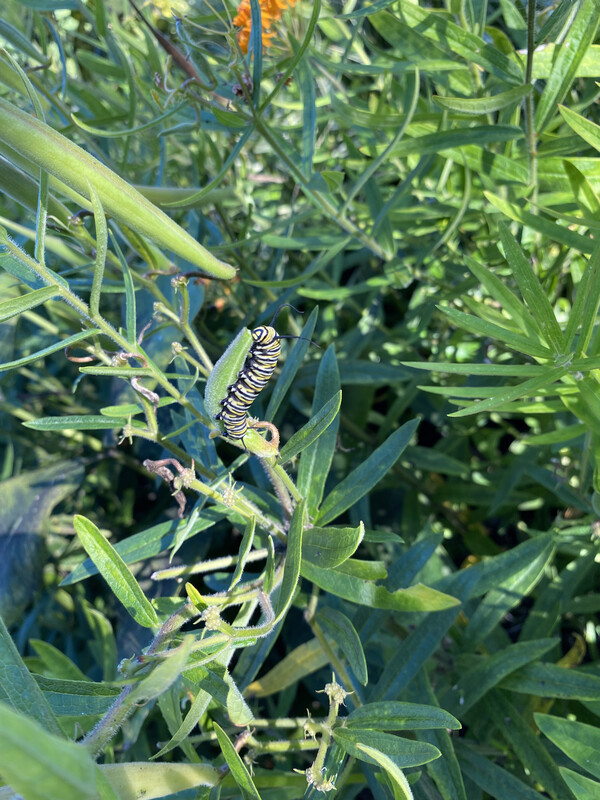
New natives
August 16, 2025
herbaceous, observations | permalink
I identified three new native plants in what I'm currently calling the southern woodland edge (a fancy name for the strip at the corner of the road and our driveway that I've reclaimed from grass): common dewberry (Rubus flagellaris), common copperleaf (Acalypha rhomboidea), and white vervain (Verbena urticifolia). I also realized that there was a potential that what I thought was American plantain (apparently pronounced "plan-tin", not "plan-tane", Plantago rugelii) was actually a different species, and so went looking for some information on how to properly identify it. I found a page from the website "Edible Wild Foods", which had an excellent video comparing it with a similar, but non-native, species, Plantago majora. Thankfully it appears I have the native one, or at least of those I looked carefully at.
A bunch of Monarch caterpillars
August 16, 2025
wildlife, lepidoptera, observations, milkweed | permalink
My daughter alerted me to a butterfly on our back patio and told me to come see it. It was a Monarch, flitting around the milkweeds planted there. I'd also seen it there not too long ago, when I thought it might be laying eggs. I don't know how soon Monarch eggs hatch, but decided to check the plants for any sign of caterpillars, and counted 13 of them, a bit smaller (I'd say between 1/4 and 3/4 of an inch long) than the first one I saw just over a week before. I haven't yet checked the front patch again, where there are many more plants, but so far I haven't found any out there.
Monarch caterpillar
August 7, 2025
wildlife, lepidoptera, observations, milkweed | permalink
I was just about to come inside for the night and I thought I'd check the milkweeds for signs of monarch caterpillars. First I saw what looked like some leaf munching, and then I found the culprit (or one of them at least). Very happy to see the work to get some colonies of milkweed started has begun to pay off. And looks like I was right a couple weeks ago when I thought a butterfly I saw was a monarch.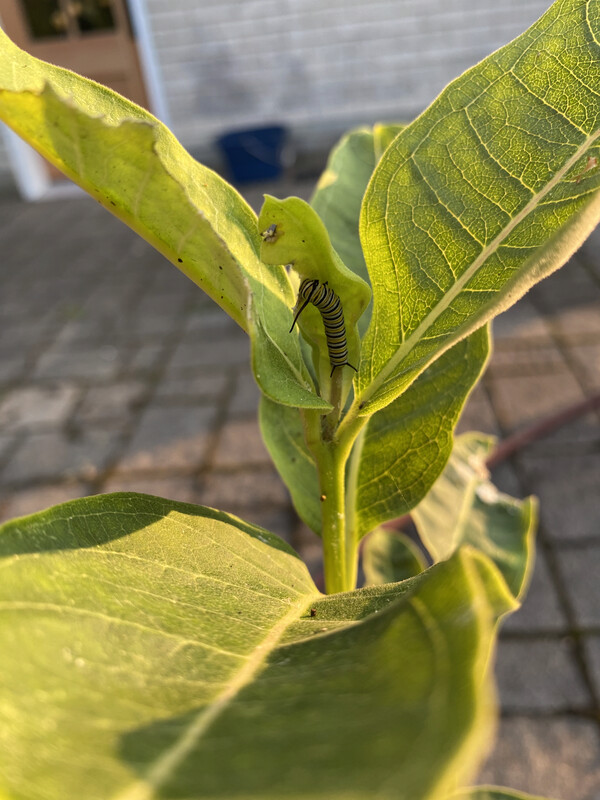
Reaching peak tomato
August 4, 2025
vegetables, tomatoes, observations | permalink
Seems like today is the start of having a good amount of tomatoes every day for the rest of the growing season. It won't be long before we've reached our capacity to eat them and will need to give some away. Maybe two weeks? I may also make an extra batch or two of marina sauce to freeze.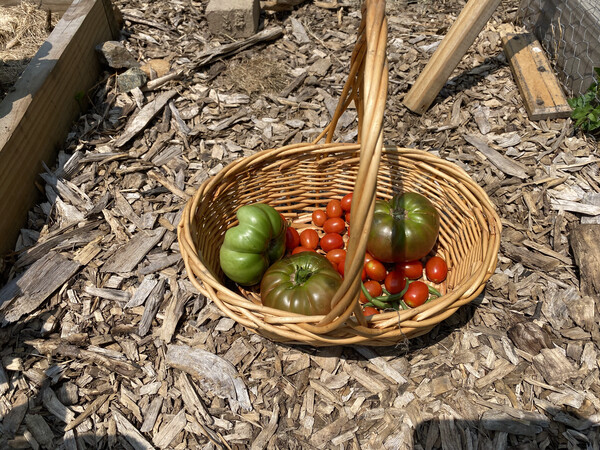
Peaches dried up or moldy
July 26, 2025
trees, fruit, observations | permalink
All of the peaches left (about 10 on the tree planted in 2024 on the terrace) were dried up/moldy. I'd been waiting to see if they'd get any bigger - they were only about an inch and a half in diameter. They were supposed to ripen in mid August, but that's based on Ithaca, NY and so maybe it's mid July here. It could just also be the fact that it's only a two-year-old tree. I wasn't even expecting to get any peaches this year. Though I'm still disappointed I missed the chance to try one.
Possible monarch butterfly
July 26, 2025
wildlife, observations, lepidoptera, milkweed | permalink
One of the things I wrote down to do today was to go out and look for Monarch caterpillars, since I've seen a few people on the fediverse post pictures of them recently. Well, no caterpillars, but I'm about 90% sure I saw a butterfly around the milkweeds in the front yard. There's a slim chance that it was the eastern tiger swallowtail I saw yesterday, but I don't think so: this one seemed more orange than yellow and its behavior was definitely different. I couldn't get within five feet of it to take a picture - it would just flit away, sometimes pretty high in the air, and the circle back around. Hopefully it laid some eggs!
Eastern tiger swallowtail
July 25, 2025
wildlife, observations | permalink
This is the third summer I've been at my house, and I think the first time I've spotted a non-white butterfly. Maybe I'm paying attention more, maybe wildlife finds the place more welcoming now. Either way, happy to see an eastern tiger swallowtail.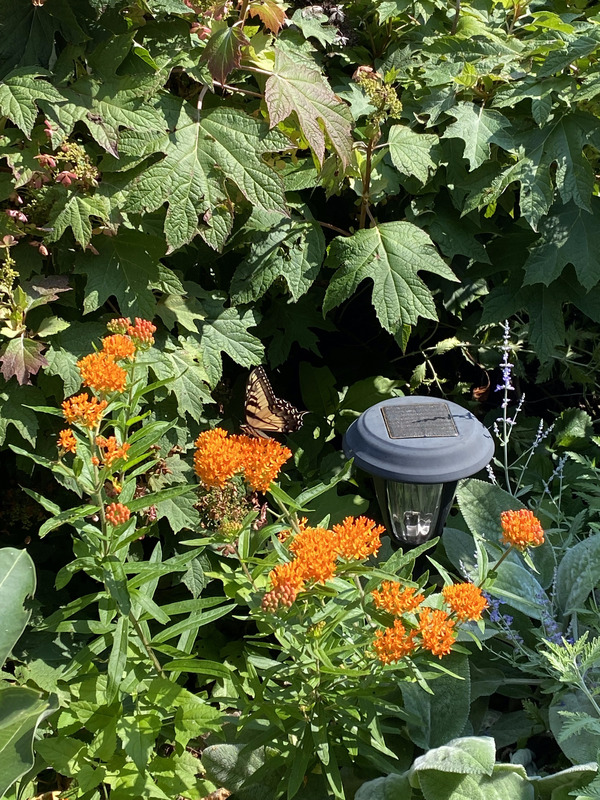
Garlic Season Two Complete
July 23, 2025
vegetables, garlic | permalink
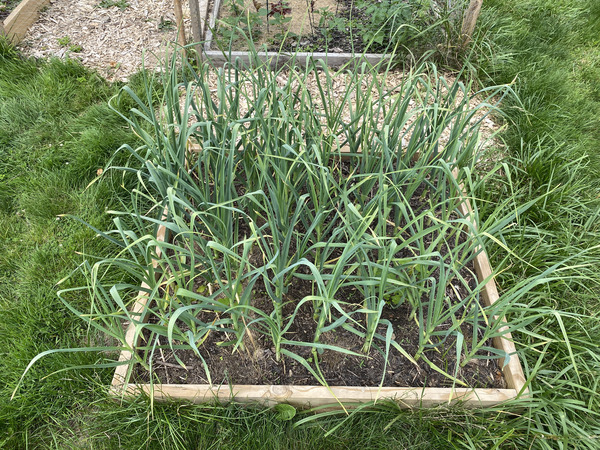
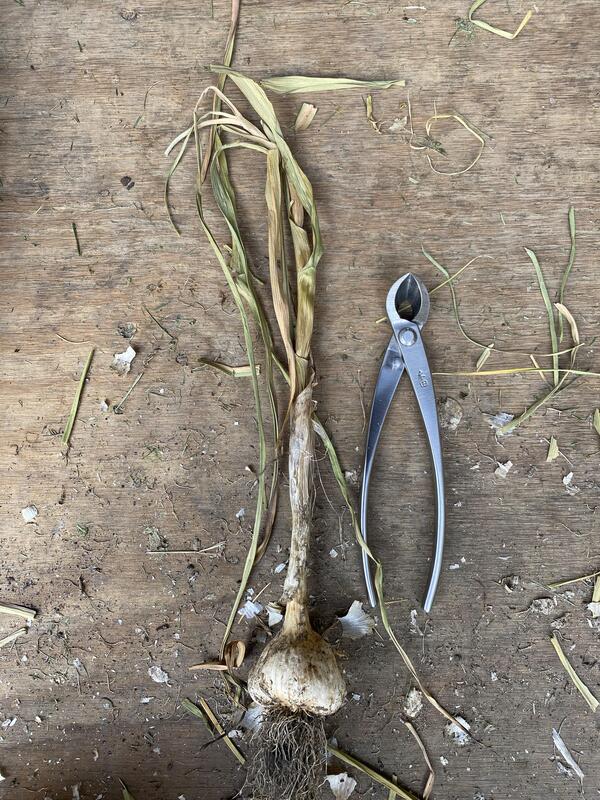
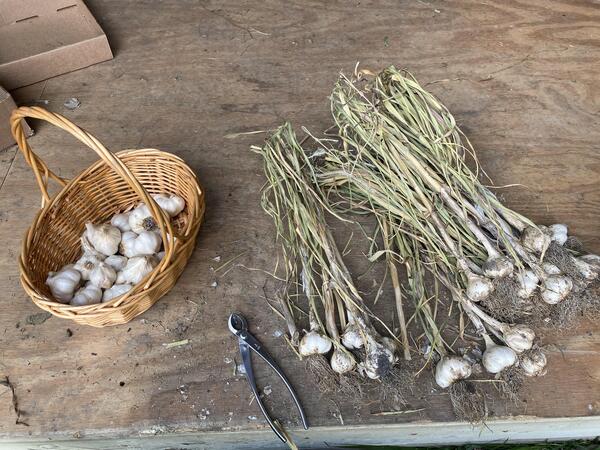
Garlic season two began with the planting of 64 cloves, saved from garlic season one. Late last year or early this year I noticed a couple had not come up, and then there were several in the past month that had wilted and I found to have rotted at the stem. That prompted me to harvest them about 10 days earlier (July 5) than I'd planned to (mid July).
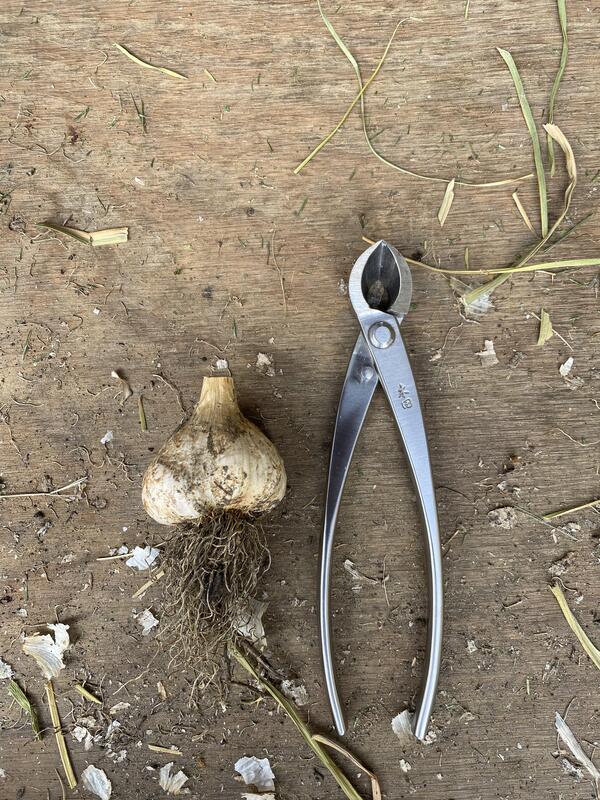
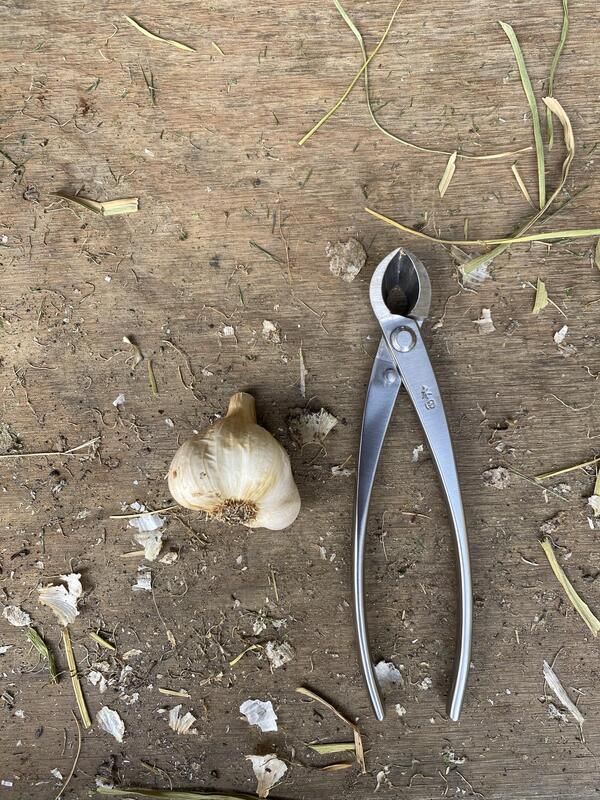
Out of 64 planted, I ended up with fewer than expected - 50. That's a decent number and more than last year's 35 or so, but that's a 20% failure rate, double the previous year. I think the ones I lost in late spring and early summer were due to it being much wetter this year than last, but I'm not really sure. I did water them in mid spring when it hadn't rained for while, and I didn't do that last year. At the same time, I think the garlic that did survive has, on average, bigger cloves than last year. Maybe I'll do some reading to improve how I do things next year.
After harvesting the ones that did survive, I tied them together with twine in groups of five, and then hung them over the garden for a couple days. After that, I moved them to the shed, where I placed some hooks in the rafters and then hung them between. They dried there for 16 days, which seems to have been an adequate amount of time.
Eight of the largest heads will be saved for planting the next crop in October, leaving 42. This year I'm going to try to remember to keep track of how long they last us, with an eye towards eventually planting enough to last all year. Though I may have to research how to store them that long.





Sunrise
July 23, 2025
Sunrise these days is around 5:50. Some days I'm waiting for it, due to waking up earlier than I really would like. Other days I'm up not too much later anyway. This is the most I've ever been interested in what time the sunrise is. It's a peaceful time of day, until the car drivers start speeding by on the road. But mainly, there are things to do. Eventually I want to relax more in the garden, or at least do less, but I feel that more effort put in now will pay off later.
Goldfinch
July 15, 2025
wildlife, observations | permalink
Caught a glimpse of a goldfinch flitting from the hillside to the front of the neighbor's house. For as bright as they are, this is only the second time this year I've seen one.
June beetles
July 7, 2025
wildlife, observations | permalink
I saw two common green June beetles (native) on the terrace today, and identified the white butterflies as small whites (unfortunately non-native).
Lightning bugs
June 28, 2025
wildlife, observations | permalink
Saw lightning bugs somewhere near the middle of the month if not earlier. Still going, more now.
New growth on asters
June 27, 2025
herbaceous, observations | permalink
New growth on asters is up about a foot, in some places more. I thought (probably mistakenly) that last year there had been new growth on the woody stalks from the previous year, but not seeing any now.
Spring 2025
June 22, 2025
trees, vegetables, fruit, wildlife, herbaceous, shrubs, seasonal review | permalink
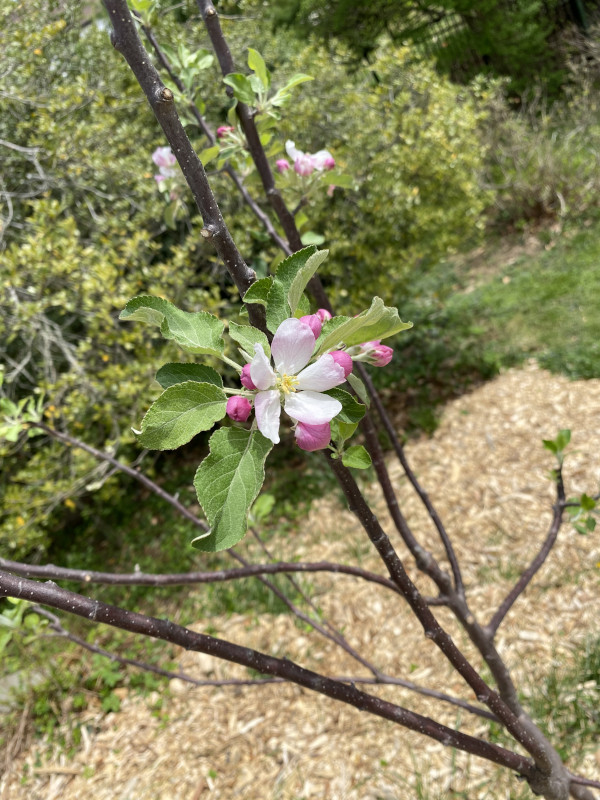
It felt like spring was a lot of effort and not too much to show for it. On the other hand, this work of taking a sterile lawn doused in chemicals to something that actually contributes to and supports the local ecosystem does not happen overnight. I think I need to be more mindful of that, especially at moments of setbacks, of which there were several this season.
I'm going to try something a bit different for this reflection of the past season and go by layer. So let's start from the top: one shade tree went in, a black cherry (prunus serotina). It is at the corner of our property, several feet back from the road. After oaks, it is one of the best trees to plant to support a wide range of wildlife.1
I also planted a few understory trees: an American hophornbeam (ostrya virginiana) and two American hazelnuts (corylus americana).
The black cherry and the hophornbeam came from the township's Shade Commission, while the hazelnuts came from MH.
There was also some work on existing trees: at the end of April, I cut about three feet off the American hornbeam I planted last spring, so now it's about two feet tall. Last year, it dropped nearly all of its leaves during the summer, but then regrew some of them towards fall. I didn't have high hopes that it was going to make it, but then the bottom of it leafed out. Aside from being much shorter, it now looks as healthy as it was when I planted it. I think it probably gets too much sun, so hopefully the black cherry in front of it puts on a few feet in the next couple years to give it a bit of shade. I also extended the fencing on the pear tree and apple tree I put in last season, after removing the top I'd placed on them as a temporary measure. The fencing is now six feet tall rather than four, and so is sufficient for deer protection. I'm not sure how many more trees I'll be putting in, but I'm going to find and use six-foot fencing going forward so I don't have to do that again. Live and learn.
I identified the tree - now about five feet tall - growing in the vegetable garden. It's a northern capalta (catalpa speciosa), which is great luck because I wanted to get one of them. I have not yet decided whether I'm going to do the work to transplant it or just let it go and garden around it. On the one hand, moving it will be a decent amount of work (and it might not survive) and perhaps it could act as a good pole for a pumpkin to climb? On the other, it will probably shade too much of the garden. I'm torn. But I can't be torn for too long, because late fall/early winter will be the best time to move it if I'm going to.
I also have a tentative identification of another tree, which somehow has survived unprotected to about four feet tall in the mulched area in the backyard. It may be an ash - I need to look more closely at it.
So that's the good news on trees. Unfortunately, though, the oak I transplanted last fall did not survive - or at least not as a eight-foot-tall tree. The only sign of life was one shoot coming from its base, which was eaten by some animal within a couple days. I'm reluctant to cut it down, mainly because of how much work it was putting it in but also because I still want to believe it will come back. But I will probably do so between now and next spring. I would like an oak in that spot, so in the meantime I'll probably dig up one of the little saplings I frequently find in the lawn and put it there, under some protection.
The second attempt at a holly hedge failed. I'm going to continue trying, but on a much smaller scale. I'm going to take a cutting or two from one of the existing hollies and see if I can get them to root in water. I think I'm also going to have to protect them from wildlife - while some simply didn't root, others were eaten.
A few shrubs went in: another northern spicebush (lindera benzoin) and two red osier dogwoods (cornus sericea). I put the spicebush between the other two I'd planted in May 2023. I did not cage this one, mainly because it's rather large and probably needed to be pruned after the transplant anyway. I'll watch how much it gets eaten (so far fairly minimal) and then perhaps just cage all three of them together if necessary. I think I need to get one more in that area, opposite the others, to make it too thick for the deer to reach the middle so they'll do better. I did cage the dogwoods. Fucking deer.
I ordered and planted four bearberries (Arctostaphylos uva-ursi), which are doing well. I also tried to propagate several more by root and stem cuttings, but only one may have been successful. It seemed like it was alive the last time I checked.
I spent a lot of time preparing various native seeds for planting outside and then planting either them or the resulting seedlings. None of them developed into full plants, if they grew at all. I knew that would be the case for the milkweeds and blue wild indigo (baptisa australis), but I thought I'd get some decent-looking sundial lupines (lupinus perennis) or literally anything else (black-eyed susans, columbines, purple love grass, little bluestem, buttonbush, blue vervain), but nothing is taller than four inches, except maybe the butterfly milkweeds. I haven't seen a sign of the black-eyed susans, purple love grass (eragrostis spectabilis), little bluestem (schizachyrium scoparium), buttonbush (cephalanthus occidentalis), or blue vervain (verbena hastata). I'm hoping some are just putting down roots and will come up next year. Even if not, I suppose it's ok. I have double that number of species that I'm going to plant in the fall. Seeds are relatively inexpensive (and sometimes free); I'm going to load the ground with them every spring and fall, with the occasional season off to give myself a break.
Removing lawn continued, but at a slower pace than I would have liked. Aside from areas where trees went in, it amounted to maybe 20 square feet.
In the vegetable garden, now nearly double the size it was last year, most things that I planted came up. The things that didn't: about half the corn, most of the Detroit Bull's Blood beets, and none of the handful of cucumbers. Those only accounted for a very small amount of the space, though, and I moved other things that were too thick into their spaces. So everything else came up and grew well, until deer (I assume) got into the raised bed and destroyed the 130 pea plants that were over four feet tall. I was able to save maybe a quart of peas. I'd wanted to keep saving them to replant year after year, but will have to buy some next spring now. Something has also been getting in and eating the green bean leaves. I'm not sure if that's also deer (maybe a rabbit?), but soon I'm going to extend the fencing from four feet to six feet tall. If the green beans are still being eaten, I guess I'll have to put in better protection at the ground level.
I was doing more weeding (mostly grass of one sort or another) than I wanted to, in both the vegetable garden and in the areas where I've removed grass and mulched/planted other things. It's frustrating because one of the reasons I'm trying to remove the lawn is to lower the amount of maintenance needed. And things I've planted are either growing extremely slow or being eaten by deer, allowing room for weeds. It's doubly frustrating because some of it is coming from my compost. I'm hoping that by next year, after another round of native seed planting in the fall, the good things will begin to out-compete the bad things. In the vegetable garden, I think it's now mostly under control from grass clippings I put down, which will have the added benefit of keeping soil more cool and more moist during the hot summer months that are now upon us.
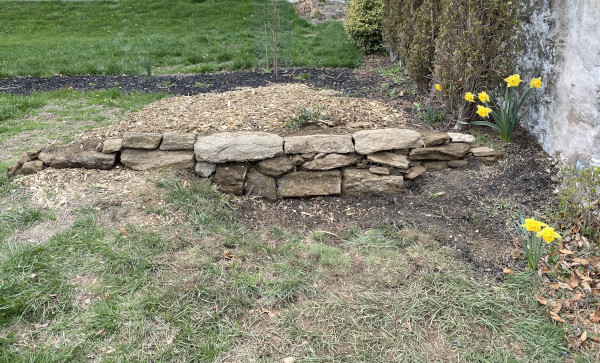
One thing that I did that I had not planned on doing was creating a small rock wall on the western edge of property. I was originally just digging out some rocks so I could plant one of the bearberries, and got carried away, digging up giant rock after giant rock with the help of a neighbor's pry-bar he calls "the persuader". It certainly persuaded the rocks out of the ground much easier than any tool I have. I like how it turned out, and that makes a clear distinction between the grass and the mulched/wildflower area. (Eventually I also intend to start removing the lawn on this side of it, but that's probably at least several years off.)
Other tasks completed:
- fill small sinkhole next to driveway with mulch
- identify groundcover with yellow flowers in space between us and neighbors (lesser celandine)
- empty rotating compost barrel
- transplant blue violets from hillside with grass to new rock wall and hillside with apples
- transplant some of the pussytoes - I don't want to lose them when I eventually get around to removing grass on hillside below flowering dogwood
- plant white hyacinths from MH&DW
- plant sunflowers from MH
- weed and spread woodchips around chestnuts, oak, and maple
- do soil test in vegetable garden
- sharpen mower blades
- Read Chris Baines's How to Make a Wildlife Garden
1. According to Doug Tallamy. I saw this once before but the most recent place was on the May 15, 2021 episode of the Native Plant Podcast.
Hawks
June 19, 2025
wildlife, observations | permalink
I saw two of the hawks, which I think are bald eagles, flying pretty high up around 1:30pm.
Hummingbird
June 13, 2025
wildlife, observations | permalink
Just saw a hummingbird while sitting on the patio. It checked out the red handle on the rain barrel drain, then a couple flowers, and flew off. Iridescent green on its back, bright red around its neck.
Oak-leaf hydrangeas
June 11, 2025
shrubs, observations | permalink
Oak-leaf hydrangeas are in full bloom.
Peonies done blooming
June 6, 2025
herbaceous, observations | permalink
Peonies are done blooming.
Bald eagle
June 2, 2025
wildlife, observations | permalink
Bald eagle flying overhead (1:30 pm).
Bald eagle
June 1, 2025
wildlife, observations | permalink
Bald eagle flying overhead (11:22 am).
Lilac tree blooming
June 1, 2025
trees, observations | permalink
The lilac tree out front is in full bloom; hadn't noticed it until now.
Goldfinches
June 1, 2025
wildlife, observations | permalink
Spotted goldfinches for the first time this year - two flying from AM's backyard heading through our front yard.
Peach count
May 31, 2025
fruit, trees, observations | permalink
Counted the peaches on the peach trees: 30 on the one on the terrace, 13 on the one in the backyard (and none on the newest, naturally).
Apple count
May 23, 2025
fruit, trees, observations | permalink
I went around and counted how many apples have started: 1 on the Crimson Crisp, none on the Honeycrisp, 2 on the Winecrisp, and 4 on the Black Arkansas. (And obviously none on the Sundance, just planted a couple months ago.)
Fox and minivan
May 8, 2025
wildlife, observations | permalink
I saw the fox for the first time in a while, at least in our yard. A week or so ago, I saw it, or one of its family [side note: I need to learn how to identify male and female foxes so I can stop calling them "it"] a few blocks towards town running in our direction. Tonight, as I was doing dishes, I saw it slowly trotting along the edge of our driveway toward the road. I moved to the front window to watch it. It spotted me, but didn't really seem to care. It then continued a few feet, but stopped to investigate something in the grass. Then I saw a minivan driving very slowly on the road, which then came to full stop about ten or fifteen feet before our driveway. It was very nice, and unfortunately unusual, to see. So kudos to that person for both paying attention and also stopping. But the fox did not trust it: rather than continue on its path across the road in front of the minivan, it cut through the neighbor's yard and then crossed about ten feet behind it. The minivan then also continued on. I wish more animal-driver interactions were like this.
Milkweed propagation
May 3, 2025
milkweed, herbaceous | permalink
During evenings from February 27 to March 7, I planted, among other things, 45 common milkweed seeds - that I'd saved in the fall and then cold stratified (some moist and some dry) in the fridge for a couple months - in pots in my basement. Just one came up about three weeks later. But I left all the pots where they were for a while and kept watering them. Then I mostly gave up and reused the soil for other things, except for one pot, which I moved up to the living room and put in a windowsill there. That was probably three weeks ago. And I kept watering it every few days, though I figured it was a lost cause. Wouldn't you know it, though? One came up. So 2 out of 45, given the conditions I put them in. I'm assuming it was temperature related. If I try this again next year, I'll try them in a warmer spot, probably in late March or early April. At the same time, they spread well on their own, so maybe I'll just dig up some new ones that come up if I want to give them away.
Oaks
April 24, 2025
trees, observations | permalink
The red (or black) oak in front of the gazebo, that MH and I transplanted on March 12, 2023, and is now about 8 or 9 feet tall, began to leaf out. Makes me slightly worried for the third one that I planted, in October of last year, since it's not showing any sign of life yet. But this first one also took a little while to come to life that first year after being moved, so we'll see.
Deer
April 21, 2025
wildlife, observations | permalink
I just watched a doe and what I assume is her kid from last year walk through the front yard, about 6:15 in the morning. The mother was in front by about 20 feet, and heading the opposite way than they do at night - from east to west. The yearling nibbled on the new spice bush and then spent some time reaching up to eat some of the non-native cherry blossoms. Then they crossed the road at their usual spot to go back to wherever exactly it is that they spend their day (I assume).
Crows
April 21, 2025
wildlife, observations | permalink
I just saw two pairs of crows flying overhead while I was in the backyard. Mainly of note because I thought there was only one pair regularly around here, because I only ever saw one at a time before.
Lesser celandine vs blue violet
April 20, 2025
Here's a couple of leaves from low-growing plants in my yard that look similar. The one on the left is slightly smaller, smoother, silkier, and has more shallow veins than the one on the right. The plant the left leaf belongs to has a small daisy-like yellow flower. I believe it's lesser celandine (Ficaria verna). The flower for the one on the right is purple. It's some kind of violet, and until I saw the many different kinds listed at the Native Plant Trust while writing this and looking for a link, I thought it was common blue violet (Viola sororia, which they call woolly blue violet). That might be right, but I need to take a closer look, especially at the flower, to be sure. Lesser celandine is invasive, while the violet is native.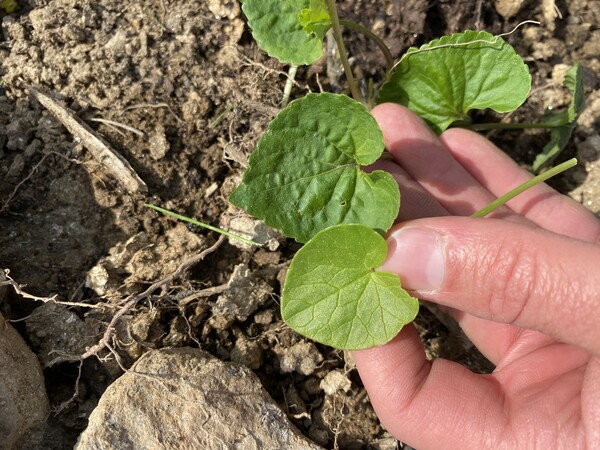
Tomato starts
April 15, 2025
vegetables, observations, tomatoes | permalink
All the grape tomatoes planted from seeds (from last year's volunteer) on March 12 now have first true leaves. Two of the four heirloom tomatoes planted from seeds (from tomato bought from grocery store) on March 31 do as well; not sure the other two are going to survive. One of the five grape tomatoes (again, from last year's volunteer) started on March 19 has a true leaf, none yet on other 4.
Tomato starts
April 7, 2025
tomatoes, vegetables, observations | permalink
First (tiny) true leaves on a couple tomato seedlings have started.
Dogwood
April 6, 2025
trees, observations | permalink
Dogwood is starting to break bud.
Groundhog
March 25, 2025
wildlife, observations | permalink
I spotted the groundhog for the first time this year, as I went to plant some beet seeds in the new raised bed. It was surprisingly fast - took a flying leap from the direction of the last blueberry, over the pile of rocks to behind the compost bins, and was gone when I checked just 30 seconds later. I assume through the hole at the bottom of the rock wall it dug rather than into the brush pile. I'm not sure if that hole is just a tunnel to the hillside or if there's also a borrow within it, but no sign of it in the yard.
Winter 2024/25
March 21, 2025
For being winter, I was quite busy with gardening and the yard. More so than I had really originally intended. I kept finding more things to do! I'm quite happy with how much progress was made.
The "farm" is coming along nicely. I put the furring strips on the back half of the existing large raised bed, so that I can hang strings from them that peas can grow up. I also built a third raised bed, and then redid the fencing so that it goes around the two large ones, with a door now opening at the center and a walkway between the two. I do not plan on further expanding the vegetable growing area anytime soon, but I could add a third raised bed in front of the one I just put in (opposite the garlic bed) if I do want to expand it in the future.
In early February I planted the 12 elderberry cuttings from River Hills Harvest. Eventually they should provide a decent amount of food for wildlife, in addition to making the yard look more interesting. Planting took little time; what took longer was making the small cages for them.
I started a new wildlife habitat area at the back of the terrace. That didn't amount to a lot of time spent, but it was fun/hard to carry the large logs up the steps (otherwise I used the wheelbarrow from the shed to the steps, and then again from the top of the steps to the back of the terrace).
I did a lot with herbaceous perennial seeds - packed them up for cold (dry and moist) stratification in the fridge. Then at the end of February/beginning of March, I spent an hour or so each night for a week planting them in pots in the basement and putting them under grow lights. At first I thought it was a giant failure, but then after three weeks the first butterfly milkweed seedlings started to come up. Since then a couple of common milkweeds have emerged and there is also a decent amount of beebalm. I also planted a bunch of seeds outside during the last two weeks before spring.
Got a load of woodchips from ChipDrop and spread them on the hillside with the apples. Also mulched all of the fruit trees, the blueberries, and a 4-foot wide section on the terrace along the rock wall from the gazebo to the raspberries. Some in other places like what appears to be a small sinkhole next to the driveway and on top of the part of old cement foundation sticking out of the ground by the bald cypress. Still have 3-4 yards of it left probably.
Finally, the other big project was expanding the mini orchard. Three new trees - an apple, a peach, and a pear (from Cummins Nursery in Ithaca, NY) - went in, all on the terrace, packed into the unmowed middle section. I could maybe fit another small one in there but I'm not going to - I think that's it for the fruit trees for a while, maybe for good. We'll see how these ones do over the next few years. It makes nine total - five apples, three peaches, and one pear - and six on the terrace.
Other tasks completed:
- read Tallamy's Nature's Best Hope
- watch this video on no-dig
- (re)cage apple trees on terrace
- organize notes on herbaceous plants; go through pictures I took when I planted the bulbs this fall and note what I planted where
- read "Roll Back Your Turf"
- cage top of hickories
- cage spice bush in front
- Read Kate Bradbury's One Garden Against the World
- clean up and organize shed
- define areas of yard/garden to consistently measure light and moisture at
- Read Uri Lorimer and Native Plant Trust's Northeast Native Plant Primer
- transplant asters out of new raised bed
- transplant pokeweed that's in front of compost
- prune rose bushes
- prune apple trees
- weed grass that has survived mulch in new front hedge
Milkweed propagation
March 16, 2025
herbaceous, milkweed, observations | permalink
Three butterfly milkweeds have sprouted, each from a separate pot, but all from the ones planted on Feb 27 or 28. Three beebalms have also come up.
Flower seeds started
March 5, 2025
herbaceous, milkweed | permalink
Over the past week, I started a bunch of flower seeds. Roughly:
- 45 common milkweed (from my yard)
- 45 butterfly milkweed (from my yard)
- 7 swamp milkweed (from local nature center seed library)
- 66 bee balm (from my mom)
- 130 columbine (from my mom)
- 40 obedient plant (from my mom)
- 20 daisy (from my yard)
- 80 blue-eyed grass (from local nature center seed library)
- 13 swamp rose mallow (from local nature center seed library)
- 8 unknown (from a seed pod I'd snagged while traveling in central PA; curious to identify it)
That's 450 seeds in all! For most of them, I only used half of what I have, and I'm going to directly sow the remaining ones outside in the next few weeks. (Except for the common and butterfuly milkweeds - I probably have 1000 of those.)
All except the bee balm were cold stratified in the fridge for two months, which I think is cutting it close. The columbine I did only dry, but all the rest were half dry and half moist. For the moist stratification, I used unbleached coffee filters (which held up very well). I'd first moisten a filter on a plate with a thin layer of water on it, hold it up to let the excess water drip off, and then put it on another plate before adding seeds and wrapping it up to about the size of a half a roll of pennies. Then the filter went into a ziplock bag, labelled, and finally when they were all done, they went into a small plastic container. Similar thing for the dry stratification, just minus the coffee filters. Both containers then went into the back of the fridge, where I patiently waited for them to do their thing. And now I'm waiting for them to do their next thing.
Soon I'll need to figure out where I'm going to start the vegetable seeds, because there's not a hell of a lot of space left under grow lights. I'm hoping I can move the flowers to windowsills once they start to come up to make way for the veggies.
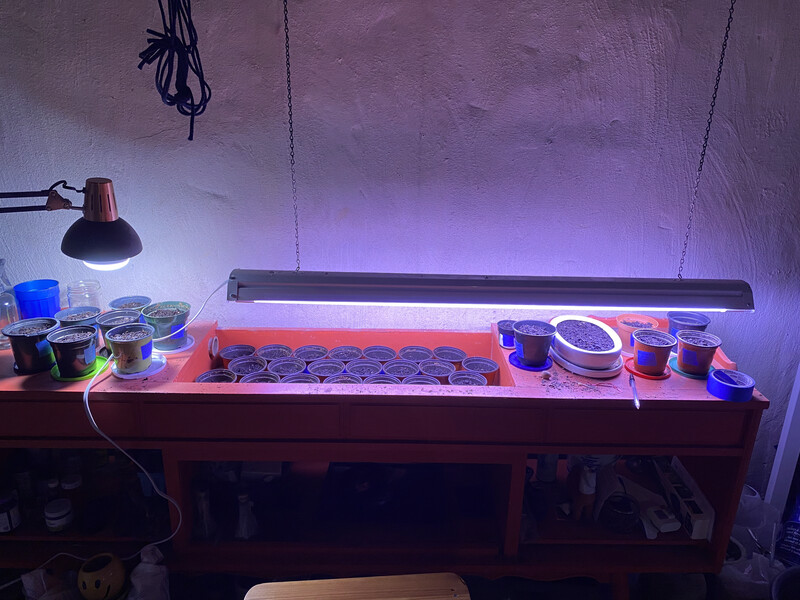
Third raised bed built
February 9, 2025
Nearly two years after I built the first large raised bed and five months since I built the small one for garlic, I've added a third raised bed, just a bit smaller than the first one (4 feet x 10 feet, rather than 5 feet x 10 feet). Five feet is just a bit too wide to be able to comfortably reach into the middle from the sides; I think four feet will be better.
It was just as easy to build as the first one: buy three boards, cut one in two, screw them together. This time, though, I built it on the floor of the shed (one end hanging out the open doors), rather than in-place, so it would be easier to square the boards up. So I then had to carry/slide the finished frame from the shed through the yard and up the hill to the terrace. I wouldn't have been able to do it myself had it been much bigger, but it ended up being easier than I thought, thankfully.
It's about half-filled with decomposing wood chips that I got late in the fall, a bucketful of deer poop, and some ashes from the fireplace. Sometime in the next few weeks I'll top if off with compost and soil, and then work on extending the fencing from the other raised bed to encompass both of them. Before I do that, though, I'll move the asters that are growing in the middle of it.
Now that I have three raised beds and two compost bins, I think I'm going to start referring to it as my farm, tiny as it is.
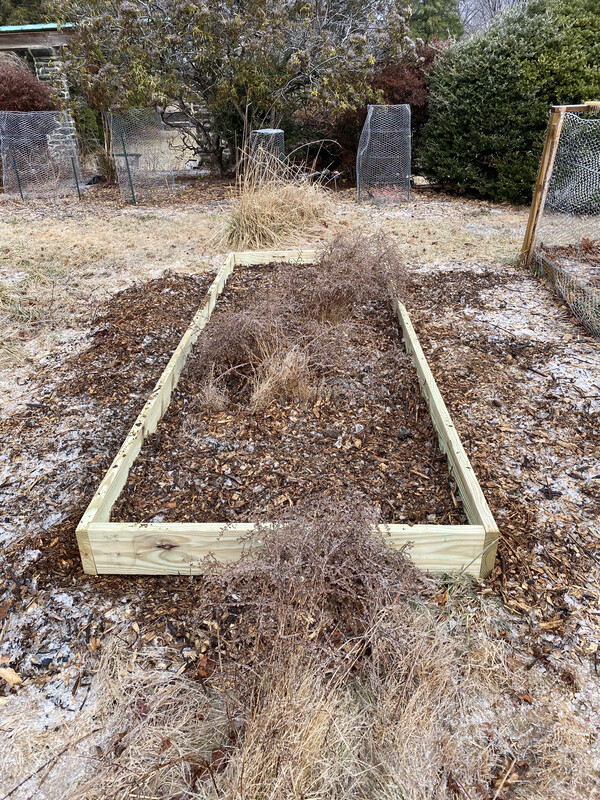

Elderberry cuttings planted
February 2, 2025
In September, I ordered a dozen hardwood American elderberry cuttings from River Hills Harvest, based out of Missouri. I was inspired to do so after listening to an episode (817) of The Urban Farm Podcast, interviewing John Moody about a book he wrote about elderberries. The ones I bought are the Adams 2 variety of sambucus canadensis, which RHH describes as "Early ripening with very large clusters of purplish/black berries. Sweeter than most elderberries and somewhat self-fruitful. One of the oldest cultivars from New York." They go on to say they are indeterminate, can grow between 8 and 10 feet tall, and have excellent yields. (Hurray for the birds and whatever other wildlife will get them!)
At the end of January I got a notice that they had shipped and a couple days later they were on my doorstep. They were about eight inches long, between 3/8" and 1/2" in diameter, and had two pairs of buds four or five inches apart. The top cut is straight across, and the bottom is angled. They recommend putting the bottom pair of nodes two to three inches beneath the soil. Full planting instructions can be found on this page of their site.
Over the course of four hours, I desodded grass, dug up rocks in the way, planted the cuttings, mulched them, and then finally surrounded each one with chicken wire to protect them from deer. Looking forward to see how they do!
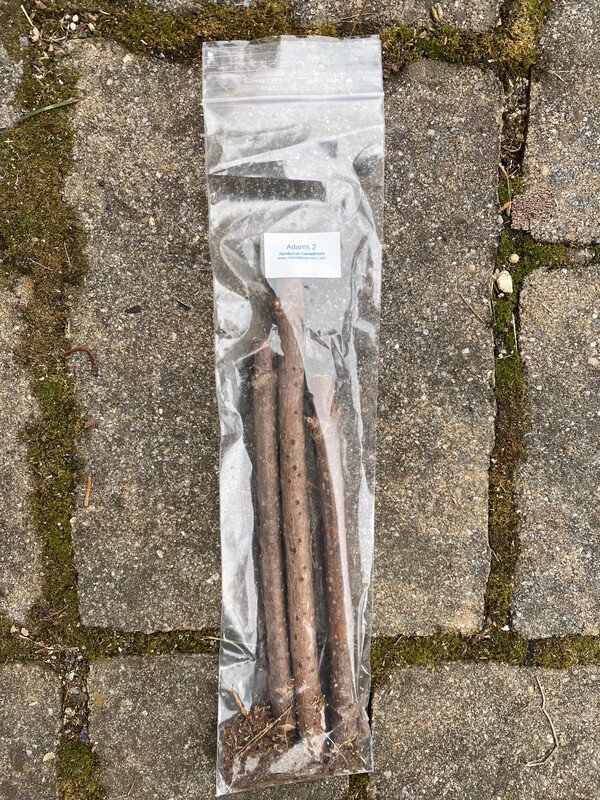
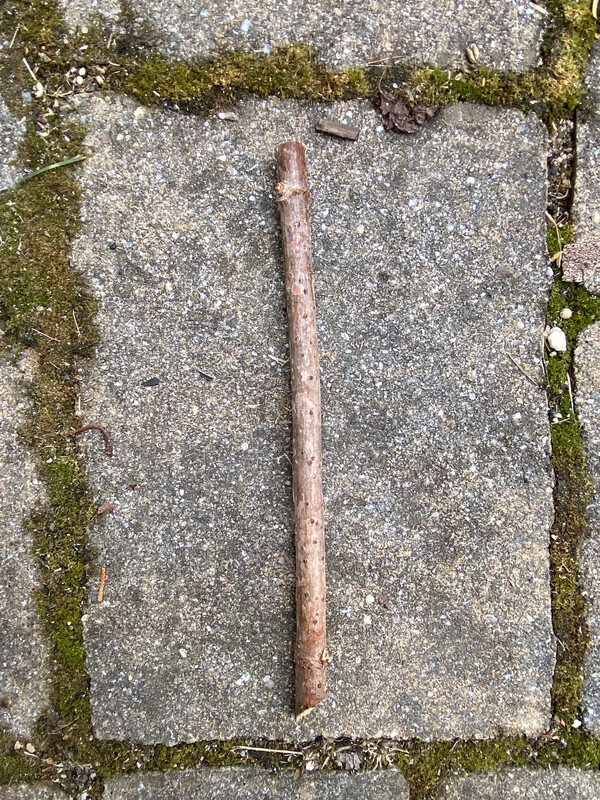
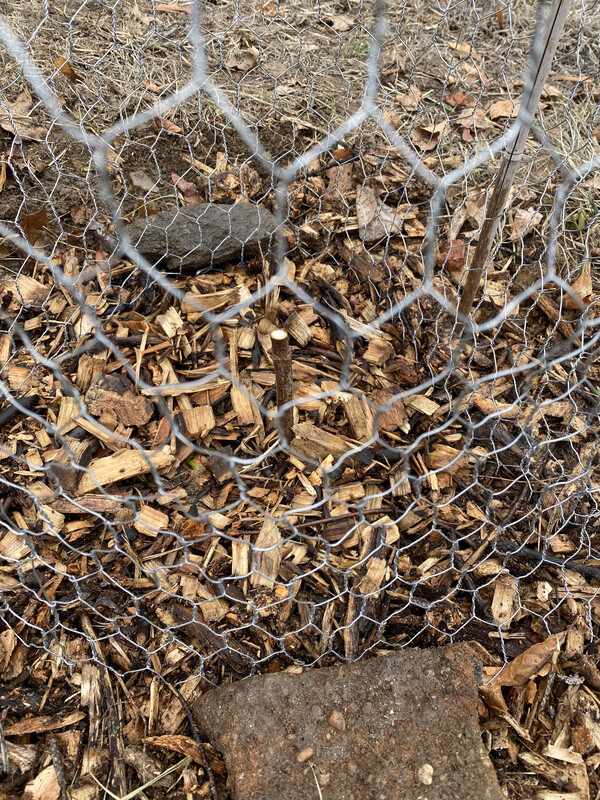
Puttering
January 29, 2025
"Puttering" to me means walking around your garden and/or yard, often with some kind of beverage in hand - maybe coffee in the morning, maybe beer in the afternoon - and doing the occasional work you hadn't necessarily planned to do but figured why the hell not. This at least is the definition that was handed down to me by my parents. I recently learned that it's "pottering" in the UK, and I'm kind of surprised it took me this long to hear the UK-English version of the word.
So I puttered for a bit around the yard today, between the end of work and nearly sundown. It was very relaxing and I think needed. First it was dumping the compost and filling the birdfeeder, dropping an ear of corn for deer. Then I noticed just how much deer poop (and some rabbit, I think) was around and so I grabbed a shovel and slid the little pellets onto it, dumping them into a bucket I was carrying around, and then dumped that on the spot where I'll be building a second raised bed for vegetables this spring. Grabbed a package that was delivered off the front porch. Then decided to get a start on making small cages for the elderberry cuttings that I'll be planting soon. I think I already have nine that will work, at least for the first year, so just three more to go. I had a portion of chickenwire left over from other caging needs, and so cut out three pieces, got two of them twisted up into little columns.
Then it was getting a bit dark, so I left the last one and the tops to do another time. The motion-detector light was on in the side yard, but I didn't see any deer out as I went inside. They either spotted me and left, or it was just set off by the holly being blown around by the gusts of wind. Or a fox did a quick round looking for something to eat.
Tree-planting advice
January 28, 2025
I think I'll add additional tips later, but for now I wanted to note this passage from Doug Tallamy's book Nature's Best Hope: A New Approach to Conservation That Starts in Your Yard (Timber Press, 2020, pp. 195-7):
Life is not risk-free, but treefalls are something we can and should manage. The obvious solution most people offer is to plant all trees with the potential to become large far from the house or driveway. This works if you own lots of land, but it's not an option on small properties. Not planting large trees also deprives your house of the cooling that shade from trees provides in the summer and the windbreak trees provide during winter.
Fortunately, there is another solution to this vexing problem and it comes from the way trees grow in nature. Trees evolved to grow together in a forest. They intertwine their roots, forming a root matrix that is nearly impossible to uproot. Forest trees with interlocked roots may snap off in big winds, but they typically don't uproot. Because aesthetics have trumped function for so long, we have planted large, isolated specimen trees ready to blow over nearly everywhere. If we change our goal from creating majestic specimen trees to picturesque groves of trees, the interlocking effect of root matrices will be strongest. [...] if we planted our trees in groups of three or more on ten-foot centers, the resulting root matrix would keep them locked in place thick and thin. None of the trees would develop into a single majestic specimen tree, but together they would form a single grove of trees that the eye will take in just as if they were one large tree. Planting tree groves will also protect against the domino effect. Every time we take down a tree, we are making the remaining trees more vulnerable to straight-line winds. There is one catch to this approach, however: the trees must be planted young, so their roots can interlock as they grow. Transplanting five-inch caliper trees that are twenty feet tall for instant gratification is a poor way to achieve interlocking roots with any strength.
Joined Homegrown National Park
January 11, 2025
Not much else to say about it, really. I've only just joined and put myself on the map. It would be great if the vision in the book were put into practice. Whether or not that is being done by whatever effort is being put into it with this website is a question I have. So far it seems a little fancy up front but superficial.
Fall 2024
December 21, 2024
It was a pretty productive fall. I started another holly hedge in front, mulched it. Planted two trees from the shade commission, a pagoda dogwood and a white fringe tree, along with another oak and another chestnut. I also transplanted a tulip tree that had come up in the vegetable garden to the other side of the picnic table. Planted various bulbs I bought from the local garden center. Planted some seeds I got from a local seed exchange. Ordered more fruit trees. Ordered elderberries. Made a separate bed for the garlic and planted it. Tried out winter sowing potatoes in the vegetable garden - will check how they've done in spring. Got free wood chips from an arborist working next door, spread as foundation for next raised bed and around blueberries. Attempted two more grey owl juniper propagations. Harvested, dried, stored some seeds. Picked up two rain barrels from a neighbor giving them away.
Tasks completed:
- get bulbs and sedum, plant (2024-09-21)
- create small raised bed for garlic (2024-09-22)
- watch the tree/fruit production webinar
- order peach, pear, and apple (but shorter one) (2024-10-04)
- plant garlic (2024-10-05)
- transplant the other oak from MHDW (2024-10-11)
- winter sow (more) potatoes (2024-10-13)
- plant bulbs (2024-10-13)
- transplant the small tulip tree in the garden to other side of picnic table, protect it (2024-10-14)
- take holly cuttings and try to create hedge (again) (2024-10-18)
- spread compost (2024-10-19)
- get trees from Shade Commission (2024-10-26)
- spread mulch - along road around hollies (2024-10-26)
- plant white fringe tree from Shade Commission (2024-10-27)
- plant pagoda dogwood tree from Shade Commission (2024-11-02)
- try to propagate grey owl junipers again (2024-11-02)
- put chicken wire over garlic bed (2024-11-05)
- plant blue false indigo (baptisia australis) in front of hollies (2024-11-06)
- collect, dry, and store tomato, carrot, and marjoram seeds (2024-11-16)
- plant Mary Frances iris (2024-11-27)
- get two rain barrels (2024-12-04)
- return fabric pots to Shade Commission (2024-12-06)
- spread wood chips - base of new raised bed, around blueberries (2024-12-07)
- plant second chestnut from MH (2024-12-10)
Herb garden in 2023 and 2024
December 14, 2024
I was planning on writing this post about 2024 only, but it turns out I didn't write anything about 2023 yet, so I'm going to cover both years. It took a bit of digging through old photos and unfortunately I only found a couple for 2023. Many more for this year though. Next year I'll try to be a bit more organized to make a year-end review a bit easier.
2023In spring 2023, I desodded a small bit of the lawn next to our back patio for the herb garden. I planted the back quarter of it with basil, marjoram (a subspecies of oregano), thyme, and rosemary. All but the basil I bought from a local garden center. The basil was just from buying fresh at the store and then rooting. I kept adding more basil for a couple months, so it was a bit fuller by mid-summer.
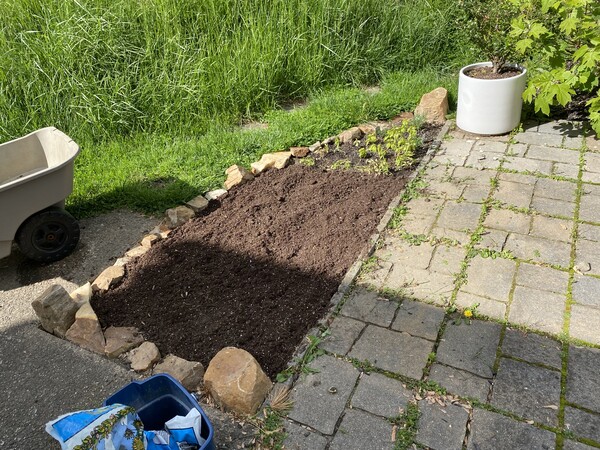
In July, I had harvested and dried some thyme, basil, and rosemary. I also did so again in October, and this time was also able to get some marjoram:
This year, I planted the whole space. In all, it's somewhere around 15 square feet.
The rosemary, marjoram, and thyme that I'd planted last year all survived the winter and spread a little. The rosemary probably grew the most - taller and bushier with a little bit of pruning. The marjoram probably tripled the ground it covered and then in mid-June sent a lot of stalks up into the air, most of which I allowed to flower and go to seed. I wish thyme was faster growing than it is - next to basil that's probably the herb I used the most, at least among those I grow. So I split it and planted half of it at the front corner. I'll probably split it again next year so there's more of it. I harvested and dried all three of those. I now have more rosemary than I know what to do with, a bit of marjoram, and, sadly, no more thyme.
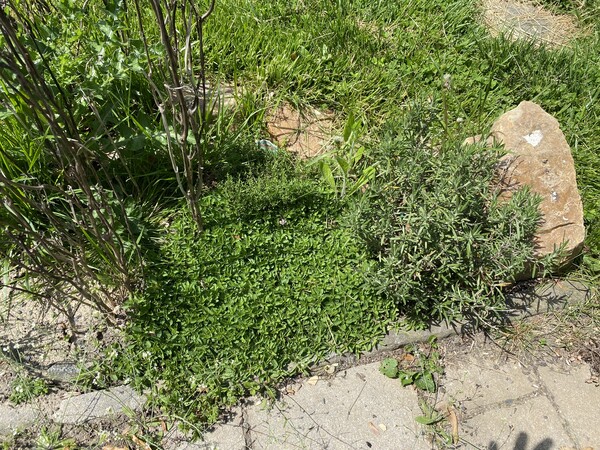
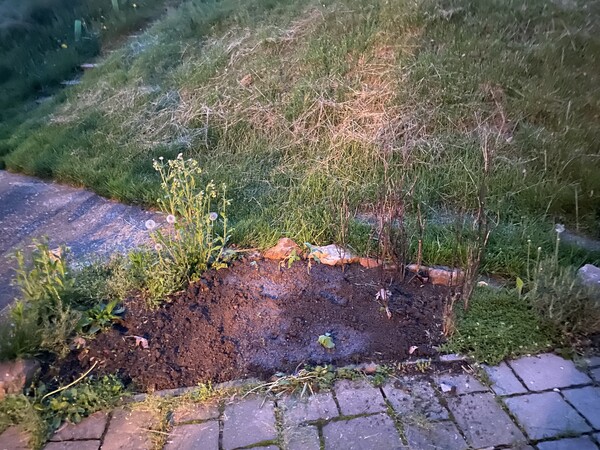
Parsley, cilantro, and lavender were new additions this year. I also attempted to plant some sunflowers on the edges of it, but, though they ignored them for a while, the deer eventually ate them. I also threw in a cucumber among the basil, because I had grown it from a seed but didn't have space for it in the vegetable garden at the time. After a couple things didn't survive in the vegetable garden, I moved it there.
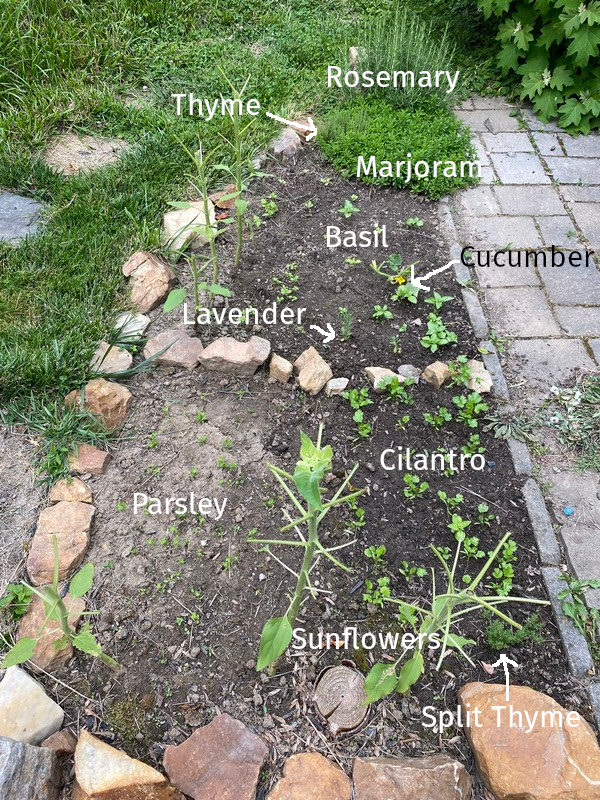
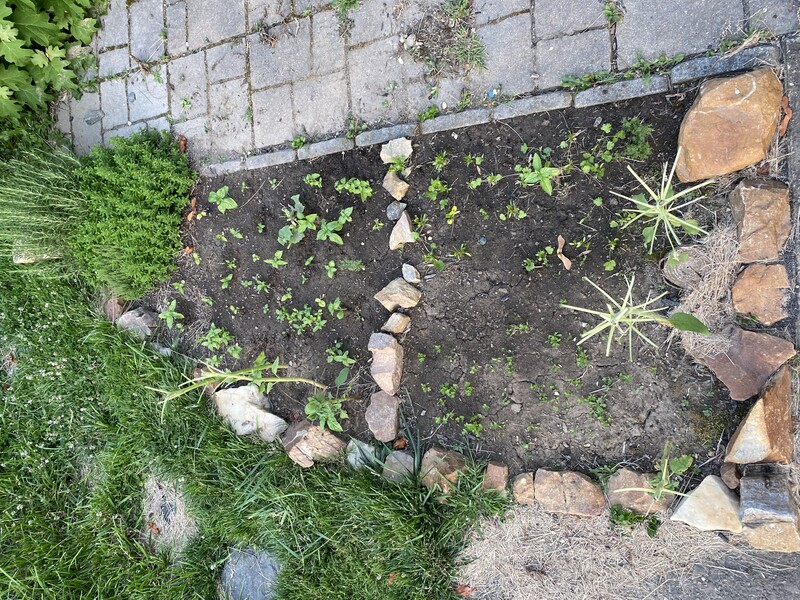
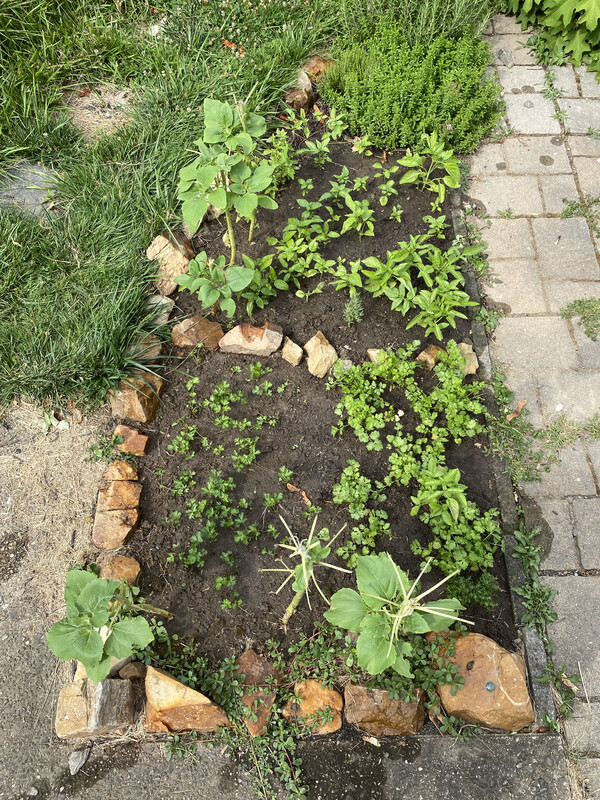
The basil, Italian Genovese grown from seed, was the great success of the year. I aggressively pruned the plants and by the end they were nice and bushy and about 20 inches tall. Anytime I needed fresh basil it was available. I gave some to my neighbor. I also dried a bunch and made two batches of pesto. The second batch was big, and in addition to the couple of meals it provided a sauce for at the time, I think there's probably enough in the freezer for three or four more. I'm looking forward to seeing how well it has fared. About a month ago it got hit by frost. Half of the 15 or so plants turned completely brown, while the rest lost most of their leaves but stayed green for another week or so. Just before spring I'll cut them off at their base and chop them up into the compost.
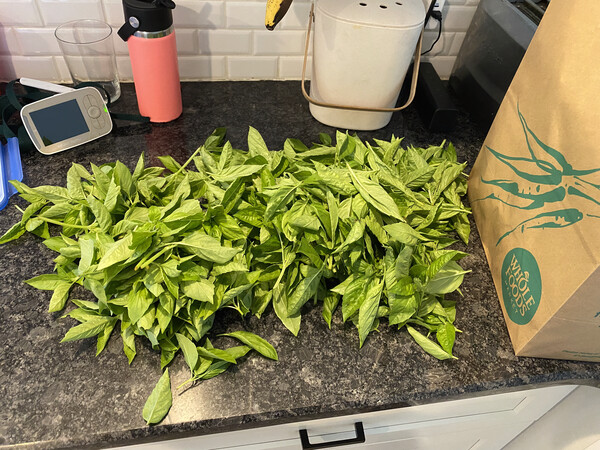
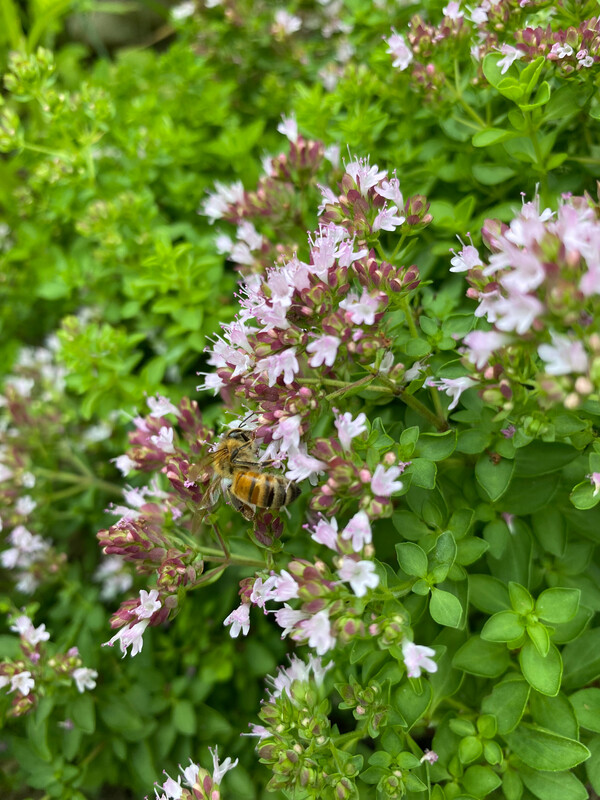
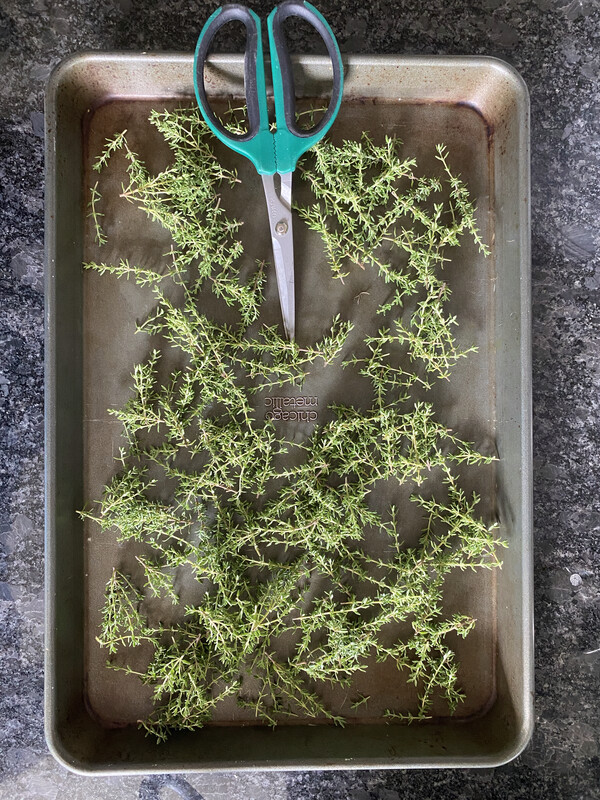
The cilantro was the first thing to go, long before frost. Although I got a few handfuls from it, it didn't do that well. But I let a few go to seed, which I'll use for next year.
Surprisingly, the parsley is still alive and doing well. It did not start off well - something was eating it when it first started coming up, but then let it go. With how delicate the leaves are, I figured it would have been the first thing to succumb to frost, but despite several periods of below freezing temperatures for multiple days, it's still there. Which reminds me - I should grab some before it's gone. Like the cilantro, I got a few handfuls from it over the summer and fall.
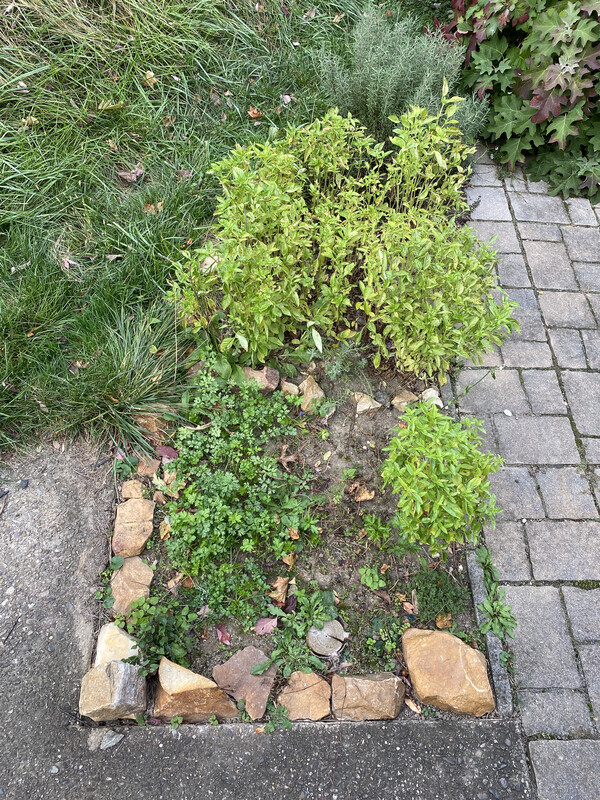
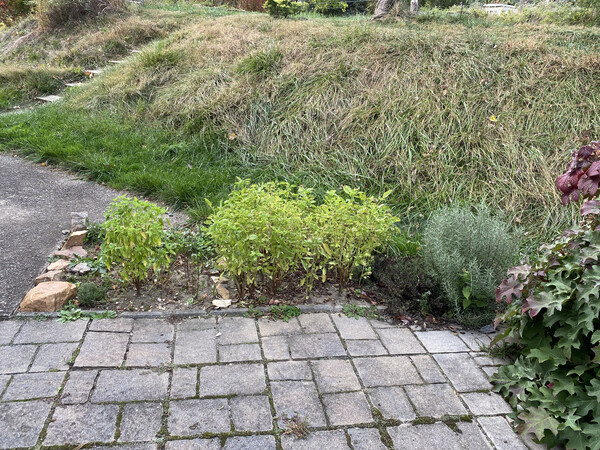
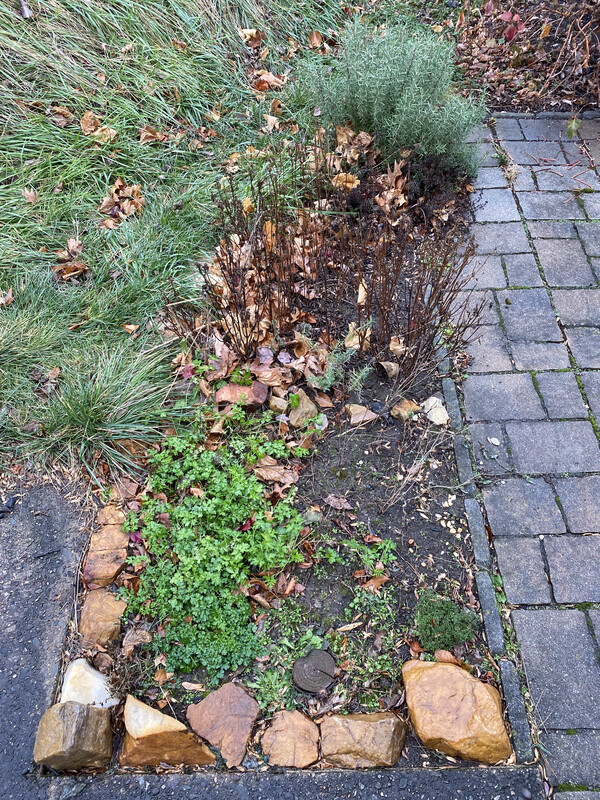
Second Chestnut Planted
December 10, 2024
I planted the second chestnut given to me by MH, to go along with the first one planted two years ago, in December 2022. Just as the first one, this one is also from the American Chestnut Foundation - their "Improved American Chestnut Seeds with Intermediate Blight Resistance" stock. These are the only ones they offer east of the Mississippi, due to the chestnut blight. From the ACF's website:
These hybrid seeds have some level of Chinese chestnut ancestry to confer blight resistance. They will tolerate blight infection more effectively than an American chestnut, but not as well as a Chinese chestnut. In general, blight will grow rapidly on an American chestnut, more slowly on these hybrids, and do minimal damage to a Chinese chestnut. At this time there is no 100% blight-resistant American chestnut seed or seedling and there is no guarantee that any seed will grow free from blight. Scientific efforts toward this goal are part of TACF’s mission.
Mine's ID is W8-23-18XOP. I briefly tried to figure out what the numbers mean with no luck, though I assume the "23" is for the year it was started, since the previous one I planted in 2022 had "20" in that position.
It's on the front line between the maple that was already here and the American hornbeam I planted earlier in the year, and diagonal to the first chestnut, maybe 20 feet away.
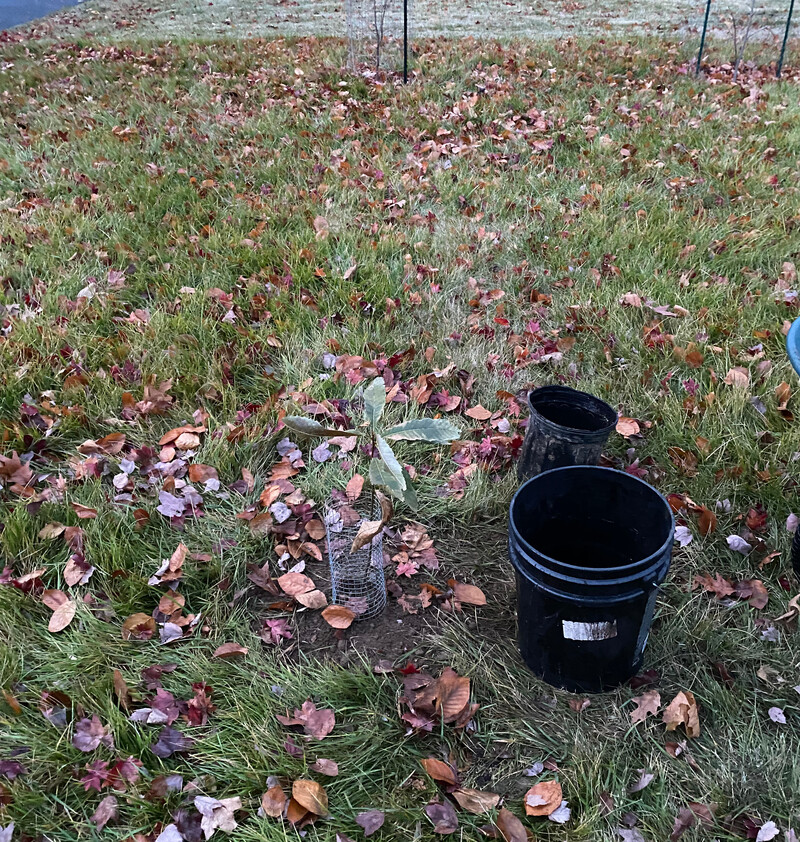
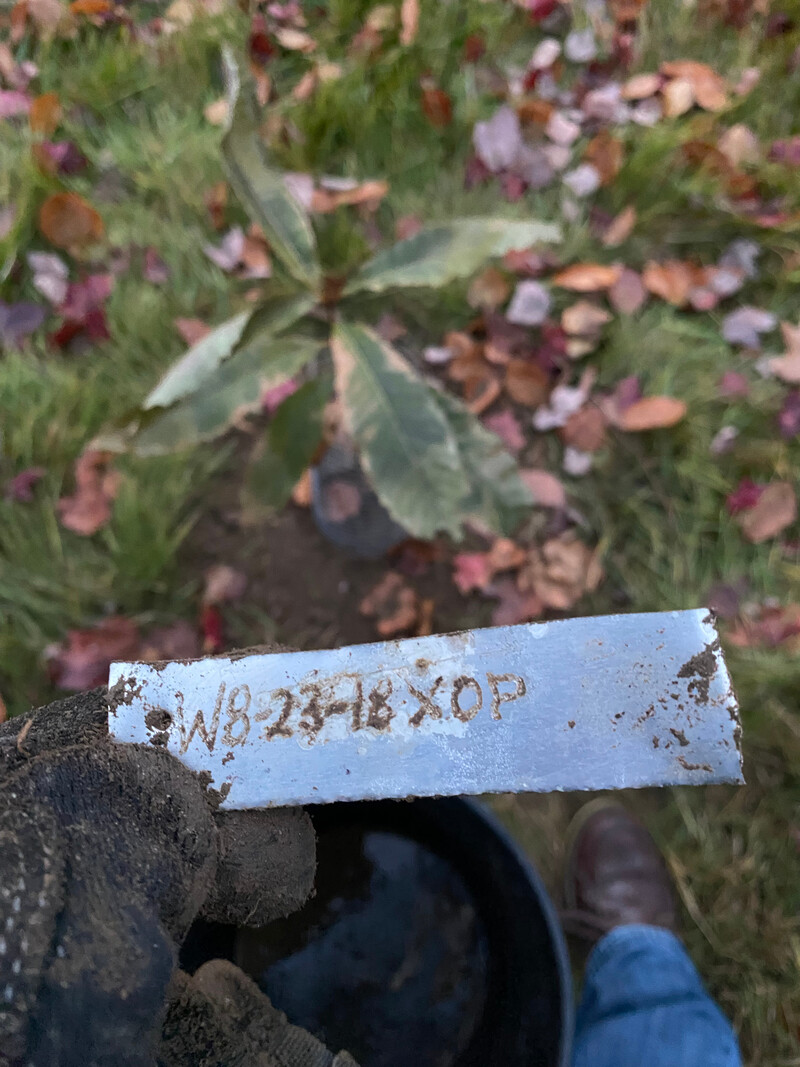
Wood Chips Scored and Spread
November 24, 2024
A few days ago, an arborist was trimming a couple of the neighbor's trees and I decided to see if I could get some free wood chips. The idea came from listening to some episode (not sure which one) of The Urban Farm Podcast, where the host talked about a service called ChipDrop. Arborists, apparently, have to pay to dump the wood chips they create during the course of their work. That service connects people who want wood chips with people who have them. But, as I learned, you can also just walk over and ask if they want to dump their chips in your driveway and that works too. So, I was the grateful recipient of 3 or 4 yards of free wood chips.
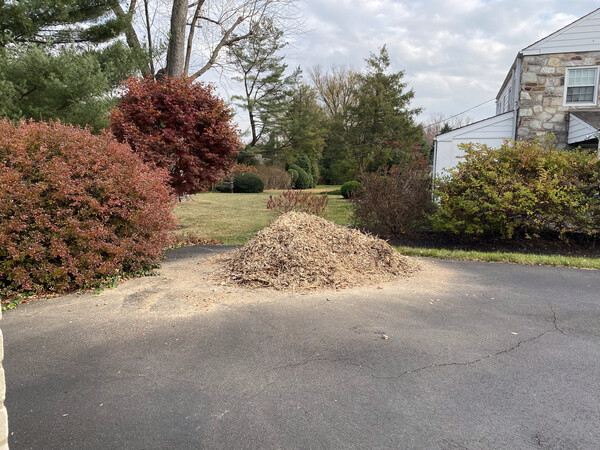
I spread a few wheelbarrow's worth yesterday, and today I spread about half of them. Most went in a 4-to-5-inch layer where the next raised bed will be. I'll let them sit and start to decompose through early spring, and then will build the bed around them and top off with compost and dirt. I also mulched the two newest trees - white fringe tree and pagoda dogwood, both from the township's Shade Commission's free fall giveaway - and started on the blueberries. The remainder will be enough to finish the blueberries and mulch the two apple trees nearby.
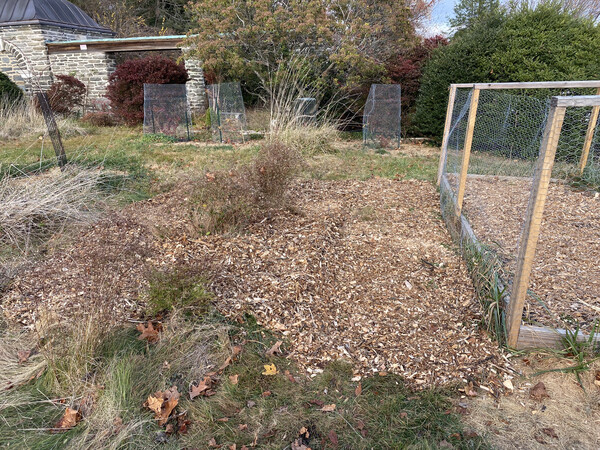
Snow!
November 22, 2024
observations, weather | permalink
First snowfall of the year. It was mixed with rain - and actually just rain most of the day - but there were at least a couple periods with snow.
Rain!
November 21, 2024
observations, weather | permalink
It's been raining the last 3 days! That ! is excitement, because there has been almost no rain here going on at least a month and a half. There was a brief, light rain about ten days ago, but otherwise it's been so dry. Now everything has had a great soak and I'm less worried about the things I've recently planted, but also grateful that I now have at least a week off watering things, if not much longer.
Pagoda dogwood planted
November 2, 2024
I planted a pagoda dogwood, courtesy of the shade tree commission. It was fairly easy digging compared to others. It went in the ground several feet to the southeast of the picnic table, for future shade.
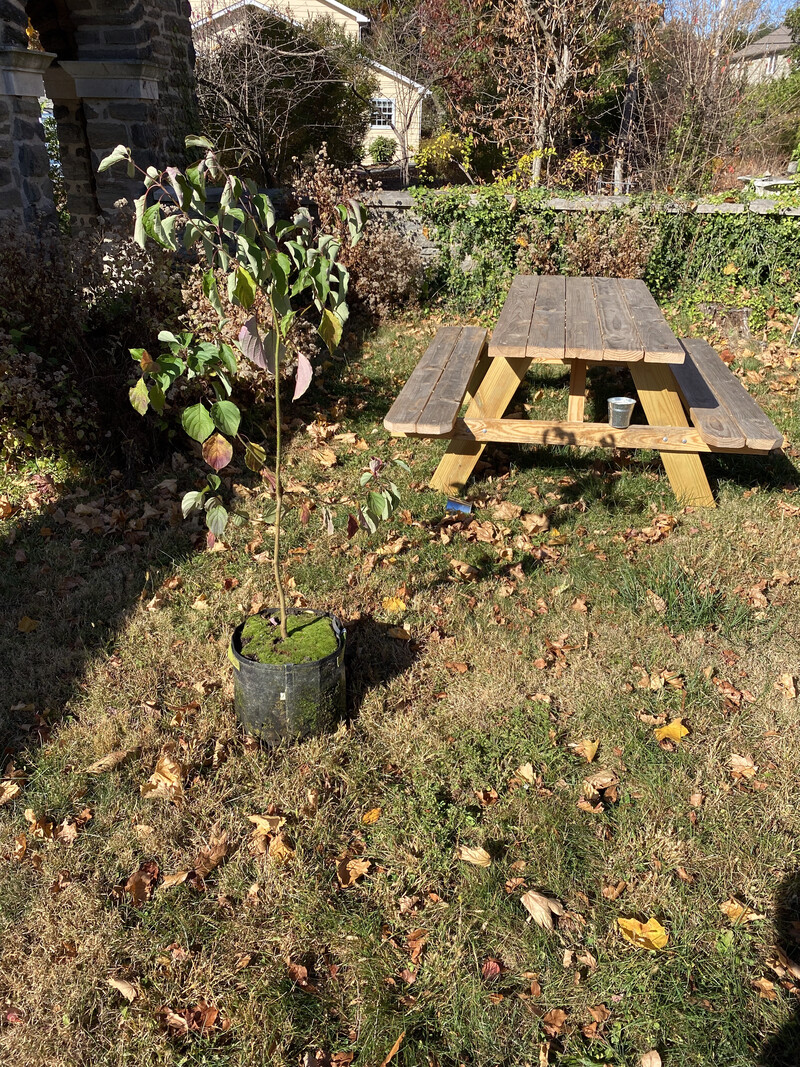
White fringetree planted
October 27, 2024
I planted a white fringetree, courtesy of the shade tree commission. Top of the steps to the terrace, on the left. Like all of the trees I've planted, I am interested in seeing how it turns out over the years. This one was placed to add a bit of shade to the front of terrace before the vegetable garden. With some shrubs I want to put in front of it, on the hillside next to where the foxgloves were planted, it's the start of a section of taller things that will provide a different habitat along with screening.

Started holly hedge (again)
October 19, 2024
In March, I spent a couple hours planting a holly hedge out front along the road, from very short cuttings I had taken months prior and put under grow lights in the basement. It did not work out. The first hint that that was going to be the case was when I was planting them and only three or four (out of around 30) had any roots. Beyond that, I think I was not helped by an unusually warm early spring. Nor with how short the cuttings I made or thinking that putting them inside would help.
So, I've tried again, but this time armed with a bit more research. Mainly, it was this "Mark's House and Garden UK" video. Pretty much followed how he did things, though my cuttings were often shorter given how much existing holly I had to work with. They ranged from 12" to maybe 30" for the few tallest. In all, I planted 36 of them, spaced 24" apart, in a line 3 feet from the road. The first 33 ended where I'd previously planted a few false hollies and some as-yet-unknown tree, also 3 feet from the road and spaced about the same width apart, and then the other 3 after that. Watered them, cleaned up.
That was yesterday. Today, I dug some compost out of the bins and put a shovelful around their bases, then watered them again. A delivery of mulch is coming Monday and so I'll soon spread mulch around them.
Here's hoping this attempt fares better than the last.
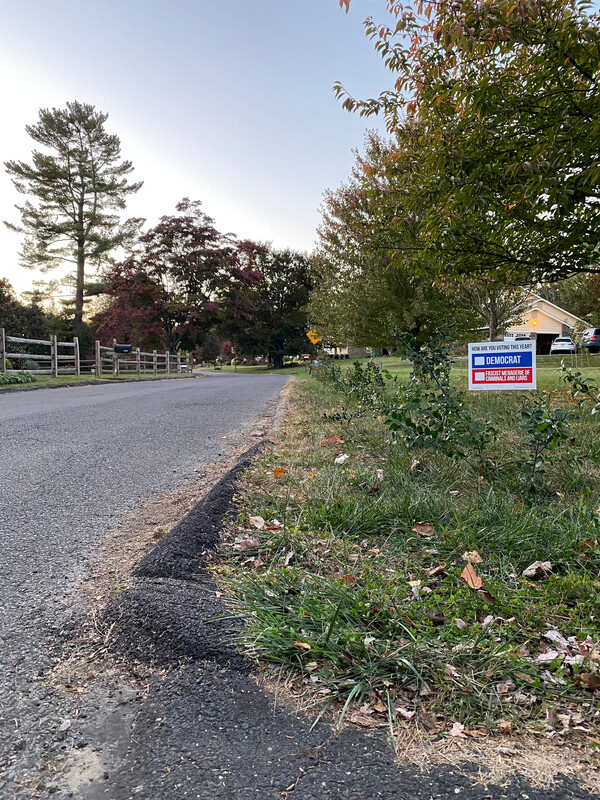
Third oak planted
October 11, 2024
Over the course of five hours, I dug up, drove, and planted a third oak tree, from MH/DW's place. This one was about 8' tall, just a bit taller than than the one MH and I had transplanted from their place in May 2023. I had originally planned on bonsaiing this one (just I had the other), and so about two years ago I topped it at about 12". At that time, it had probably been 4' tall. Grew back with a vengeance. Two-thirds of the five hours was digging it out. It was tiring, dirty work, and I wasn't able to get the tap root out complete. The drive in the little car was thankfully smooth, and so was digging the big hole to put it in. I also found a cool surprise while digging the hole at home: two glass bottles made in my hometown. If my dad were alive, he'd probably be able to tell you what they were and the approximate year they were made.
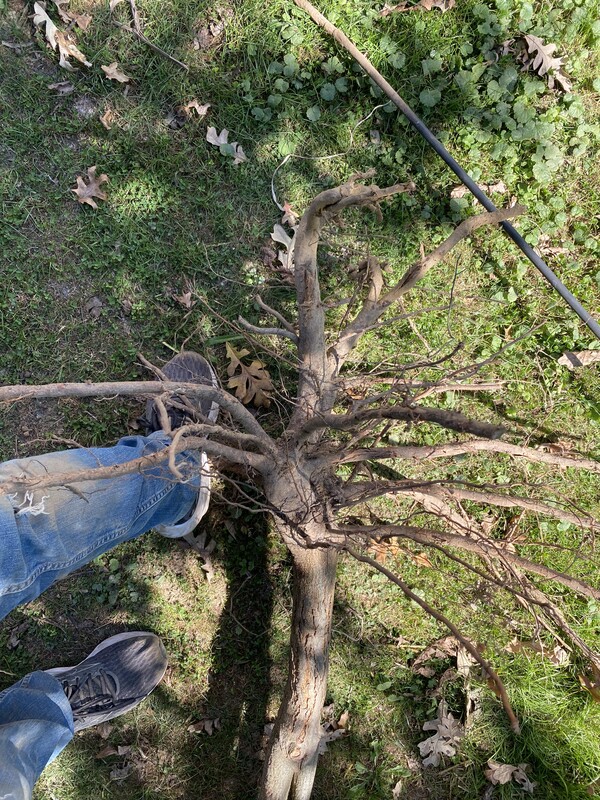
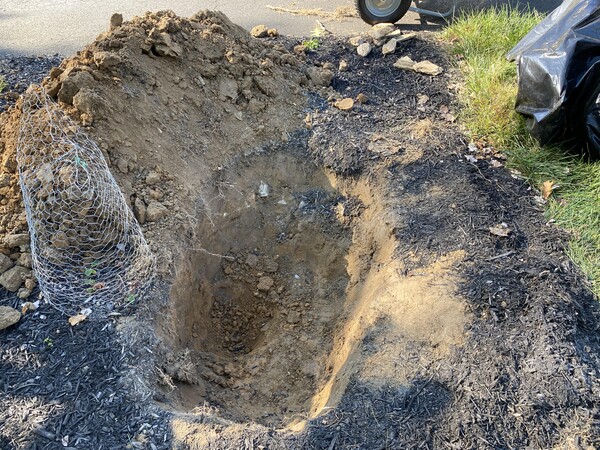
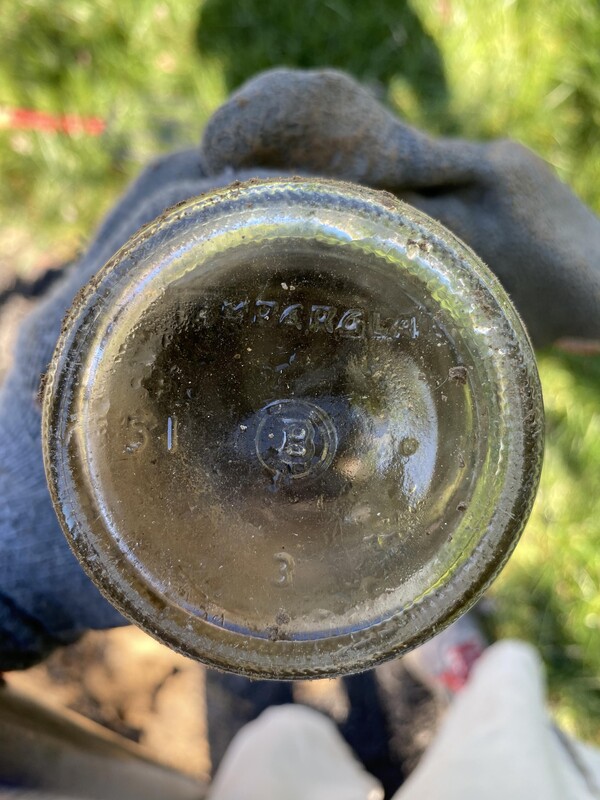

EDIT, 2025-10-07: I originally referred to this as the second oak, but it was indeed the third that I planted.
More rosemary dried and stored
October 6, 2024
No pics on this one, but I trimmed the top of about 25 stems of the rosemary plant, which soon will graduate to rosemary bush. I then trimmed off the leaves from the stems, and baked in the oven at 180 degrees for 20 minutes and then (because it didn't seem like 180 was doing the trick) at 210 for another 20. Got nearly a full spice jar. I still have a bunch leftover from last year. I'm going to need to find more uses for rosemary.
I then took all the stems and put them in the ground in various places around the yard. Not expecting much - if one survives I'll be happy. Mostly I just like the way it looks.
More basil dried and stored
October 6, 2024
I harvested a bunch of basil yesteday and dried it in the dehydrator borrowed from MH for something like 4 hours. Early this morning - since the kiddo woke up briefly and I wasn't able to fall back asleep - I crushed it up and funneled it into a jar. I didn't measure it, but I'd guess it was 4 cups fresh, which reduced to about 3/4 of a cup dried. I also did this last month, with a slightly smaller amount (because I ruined half of it by trying to air fry it in the oven), and also have some from earlier in the year and from last year, so we're all set on dried basil for some time. Still, if the plants go to seed (not sure they will flower this late in the year), I'm going to save them for next year, for either fresh basil, pesto, or drying and giving away. The variety is Italian Genovese.
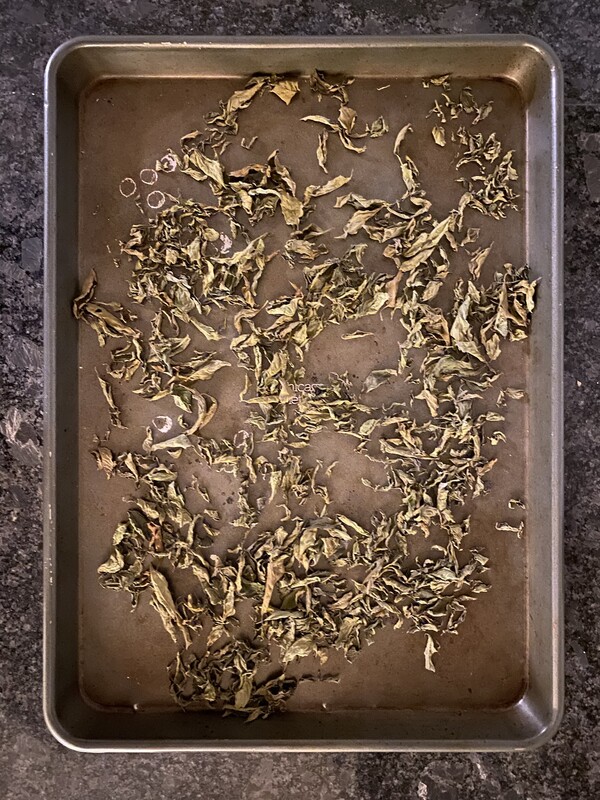
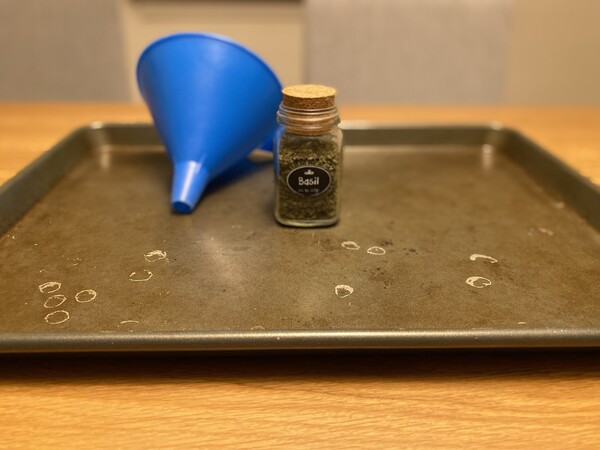
Garlic season two planted
October 5, 2024
Last year, I planted about 40 garlic cloves. Most survied, except three or four that seemed to be rotting at the neck and that I yanked out at some point. Not sure why that happened. The rest did well, though they could have been larger. After harvesting in July, I set aside the largest ones for replanting in the new bed I made for them. So today, in this new 16-square-foot area, I planted 64 cloves (8 rows of 8). I took a little under an hour, and probably half that time I was just breaking apart the old heads. It went fast; I was catching up with my friend Paul, who was driving to a protest in Cleveland, while I planted.
This year, unlike last year, I covered the top with dried grass clippings after planting. I think I also pushed them into the soil a little deeper - I was shooting for about 3 inches down. I'm looking forward to seeing how they turn out, and if there's any difference in the size compared to last year. Each has slightly more room than those from the previous set. I'm hoping 64 plants will be enough to get us through most of the year, with 8 dedicated for the planting next year. But I actually have no idea how much garlic we go through in a year.
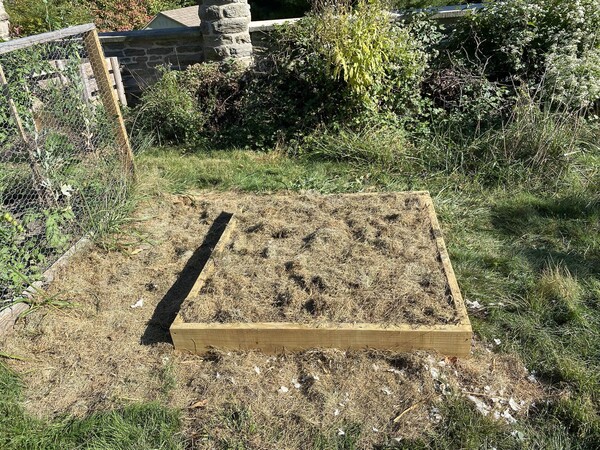
Summer 2024
September 22, 2024
I made more progress on desodding and mulching - slightly extended the area by the mailbox, created area on the hillside by the swingset, and created the area from the arborvitaes almost to the maple on the western line. Got and assembled a picnic table. All kinds of weeding and removing vines. Got lumber to make small raised bed dedicated to garlic. Finished removing excess soil around house. Transplanted ferns. Got a decent amount of things from vegetable garden - at least a few quarts of green beans, a pint of tomatoes so far, lots of squash, beets, a couple carrots, a bunch of cucumbers. Threw in some potato eyes a few weeks ago and now have several good plants - we'll see what comes of them.
Tasks completed:
- plant ferns (that got dug up with vines) on western tree line
- use D's truck to get mulch
- use D's truck to get picnic table for terrace
- move wood from driveway to firewood pile
- expand front mulched area - cover with thick paper, throw mulch over it
- assemble picnic table
- cut more boards for compost bins
- move giant stone from under false holly
- bring veggies to SE due:2024-07-17 (2024-07-17)
- mulch around blackberries (2024-07-18)
- remove vines from false holly in back (again) (2024-07-18)
- sand picnic table (2024-07-18)
- stain picnic table (2024-07-20)
- recage two blueberries (2024-07-21)
- weed left blueberry (2024-07-21)
- try to propagate dogwood (2024-07-21)
- mulch around raspberries (2024-07-21)
- weed overgrown blueberry (2024-07-30)
- open up the tulip tree cage so the branches have room to spread out (2024-08-07)
- weed/mulch around Japanese maple in front (2024-08-07)
- weed hickories (2024-08-24)
- finish removing excess soil from in front of dining room - use this for raised bed for garlic completed (2024-08-25)
- record the specific vegetables and herbs I planted this year (2024-08-25)
- desod and mulch between trees on western line, from gazebo past the oak (2024-08-25)
- weed/remulch around blackberries (2024-09-02)
- buy lumber for raised bed for garlic (2x8x8) (2024-09-16)
Made raised bed for garlic
September 22, 2024
I planted garlic last year in October in the raised bed, and nothing touched it the entire time the raised bed was unfenced, so I decided to make a separate, unfenced bed for it. Another simple project: two 8-feet-long 2x8s, cut in half, and screwed together. The compost pile contributed some rich new dirt, and dirt moved from elsewhere, grass clippings, and excess mulch made up the rest. In a couple weeks, I'll plant some of the cloves from the garlic harvested this summer.

Morning glory blooming
June 12, 2024
herbaceous, observations | permalink
I've never had a morning glory before, and when I was picking out seeds for the vegetable garden earlier this spring, either I or my daughter thought it looked pretty, so we picked a packet up. I planted all the seeds - maybe 20 to 30 - and just a single one came up. It grew inside for awhile, and then I planted it at the edge of the raised bed a couple weeks ago. I hadn't noticed it even starting to form a flower bud, and then today there was this glorious flower:
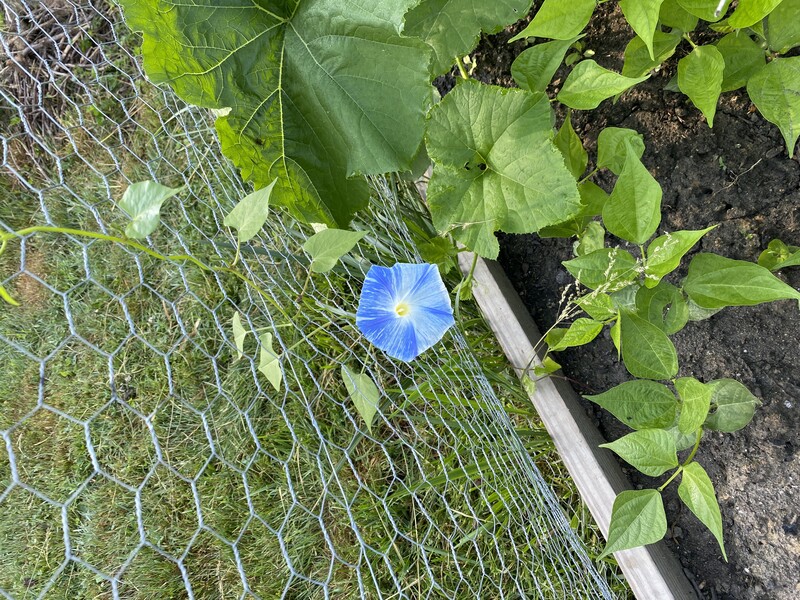
Pumpkin and the fox
June 7, 2024
wildlife, trees, vegetables | permalink
This pumpkin is currently my favorite plant. Look at it! It was about six inches tall two weeks ago. I'm training it up the wooden stake so it will have more room; we'll see how it survives once I get it up over the side. Deer snack? Maybe. Though I have another growing outside the raised bed and it has been untouched so far, knock on wood.
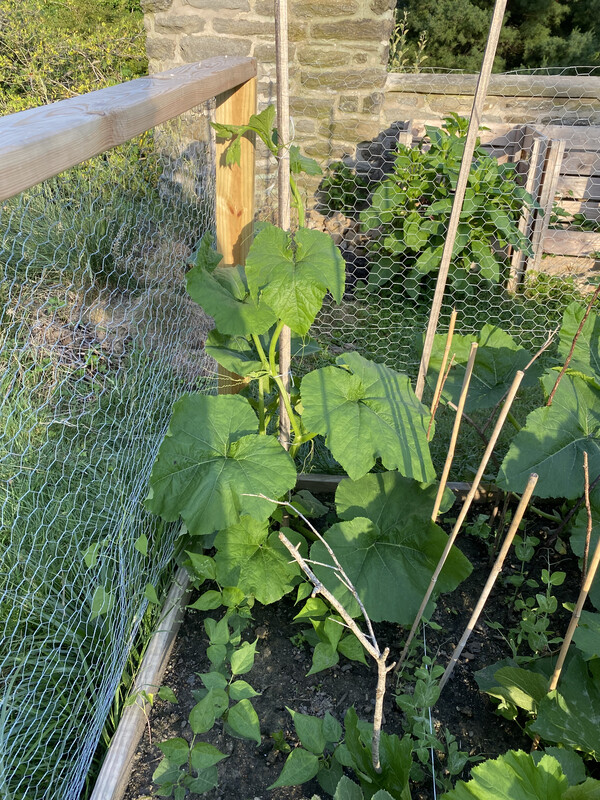
Speaking of wildlife, a bit earlier I had finished putting protection around the two newly planted hickories (because they've already been nibbled by deer), and then ran into the fox. Not sure if it's always the same fox I see, but likely? We had been walking towards each other from two different paths on the terrace. I was unaware of it until I turned onto the path it was on, which was coming from the raised bed and compost area. I'm sure the fox had already noticed me, though I think both of us were surprised. I backed up and it slowly but fairly nonchalantly continued on its way, marked its territory on a juniper I had planted, and then ended up where I took these pics a couple minutes later. First curious, then indifferent.
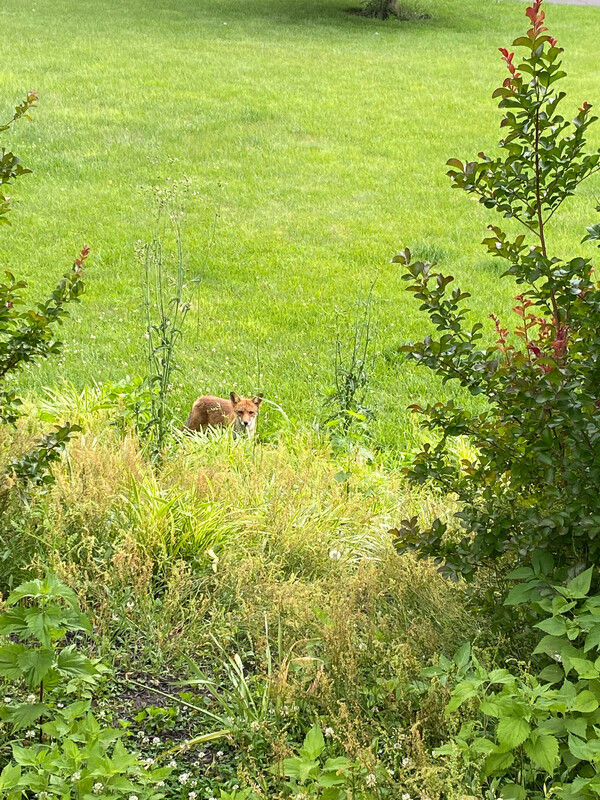
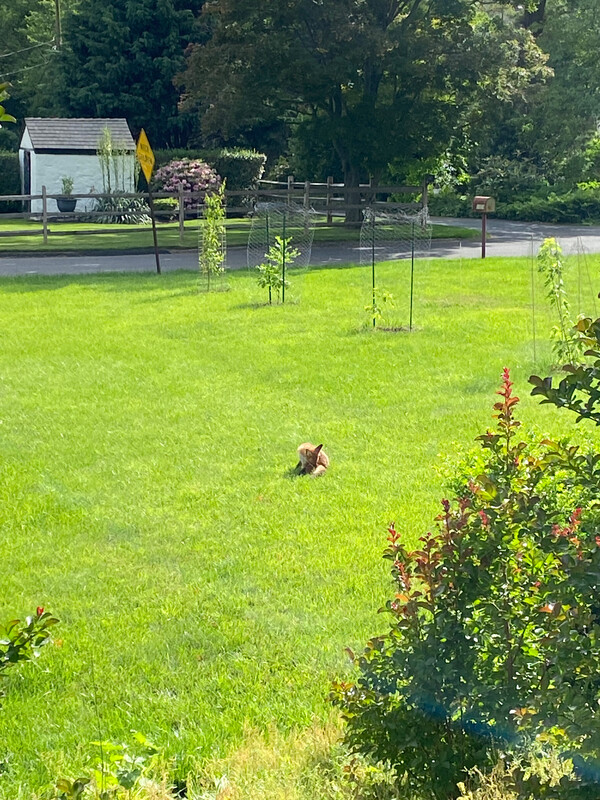
Hello me!
May 31, 2024
Although I am putting this on my website, this section is pretty much entirely for myself. If someone else other than me stumbles across this and enjoys it, great! Surprising, but great! Mostly I want to curate some of my journaling and logging into something more refined so that I can look back on how the outdoors area of my house has changed, so actually this is more for future me. Hello future me!
Planted remaining sunflowers
May 29, 2024
In the morning, I planted the last of the sunflowers that I had under lights in the basement. There were 4 in one pot and 2 in another. The roots were bound well together so I just planted them by the pot - four went into the decaying center of the large tree stump on the terrace, and two by the sidewalk. Overnight, the ones by the sidewalk had already been chomped - but I'm not sure by what. They were just cut off at a stalk segment, but not eaten. The tops just lay on the ground next to the stalk stumps that were about 4 inches tall. The ones in the tree stump survived.
In all, that's about 50 sunflowers I planted. About 20 have survived, with most doing well except the ones on the hillside that haven't grown much and are a bit spindly. I think next year I'll try a few less and also wait to put them out maybe two weeks later - so maybe around May 1.
One tray of the seedlings inside on April 3:
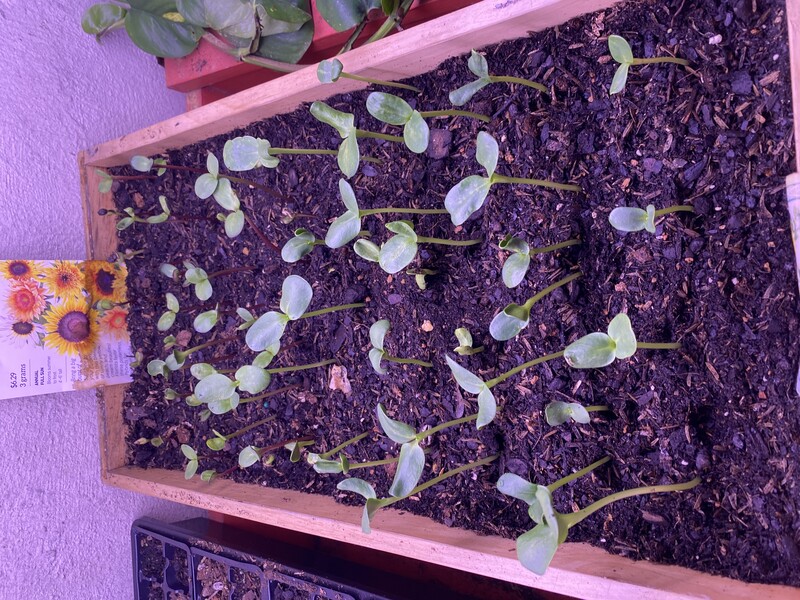
Planted spinach and beans
May 29, 2024
I planted spinach and more french filet beans in the places where other things hadn't come up or survived, which was basically all of the soybeans, most of the carrots, half of the beets, and a few french filets that had been chomped. If the beans do well, they'll now be probably half of the garden.
Raised bed deer protection finished
May 28, 2024
wildlife, vegetables | permalink
Around 8pm, I finally finished putting up the fencing to protect the raised bed from deer. For now, they are the main issue, trimming off the tops of some of the vegetables I planted. Later, I'll probably have an issue with chipmunks and squirrels since they can still easily get in. My first step for dealing with that is to plant some rosemary at the obvious entries - we'll see if that works. (And if not, oh well, it's the first year so I'm kind of expecting the worst.)
Anyway, after ten hours over the past month, it's complete. Two of the four sides of the fencing act as doors and seem to be functioning well. We'll see how long they hold up, but it's easy enough (though a little too difficult and awkward) to open and close them. I nailed the fencing to the structure and then to 1x1s that then connect to the frame by a hook. It's probably not the final version, but it works for now.
Here it is on May 11, when I'd completed the frame and put up the first portion of fencing:
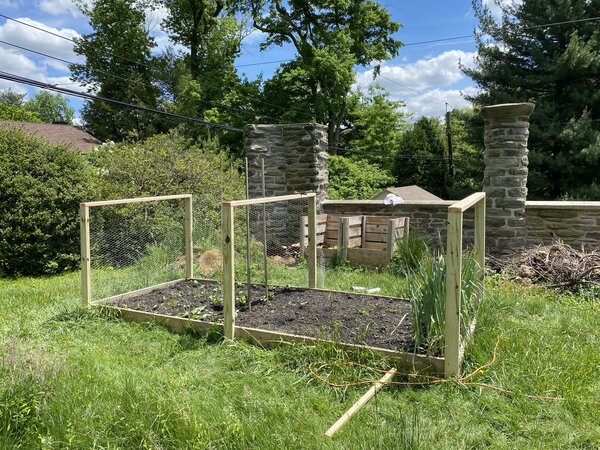
One of the foxes came to investigate right when I was wrapping up on May 28:
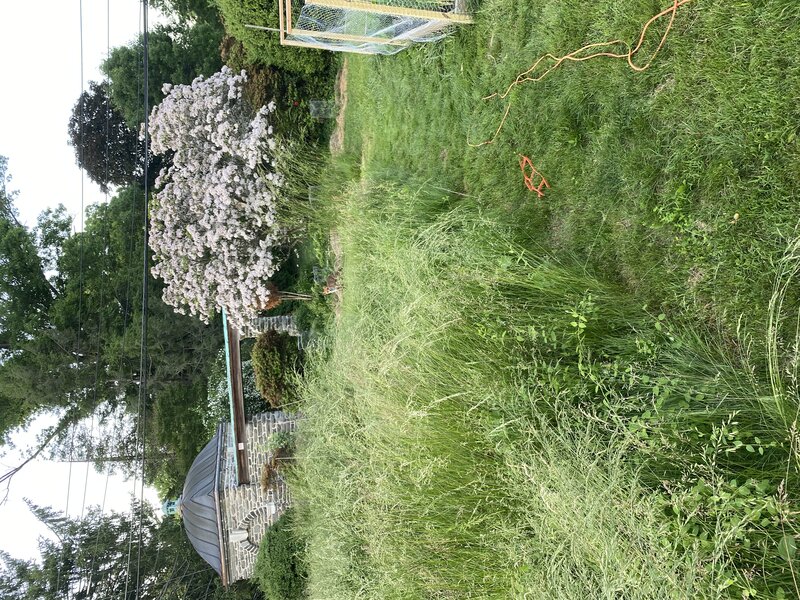
A view inside the garden a few days after completing the fencing, on June 1:
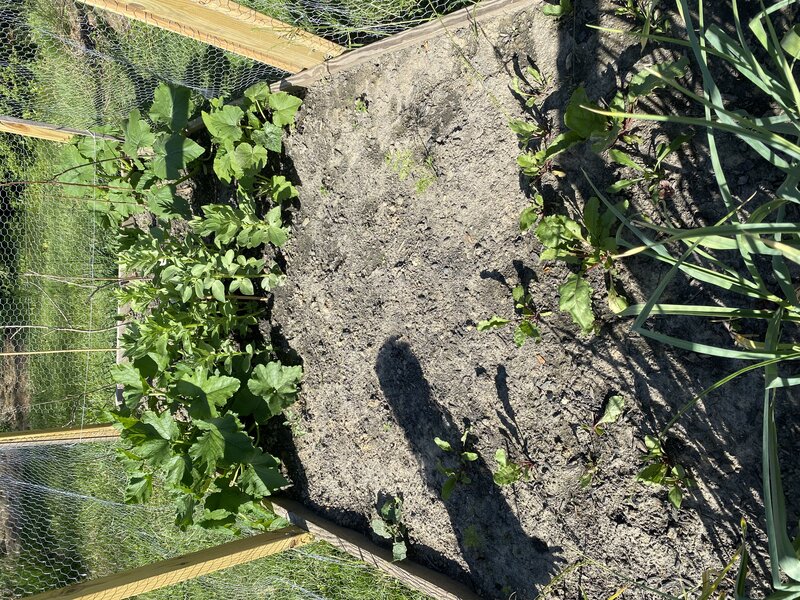
Black walnut planted
May 18, 2024
No picture yet, but I transplanted the black walnut from MH/DW. Surprisingly easy removal; I think it took all of 5 minutes to get it out. Easy planting too. It's in front of the hickories I planted.
It was much too late in the year for a transplant and it's been struggling since, but I hope that it'll survive.
American hornbeam planted
May 11, 2024
The son of neighbor MM/SM picked this up from the township's Shade Commission giveaway on April 27 since I wasn't able to go, and it sat on the back patio until today. It was bigger than I expected - nearly 7 feet tall. I put it on the southwest edge of the yard, so it's now the first in the line of trees along the western boundary.
Peach trees planted, blueberry and apple blossoms
April 26, 2024
I took the day off work so I could plant two peach trees and do other yard work. The trees had arrived the weekend before - if not before that - from Cummins Nursery, based out of Ithaca, NY, the same nursery where I had got the four apple trees the year before. The peach trees were supposed to both be grade 1, but they had miscounted their inventory, so I had one grade 1 and one grade 4. Both are Challengers, a yellow flesh peach, on BY520.9 root stock. The description from their page for the cultivar:
A very cold-hardy, freestone peach with excellent disease resistance. Also known as NC-C3-68.
Challenger is very cold hardy. Its flowers buds, bloom, and young fruit all demonstrate high tolerance for freezing temperatures. This tree also has excellent resistance to bacterial spot. It is self-fertile and does not need a second variety present as a pollenizer.
Challenger is an improved descendent of Reliance. It has a larger fruit with more attractive coloring, firmer flesh, and improved texture. The peaches are medium sized with a red, low fuzz skin.
Crossed in 1987 and selected in 1990, this cultivar is a cross of Redhaven with a breeding selection derived from Reliance and Biscoe. It was developed by NCSU.
One I put on the terrace, about 15 fifteen in front of the two apple trees up there, and the other in the backyard near the property line with AM. Peach trees are surprisingly small. These are both standard trees, and will grow to 12 to 13 feet tall. I'm not sure if this is true of all peach trees, but these ones are self-fertilizing.
I also noticed that the largest of the four blueberry bushes I planted last spring had a few blossoms on it. And so did two of the four apple trees - the Arkansas Black (below) and also the Winecrisp.

Two hickories planted
April 24, 2024
I haven't taken pictures of these yet, but I planted the two hickories gifted by MH. They are in the shared area beyond the rock wall, bordering JM & CM.
Raised bed planted
April 21, 2024
Raised bed was planted: two types of beets, carrots, soybeans, fava beans, green and yellow squash, a pumpkin or two, peas, french filet beans. Too much for the space, but I figured some of it wouldn't make it and if everything did I'd just move some things somewhere else. Oh, and the garlic on the left that had been planted in the fall.
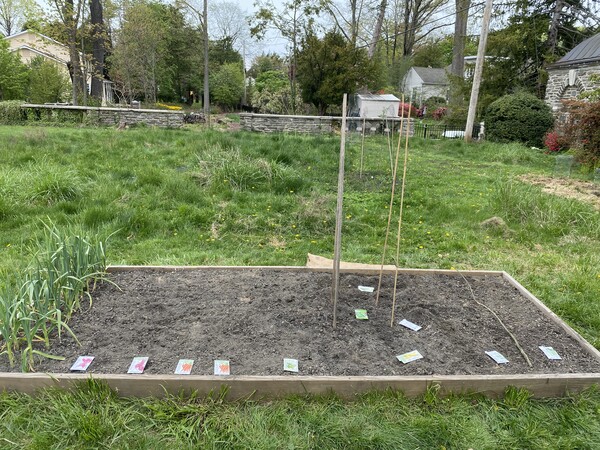
False hollies planted
March 31, 2024
I thought I was planting hollies, but since they were planted, I discovered they actually are not. I took these from the large bush at the back property line of the house, where a branch had dipped down to the ground and layered itself. I was able to pull out three separate trunks from this, between two and three feet tall. Planting was easy, and I thought I was getting a good start to the holly hedge I'm attempting to start along the road.
The reason I thought these were hollies was because the leaves near the bottom of the tree very much looked like holly leaves - dark green, thick, jagged edges. I remember reading some time ago that holly leaves will lose this jaggedness towards the top of the tree, and I assumed that was the reason that most of the leaves of the tree were ovate. However, once the fruit developed on the parent tree, it was obvious it wasn't a holly. Instead of a small red berry, there is a larger dark blue/purple ovoid drupe (which something enjoys eating - been finding the seeds on the playset, on the raised bed frame, and on the top of the compost bin). My first attempt at identifying it came up with Phillyrea latifolia (via the PlantNet app), but now I think it is Osmanthus heterophyllus, aka "false holly" according to Wikipedia. (Another good source on it is from Trees and Shrubs Online, a publication of the International Dendrology Society, which I did not know existed until now.)
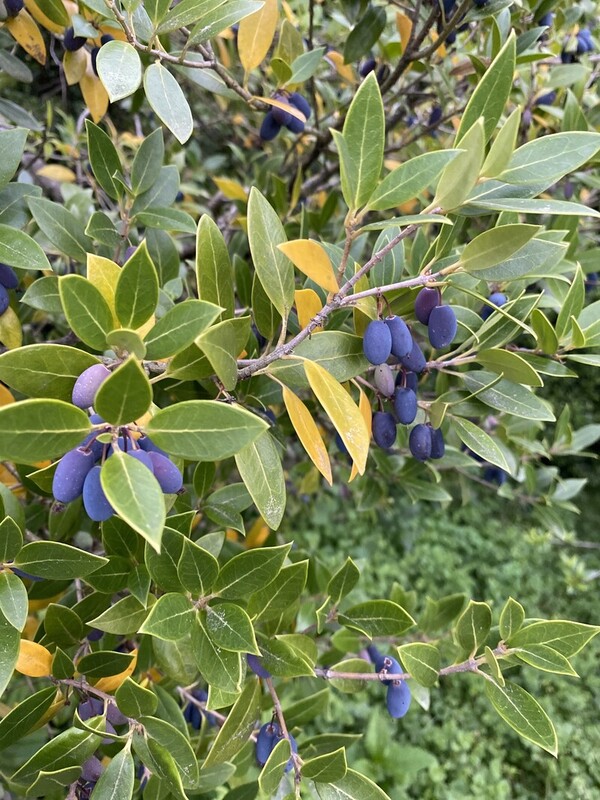
Holly planted
March 16, 2024
I've been carting around a small holly in a large container between the moves the last few years, and now it has found its permanent home: on the other side of the gazebo.
Planted juniper cuttings
March 10, 2024
I had taken about five cuttings from the owl gray juniper that we planted on the hillside with the apple trees, and then kept them inside for months under lights, regularly watering them. So on this day, I planted them on the hillside.
Spoiler from a few months in the future: none of them survived. At least two were probably because I didn't water enough. Another was because of being hit with a weedwhacker. Not sure why the other two didn't make it.
Daffodil bulbs planted
February 25, 2024
I had wanted to plant these in the fall, but ran out of time to do it. So in they went at the end of February. In total, I probably planted 50+ bulbs. They are along the steps up to the terrace, then in a cluster at the top, and finally between two of the pillars.
They all seemed to do well.
Ashe's magnolia and bald cypress planted
October 28, 2023
I got both of the trees from the township's fall giveaway. They came with good fencing too. The magnolia went in easily, less so with the bald cypress because of rocks. In all, about 3 hours work to put them in the ground. Not bad at all for the benefits of trees. Glad to have some less common species, and that they are native.
Garlic planted
October 1, 2023
I picked up a bag of California Giant garlic and planted it in the raised bed - first thing to go in. Here it is moments before I started pushing the cloves into the dirt:
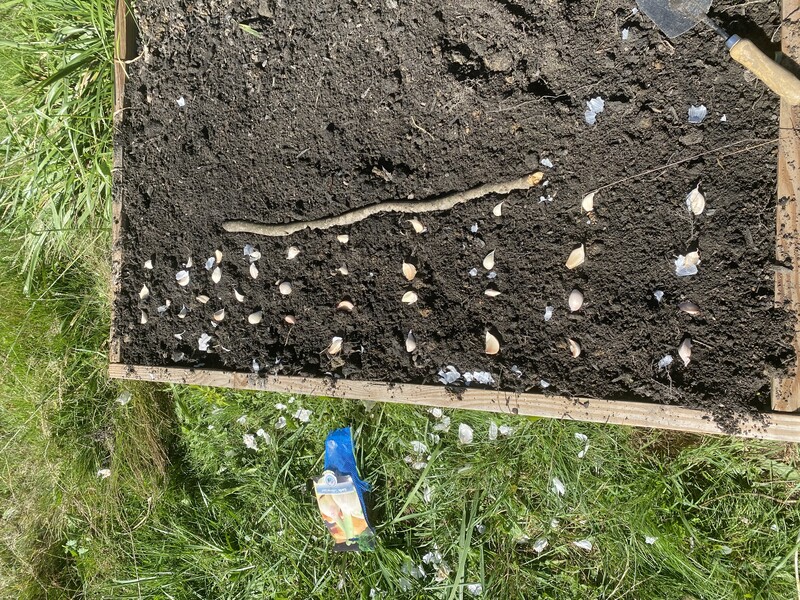
The timing seems to have worked out well. My mom's advice was to plant during the waning moon (maybe specifically during October, I'm not sure), which was advice they heard from "coach" (Harry Pinge I believe). I think that's what I did, though at the same time I don't think it matters, though I'm open to there being some reason for this existing. I imagine just timing, and so "October 1 or thereabouts"; will do for me in the future.
Compost bins built
June 10, 2023
After a bit of searching the web, I found a compost bin design I liked, written up in "How to Build a DIY Compost Bin For Rich Amendments" by Sarah Jay. Aside from only doing two bays, I also simplified the design a bit and left off the inner 2x4s on the end pieces, in both front and back.
I'm writing this a year later, and there's been no issues with it, so I'd say it was a success. During the first six months, I was surprised at how quickly the food and yard waste would lose mass. Partly I think this was caused by various animals (birds, fox, and groundhog that I saw in it, and I assume deer, chipmunks, and squirrels too) eating from it, but mostly I assume from water loss. So I started putting in more yard waste, including grass clippings a couple times. One bay is now about half full.
Here's a picture of them just a couple days after being built and placed into a cleared spot, without any front boards on yet:
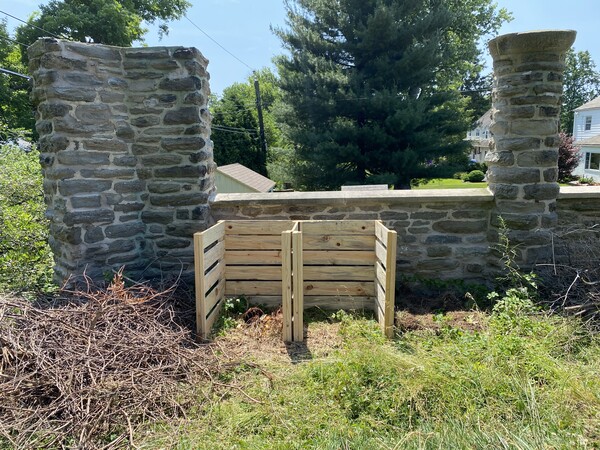
Raised bed started
May 8, 2023
Here's the first picture I have of the raised bed I made. Compared to the two other small building projects, this one was really a breeze: three 2x6s, 10 feet long, cut one of them in half, screw them together. Most of the work was hauling up dirt to fill it in. Thankfully, I suppose, there was a ton of excess soil/mulch around two sides of the house that needed to be removed and so it went into the bed.
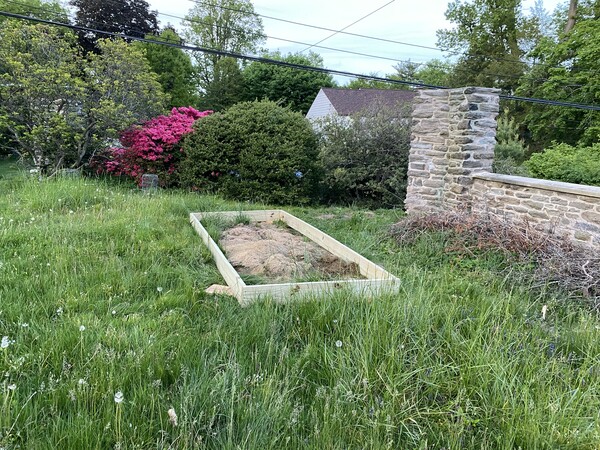
Here is the lumber I had picked up for this and the other projects the week or so before:

Second oak planted
March 12, 2023
With a fair amount of effort, MH helped me dig up this oak, which he thought was some kind of red oak, from his place and move to ours. I was originally going to bonsai it, and so had cut it at about 12 or 15" tall about two(?) years prior. It grew back amazingly fast to be about 6 or 7 feet tall when we put it in.
In early October 2025, I did some research on what type it may be. Using the book (that MH let me borrow or maybe gave to me - memory is not clear) Trees of the Eastern and Central United States and Canada by William M. Harlow (Dover Publications, 1957), I narrowed it down to one of three trees in the red oak group: black oak (quercus velutina), northern (common) red oak (quercus ruba), or scarlet oak (quercus coccinea). This was based mostly on the leaf, by tracing various characteristics through his numbering system, from 1 to 9 to 11 to 12 to 13 to ... not sure. I think I need to wait for it to get a bit older and use acorns or bark to get to the final identification. Leaf color in fall might help, but I don't think I'll be able to tell myself from that.
The White Oak Initiative (ironically) has some guides for those trees that were useful in at least suggesting I was on the right track. So was "Northern Red Oak vs Black Oak" from bplant.org.

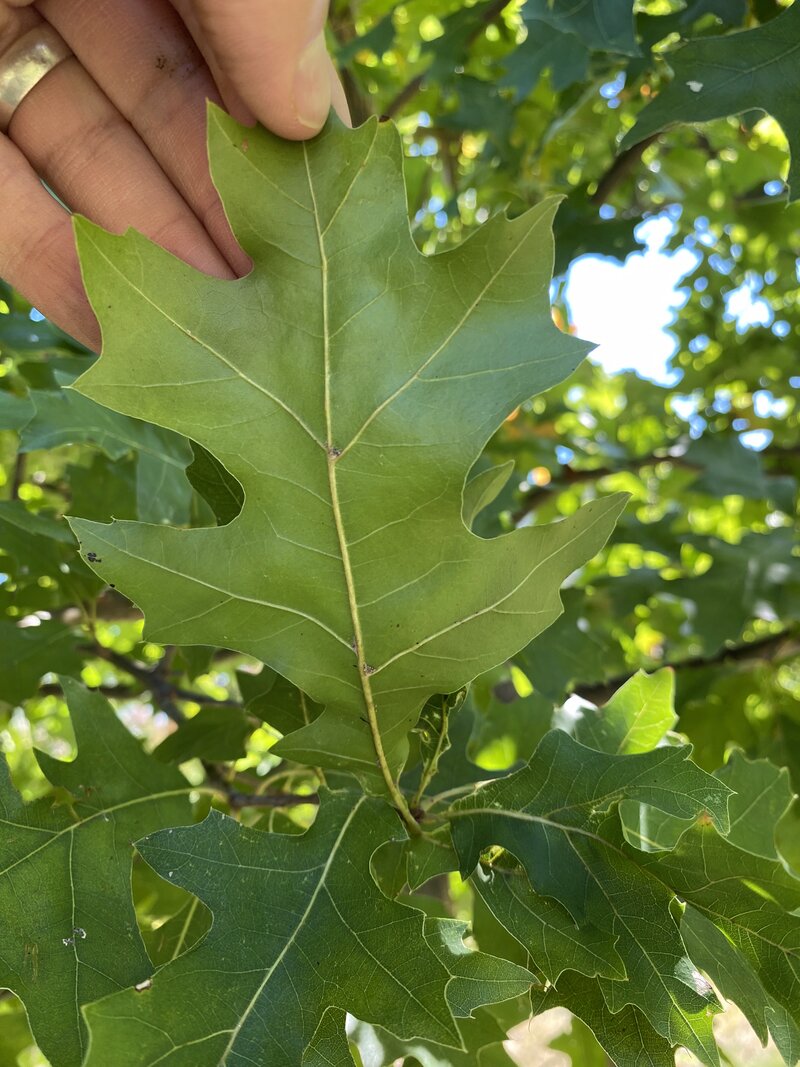
First Oak Planted
December 27, 2022
I planted the oak of unknown species given to me by MH, dug up from his yard. It went in between the chestnut and the road, about six feet from the chestnut. It was maybe 18" tall when planted.
EDIT, 2025-09-13: I'm fairly confident this is a bur oak (Quercus macrocarpa), a type of white oak. The Seek app identified it as either that or swamp white oak, and after reading "Swamp White Oak vs Bur Oak", it looks more like a bur oak, mainly in leaves and bark. Finally, I remembered that MH has an oak that has "cup" somewhere in its name, and in doing some searching found that mossycup oak is another name for bur oak. It is now about 10 feet tall, but it won't produce acorns until at least 35 years old. So, only 32 or so to go. Sorry squirrels. The USDA's Natural Resources Conservation Service has an informative guide about it.
First Chestnut Planted
December 27, 2022
I planted the chestnut given to me by MH, which came from the American Chestnut Foundation, ID W9-20-115. It's about six feet in front of the maple on the western line.
Volunteer maple planted
September 24, 2022
Planted the volunteer maple that came up in a container from a couple of living places ago, with neighbor JM. His pry bar ("the persuader") was crucial. I'm not sure what kind it is - red? sugar?